

Dohmeyer
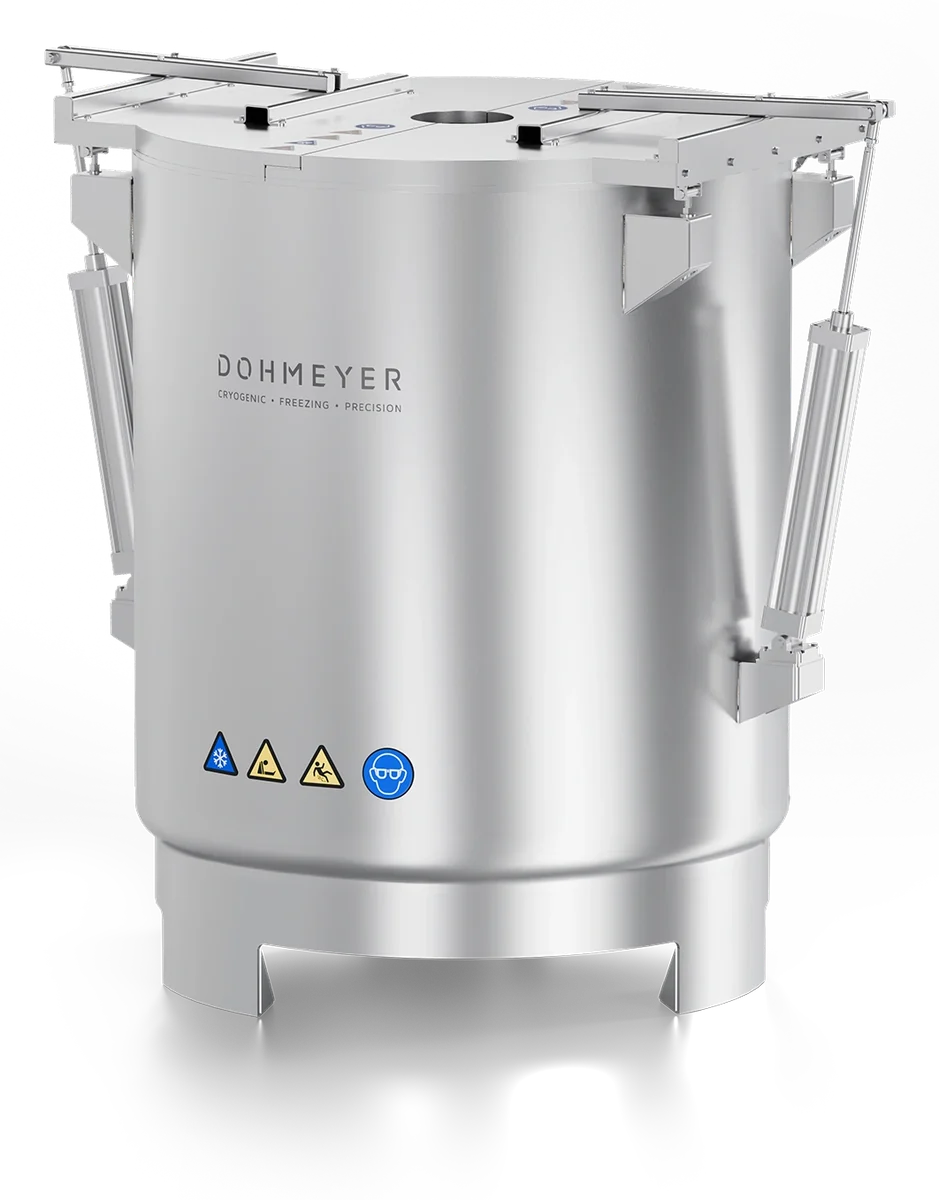
Industrial Liquid Nitrogen Immersion Bath
The industrial liquid nitrogen immersion bath speeds up shrink fitting, deburring and quenching by immersing metal and technical parts in liquid nitrogen.
Request a quote| Manufacturer | Dohmeyer (Belgium) |
|---|---|
| Method | Direct immersion in liquid nitrogen |
| Coolant | Liquid nitrogen, -195.8 °C at atmospheric pressure |
| Main applications | Shrink fitting, deburring, quenching, recycling |
| Size | Various size options |
Product description
The industrial liquid nitrogen immersion bath is a compact cryogenic processing unit in which parts are cooled by direct immersion in a chamber filled with liquid nitrogen. Since liquid nitrogen boils at -195.8 °C at atmospheric pressure, the part surface is in full contact with the fluid and cooling is much faster than in systems that cool with air. Dohmeyer manufactures this unit in different sizes; the chamber size is determined at the quotation stage according to the dimensions of the parts to be processed.
The unit is designed not for food or biomedical applications but for processing metal and technical materials. Effects such as thermal shrinkage, embrittlement and deep cooling are used in different processes, from assembly lines to recycling plants. Aerospace, automotive and medical device manufacturing are the main user sectors.
Applications
- Shrink fitting: shrinking inner parts such as shafts, pins, bushings and bearings for insertion into a housing
- Cryogenic deburring: easy removal of embrittled fine burrs from the part
- Quenching and deep cooling of metals
- Cryogenic recycling: separation of composite or multi-material waste by embrittlement
- Ammunition disposal and demilitarization processes
- Assembly and surface treatment in the aerospace, automotive and medical sectors
If the goal is crust freezing (glazing) of food products or processing of biomedical and pharmaceutical materials, the liquid nitrogen immersion bath is a separate model designed for this purpose.
Technical assessment of the liquid nitrogen immersion method
In shrink fitting, the conventional method is to expand the outer part by heating. In the immersion bath, the inner part is instead shrunk by cooling, inserted into the housing and, as it returns to ambient temperature, expands to form a tight fit. Since the outer part is not heated, the risk of surface or structural changes due to thermal effects is reduced; assembly can also be carried out without press force.
In deburring and recycling applications, the decisive effect is embrittlement. A material that loses its flexibility at low temperature breaks and separates more cleanly in a mechanical impact or grinding step. In quenching applications, deep cooling of the part is used as a step in the heat treatment recipe.
Internal chamber dimensions, liquid nitrogen capacity, insulation design and part handling arrangement are not published values; this information is confirmed with the manufacturer's data sheet at the quotation stage.
Selection criteria
To determine the correct size, the dimensions and weight of the largest part, the number of parts immersed at one time and the number of daily cycles are taken as the basis. Whether liquid nitrogen is supplied from a tank or from a portable dewar also affects consumption planning.
When liquid nitrogen evaporates, it can lower the oxygen content of the surrounding air; for this reason, ventilation at the installation site and, if necessary, oxygen monitoring should be evaluated during the project. If processing parts in a controlled cabinet down to -180 °C is preferred, the ULT cryogenic cabinet can be considered as an alternative.
Technical specifications
| Manufacturer | Dohmeyer |
|---|---|
| Operating principle | Direct immersion of the part in a liquid nitrogen chamber |
| Refrigerant | Liquid nitrogen (-195.8 °C at atmospheric pressure) |
| Construction | Compact unit, various size options |
| Chamber dimensions and volume | Confirmed with the manufacturer's data sheet at the quotation stage |
| Applications | Shrink fitting, deburring, quenching, cryogenic recycling, demilitarization |
| Sectors | Aerospace, automotive, medical |
Values are taken from the manufacturer's published technical documentation. They may vary by configuration and are confirmed against the current datasheet before quotation.
Frequently asked questions
What is the difference between the industrial immersion bath and the food-type liquid nitrogen bath?
The industrial model is designed for technical processes such as assembly of metal parts, deburring, quenching and recycling. A separate liquid nitrogen immersion bath model is available for food coating and biomedical materials.
What does cooling the part offer over heating for shrink fitting?
When the inner part is shrunk by cooling, the outer part does not need to be heated. This reduces the risk of structural changes due to thermal effects, and assembly can be carried out without press force.
How is the chamber size determined?
The dimensions of the largest part, batch size and cycle frequency are taken as the basis. The appropriate size and technical values are confirmed with the manufacturer's data sheet at the quotation stage.
Request a quote for this model
A suitable configuration and pricing are prepared based on sample type and workload.
Request a quote