

Avidity Science
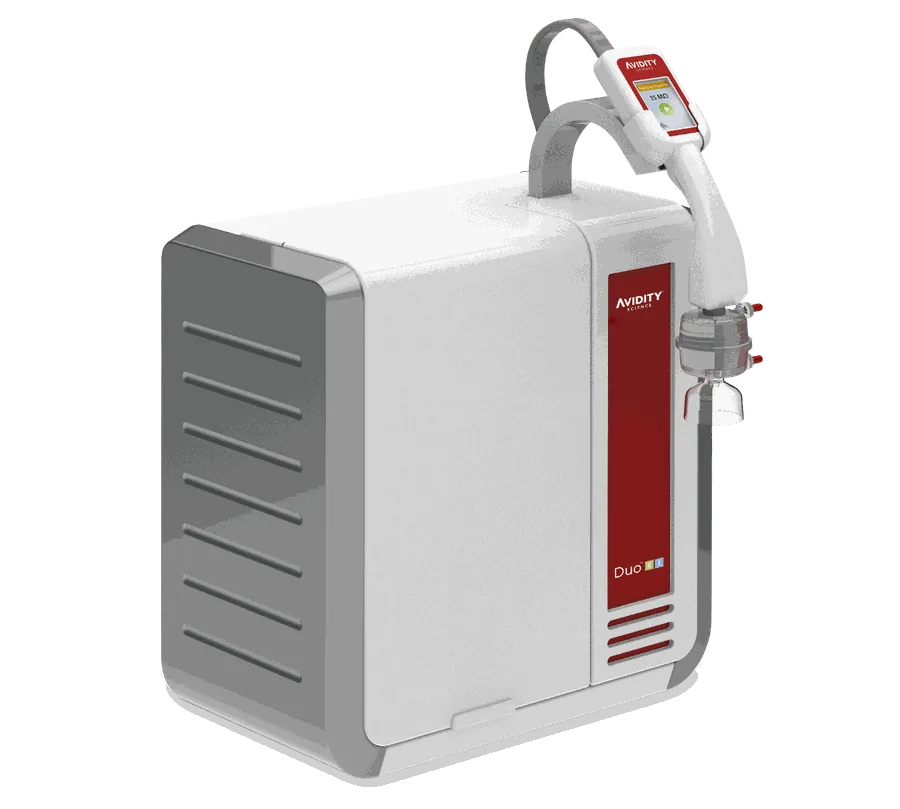
Duo II·I
Duo II·I is a combined Type 1 and Type 2 pure water system that produces Type 2 deionized water and Type 1 ultrapure water in a single unit. It produces 10 or 20 liters per hour of Type 2 water, dispenses 18.2 MΩ·cm ultrapure water at up to 2 liters per minute, and continuous TOC monitoring is standard.
Request a quote| Water types | Type 2 + Type 1 |
|---|---|
| Type 2 production | 10 or 20 L/h |
| Type 1 quality | 18.2 MΩ·cm · TOC ≤ 5 ppb |
| Dispensing | Up to 2 L/min, volumetric dispensing 0.1–25 L |
| Option | Low endotoxin / RNase / DNase on UF model |
Duo II·I as a combined Type 1 and Type 2 pure water system
Most laboratories need two types of water: Type 2 for routine tasks and Type 1 for sensitive analyses. Meeting this need with two separate units requires both space and budget; Duo II·I combines both in a single unit.
Type 2 water is produced into the tank and used for routine tasks such as buffer preparation, dilution and glassware rinsing. Type 1 water is produced at the point of use and drawn from the dispensing gun; HPLC mobile phase, cell culture, molecular biology, ICP-MS and DNA sequencing are performed with this water.
Volumetric dispensing is standard. When the required volume between 0.1 and 25 liters is entered, the unit dispenses that volume and stops, so there is no need to stand over the volumetric flask.
UF model and critical applications
In cell culture, endotoxin-sensitive experiments and RNA work, conductivity alone is not sufficient to qualify the water. The UF model also guarantees these parameters by means of ultrafiltration.
- Endotoxin: 0.001 EU/mL
- RNase: < 1 pg/mL
- DNase: < 5 pg/mL
- Protease: < 0.15 µg/mL
- Bacteria: < 1 CFU/mL · TOC ≤ 5 ppb
For RNA work, the UF model should be considered standard. The cost of losing an experiment to contamination far exceeds the price difference between the models.
Installation and consumables
The unit can be mounted on the bench, under the bench or on the wall. Up to two remote dispensing guns can also be added; bringing the dispensing gun to the point where the water is used eliminates carrying containers around the laboratory.
- TC001: Pretreatment module (on average 2 per year)
- TC002 / TC009: Endure purification packs
- TC003: UV lamp (1 per year)
- TC004 / TC011: Point-of-use filter (UF / non-UF model)
- TC010: Sanitization pack
- AV017: IQ/OQ documentation
The unit measures 500 × 490 × 290 mm and weighs 30 kg; the reservoir is selected as 30, 60 or 100 liters. All consumable codes are listed on the pure water cartridges and filters page.
Correct use of Type 1 and Type 2 water
In a combined system, drawing the two water types from different points prevents the wrong type of water from being used. Type 2 water is drawn from the reservoir and used for routine preparations; Type 1 water is not stored in the reservoir but drawn from the dispensing gun at the time of use.
Storing Type 1 water in bottles is not recommended, because ultrapure water quickly absorbs carbon dioxide from the air and ions from the container surface, causing the measured resistivity to drop within a short time. Mobile phase and dilution water should therefore be drawn fresh each time.
The replacement dates of the point-of-use filter and the UV lamp should also be tracked. For example, the UV lamp is replaced once a year; even if the lamp is still lit, its intensity decreases over time.
Selection criteria for a combined pure water system
If only Type 2 water is used in the laboratory, the Geno II Type 2 pure water system is a more economical option. If there are tasks that use Type 1 water, a combined system offers advantages in both space and initial investment.
The choice between DUO10 and DUO20 is based on daily Type 2 consumption. The UF model should be preferred in laboratories planning cell culture and RNA work. For example, if only HPLC and general analyses are performed, the standard model is sufficient. Other combined solutions are listed in the combined pure water systems section.
Technical specifications
| Water types | Type 2 (deionized) + Type 1 (ultrapure) |
|---|---|
| Models | DUO10 · DUO10UF · DUO20 · DUO20UF |
| Type 2 production | 10 or 20 L/h (15 °C) |
| Type 2 quality | 15 MΩ·cm |
| Type 1 quality | 18.2 MΩ·cm · TOC ≤ 5 ppb · bacteria < 1 CFU/mL |
| Dispense rate | Up to 2 L/min |
| Volumetric dispensing | 0.1–25 liters |
| UF model | Endotoxin 0.001 EU/mL · RNase < 1 pg/mL · DNase < 5 pg/mL · protease < 0.15 µg/mL |
| Monitoring | Continuous TOC monitoring |
| Feed water | 0.1–6 bar · < 1,400 µS/cm · 4–30 °C · hardness < 400 ppm · pH 4–10 |
| Dimensions (H×W×D) | 500 × 490 × 290 mm |
| Installed weight | 30 kg |
| Electrical | 100–240 V, 50/60 Hz, max. 3.0 A |
| Reservoir options | 30 L · 60 L · 100 L |
Values are taken from the manufacturer's published technical documentation. They may vary by configuration and are confirmed against the current datasheet before quotation.
Frequently asked questions
What is the difference between Duo II·I and separate Type 2 and Type 1 units?
Duo II·I produces both water types in a single unit; the installation space of one unit and a single interface are sufficient. Separate units provide flexibility when installation at different locations or separate upgrades in the future are required.
When is the UF model required?
The UF model is required for cell culture, endotoxin-sensitive experiments and RNA work. This model also guarantees endotoxin, RNase, DNase and protease levels.
What reservoir size is used to store Type 2 water?
Type 2 water is stored in a 30, 60 or 100 liter reservoir. The reservoir volume should be selected according to daily consumption and peak usage hours.
Request a quote for this model
A suitable configuration and pricing are prepared based on sample type and workload.
Request a quote