

Dohmeyer
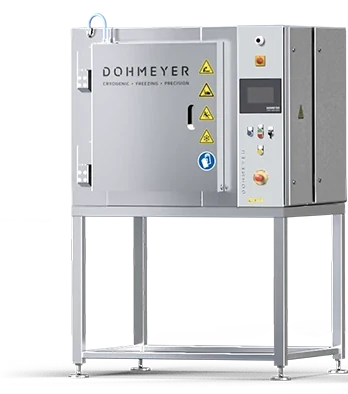
Cryogenic Cabinet Freezer
The cryogenic cabinet freezer reaches -110 °C with liquid nitrogen or CO2 and freezes meat, fish, ready meals and bakery products in batches within 5–10 minutes.
Request a quote| Usable volume | 400–4800 L |
|---|---|
| Capacity | Up to 960 kg/h |
| Freezing time | 5–10 minutes |
| Minimum temperature | -110 °C |
| Refrigerant | Liquid nitrogen or CO2 |
Product description
The cryogenic cabinet freezer is a system in which products are loaded into the cabinet on rack trolleys and frozen in batches with liquid nitrogen or CO2. Spray bars inside the cabinet deliver the refrigerant directly to the product zone through adjustable nozzles, while fans circulate the cold gas between the shelves. The temperature can be lowered to -110 °C, and the freezing time is in the range of 5–10 minutes depending on the product.
Dohmeyer cabinets are manufactured in a usable volume range of 400–4800 L, with capacities up to 960 kg/h. The smallest 400 L model, mounted on legs, is suitable for small-batch production, R&D work and pilot production. This model offers a practical starting point for businesses that want to test recipes and product quality before investing in a continuous line.
Applications
- Chilling, crust freezing and deep freezing
- Fish, seafood and sushi
- Meat and ready meals
- Ice cream
- Bread, bakery and dough products
- R&D kitchens and pilot production areas
Effect of the cryogenic cabinet freezer on product quality
While mechanical freezers operate at around -40 °C, cryogenic systems operate at -100 °C and below. The heat transfer coefficient is 100–140 W/m²·K in cryogenic freezing and 15–17 W/m²·K in mechanical forced-air systems. This difference shortens freezing time by about three-quarters on average.
With fast freezing, ice crystals remain below 10 µm; with mechanical freezing they exceed 50 µm. Small crystals cause less damage to cell structure, and drip loss on thawing is 30–50% lower. The -1 to -5 °C range, where moisture loss is concentrated, takes 10–30 minutes in a mechanical system and causes 3–5% loss, whereas in cryogenic freezing it is passed in under 3 minutes and the loss stays below 1%.
Technical assessment
The cabinet is equipped with IP66-rated fans, spray bars with adjustable nozzles and braked motors. The magnetic SoftClose door lock and heated door make operation easier in batch work with frequent opening and closing. A vacuum-insulated floor and low ramp allow rack trolleys to be wheeled directly into the cabinet. The cabinet is operated from an HMI screen; details of the control functions are confirmed with the manufacturer's data sheet at the quotation stage.
According to the manufacturer's data, this design provides up to 20% faster freezing and 15% lower refrigerant consumption compared with previous solutions.
Selection criteria
The decisive factors in volume selection are the quantity of product per batch, the number of rack trolleys and the number of cycles per shift. Liquid nitrogen allows lower temperatures to be reached; liquid CO2 provides cooling down to -78.5 °C at most. In cryogenic systems, the investment cost is usually lower than that of a mechanical freezer, while the operating cost is higher due to gas consumption; electricity consumption is lower.
If the production volume requires a continuous line, the cryogenic tunnel freezer can be considered. Other cabinet options are listed on the cryogenic cabinets page.
Technical specifications
| Manufacturer | Dohmeyer |
|---|---|
| Operation type | Batch, loading by rack trolley |
| Usable volume | 400–4800 L |
| Capacity | Up to 960 kg/h |
| Freezing time | 5–10 minutes (product dependent) |
| Minimum temperature | -110 °C |
| Refrigerant | Liquid nitrogen or CO2 |
| Fans | IP66 |
| Spray system | Spray bars with adjustable nozzles |
| Door | Magnetic SoftClose lock, heated door |
| Motors | Braked |
| Floor | Vacuum-insulated, with low ramp |
| User interface | HMI screen |
| Processes | Chilling, crust freezing, deep freezing |
Values are taken from the manufacturer's published technical documentation. They may vary by configuration and are confirmed against the current datasheet before quotation.
Frequently asked questions
Which model is suitable for small production or R&D?
The smallest 400 L model, mounted on legs, is suitable for small batches, recipe development and pilot production.
Which refrigerant other than liquid nitrogen can the cabinet use?
The cabinet can operate with liquid nitrogen or CO2. The choice is made according to target temperature, product type and the facility's gas supply infrastructure.
What is the difference between a cabinet freezer and a tunnel freezer?
The cabinet freezer operates in batches and suits flexible production in which different products are processed in sequence. The tunnel freezer operates with continuous flow on a conveyor belt and is preferred for high, uninterrupted volumes.
Request a quote for this model
A suitable configuration and pricing are prepared based on sample type and workload.
Request a quote