

Dohmeyer
Cryogenic Tunnel Freezer
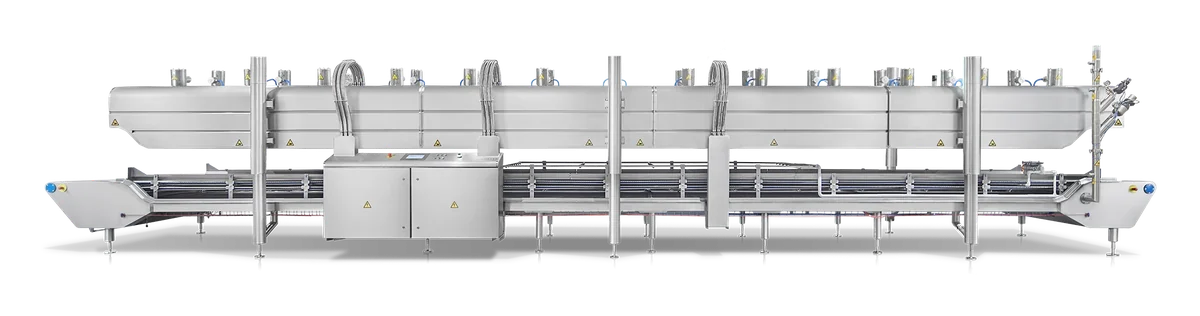
The cryogenic tunnel freezer individually quick freezes (IQF) meat, poultry, seafood and vegetables in continuous flow on a conveyor belt with liquid nitrogen or liquid CO2.
Request a quote| Capacity | Up to 1500 kg/h |
|---|---|
| Refrigerant | Liquid nitrogen or liquid CO2 |
| Retention time | 90 seconds to 3 hours |
| Usable belt width | Up to 1495 mm |
| Control | PLC |
Product description
The cryogenic tunnel freezer is a continuously operating industrial line in which the product is frozen with liquid nitrogen or liquid CO2 as it passes through an insulated tunnel on a conveyor belt. Since product pieces travel on the belt without sticking together, it is suitable for IQF (individually quick frozen) applications. Capacity reaches up to 1500 kg/h and usable belt width up to 1495 mm, and the tunnel is manufactured in different lengths.
The retention time is adjustable between 90 seconds and 3 hours. This wide range allows different products, from thin slices to thicker portions, to be processed on the same line.
Applications
- IQF freezing
- Red meat and poultry products
- Fish and seafood
- Vegetables
- Ready meals
Advantages of cryogenic tunnel freezing
The heat transfer coefficient is 100–140 W/m²·K in cryogenic freezing and 15–17 W/m²·K in mechanical forced-air systems. As a result, freezing time is shortened by about three-quarters on average. For example, in cryogenic freezing at -100 °C, 100 g of chicken breast freezes in 5 minutes, 100 g of cod fillet in 4 minutes and IQF strawberries in 3 minutes, whereas in mechanical freezing at -40 °C these times are 25, 20 and 15 minutes, respectively.
Fast freezing forms ice crystals below 10 µm, reduces drip loss by 30–50% and keeps product moisture loss below 1%. The same capacity can be achieved in up to 75% less floor space than with a mechanical system; the absence of an evaporator, fan or duct in the product zone is also an advantage in terms of hygiene.
Technical assessment
The belt is driven by a servo-motor gear unit and the line is controlled by a PLC. According to the manufacturer's data, the isothermal design provides an increase in capacity of about 15%. Bottom exhaust, an N+1 safety circuit and a vacuum-insulated distribution manifold are part of the standard design.
A gasket-free, top-lift housing design is used for cleaning; an automatic belt cleaning system also simplifies the hygiene routine.
Selection criteria
In tunnel sizing, hourly product quantity, product thickness and required retention time, belt width and tunnel length are evaluated together. The refrigerant is selected according to the target temperature and the facility's gas supply. With cryogenic lines, the investment cost is usually lower than for a mechanical system, while the operating cost is higher due to gas consumption.
For products requiring a longer retention time or higher capacity, the cryogenic spiral freezer can be considered. All line options are listed on the cryogenic lines page.
Technical specifications
| Manufacturer | Dohmeyer |
|---|---|
| Operation type | Continuous, conveyor belt |
| Capacity | Up to 1500 kg/h |
| Refrigerant | Liquid nitrogen or liquid CO2 |
| Retention time | 90 seconds to 3 hours |
| Usable belt width | Up to 1495 mm |
| Tunnel length | Various length options |
| Drive | Servo-motor gear unit |
| Control | PLC |
| Exhaust | Bottom exhaust |
| Safety | N+1 safety circuit |
| Refrigerant distribution | Vacuum-insulated manifold |
| Hygiene | Gasket-free, top-lift design; automatic belt cleaning |
Values are taken from the manufacturer's published technical documentation. They may vary by configuration and are confirmed against the current datasheet before quotation.
Frequently asked questions
Which products is the cryogenic tunnel freezer suitable for?
It is suitable for products that can be individually frozen on a belt, such as meat, poultry, seafood, vegetables and ready meals; it is used particularly in IQF applications.
How to choose between a tunnel and a spiral freezer?
The tunnel offers a linear line for retention times between 90 seconds and 3 hours. If a longer retention time or higher capacity is required, a spiral freezer may be more suitable.
How is the tunnel length determined?
The length is calculated from hourly capacity, the retention time required by the product and belt width. The exact value is confirmed with the manufacturer's data sheet at the quotation stage.
Request a quote for this model
A suitable configuration and pricing are prepared based on sample type and workload.
Request a quote