

Centrifuge Tubes and Transfer Pipettes
Plastic Transfer Pipette (Pasteur Pipette)
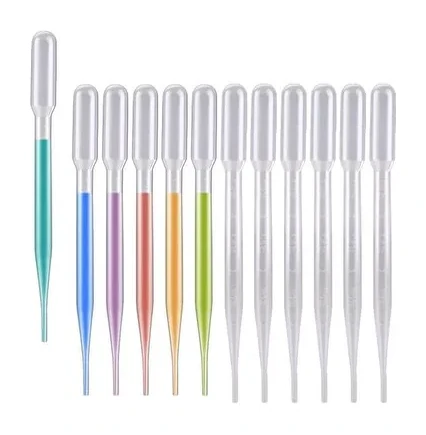
The plastic transfer pipette (Pasteur pipette) is an unbreakable, disposable transfer pipette molded in one piece from polyethylene. In the laboratory, it is used for liquid transfer, dropwise reagent addition and separating the upper phase after centrifugation.
Request a quote| Material | Polyethylene (PE), one piece |
|---|---|
| Type | Disposable |
| Options | Graduated / ungraduated, sterile / non-sterile |
| Advantage | Unbreakable, no risk of cuts |
| Use | Liquid transfer, dropwise dosing |
Product description
The plastic transfer pipette is also commonly known as a Pasteur pipette or dropper. Unlike the traditional glass Pasteur pipette, it is molded in one piece from polyethylene; the bulb and stem are integrated, so no separate rubber bulb is needed. Since it does not break, it carries no risk of cuts, and being disposable, it eliminates the risk of carryover (contamination) between samples.
The transfer pipette is designed for transfer tasks that do not require a precise volume, such as moving liquid from one tube to another, adding reagent dropwise to a solution or separating the upper phase after centrifugation. The graduations on the stem indicate approximate volume.
Applications
- Addition of indicators and reagents in the chemistry laboratory
- Sample transfer in microbiology and clinical laboratories
- Separation of the supernatant after centrifugation
- Sampling in food and cosmetics quality control
- Safe liquid transfer in teaching laboratories
In these tasks, speed, safety and single-use hygiene matter more than volume accuracy. The transfer pipette therefore takes over daily transfer tasks without the breakage risk and washing burden of a glass pipette.
Correct use
The plastic transfer pipette is filled by squeezing the bulb to expel the air, immersing the tip in the liquid and slowly releasing the bulb. The tip is then held close to the inner wall of the target vessel and the bulb is squeezed in a controlled manner to release the liquid drop by drop. This prevents splashing and contamination of the vessel rim.
- Do not invert: If a filled transfer pipette is held tip-up, liquid runs into the bulb and air bubbles form on the next draw.
- A new transfer pipette for each sample: The single-use design is intended to prevent carryover between samples; the transfer pipette is not washed and reused.
- Upper phase separation: When taking the supernatant from centrifuge tubes, the liquid is drawn from just below the surface without the tip touching the pellet.
- Waste: Transfer pipettes used with biological samples are disposed of according to the laboratory's biological waste procedure.
Plastic transfer pipette selection criteria
- Graduated or ungraduated: A graduated model is selected if approximate volume tracking is required
- Sterile or non-sterile: Individually wrapped sterile transfer pipettes are used in cell culture and microbiology
- Tip type: Fine-tip models suit small drops and access to narrow vessels, standard-tip models suit fast transfer
- Chemical compatibility: Polyethylene is compatible with water-based solutions and most acids and bases; it may soften during prolonged contact with some organic solvents
If a specific volume must be measured accurately, a pipette is used instead of a transfer pipette. Pipette pumps suit serological pipettes, and pipette tips suit micro volumes.
Frequently asked questions
Can plastic transfer pipettes be autoclaved?
Polyethylene transfer pipettes are generally not autoclavable; if sterility is required, individually wrapped transfer pipettes sterilized during production should be preferred.
Which volume options are available?
Transfer pipettes are produced in different total volumes and tip types. The suitable volume and pack option is recommended with the quotation according to the intended use.
Why choose a plastic transfer pipette instead of a glass Pasteur pipette?
A plastic transfer pipette is unbreakable, carries no risk of cuts and requires no separate rubber bulb. Being disposable, it also eliminates washing and drying; a glass pipette, on the other hand, has the advantage in tasks requiring prolonged contact with organic solvents or high temperatures.
Request a quote for this model
A suitable configuration and pricing are prepared based on sample type and workload.
Request a quote