

Centrifuge Tubes and Transfer Pipettes
Centrifuge Tubes 15 mL and 50 mL
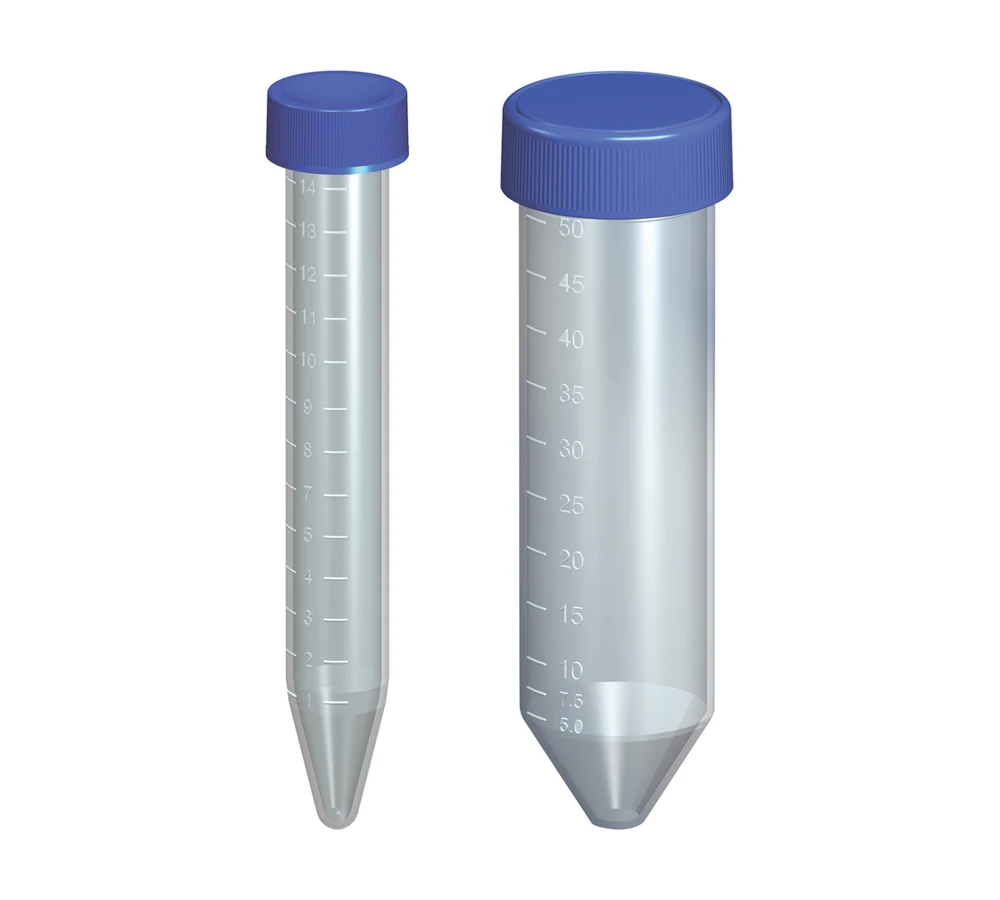
The conical centrifuge tube is a polypropylene tube in 15 mL and 50 mL volumes with a screw cap and conical bottom. It is offered in sterile and non-sterile options for sample separation, storage and transfer.
Request a quote| Volume | 15 mL and 50 mL |
|---|---|
| Material | Polypropylene (PP) tube, screw cap |
| Bottom | Conical; skirted option for 50 mL |
| Options | Sterile / non-sterile, rack or bag |
| Compatibility | 15 mL and 50 mL rotors |
Product description
15 mL and 50 mL conical centrifuge tubes are the two most frequently used tube sizes in the laboratory. The conical bottom collects the pellet sedimented during centrifugation at a single point, which makes it easier to remove the supernatant without disturbing the pellet. The screw cap provides a leak-tight seal and allows the tube to be used for transport and storage as well.
The tubes are usually made of polypropylene. Polypropylene is translucent, resists many chemicals and is autoclavable. The graduations and writing area on the tube body make it easy to see the sample volume and to label the tube.
15 mL or 50 mL?
- 15 mL: Cell pelleting, small-volume extraction, sample aliquoting and clinical samples
- 50 mL: Culture harvesting, large-volume precipitation, buffer and solution preparation, and sample storage
- Skirted 50 mL: Thanks to the skirt at the bottom, the tube stands upright without support, which is practical for benchtop work
The rotors and adapters of the laboratory centrifuge determine which tube can be used. For example, the centrifuges in the catalog offer a 15 mL angle rotor and rotor options with 50 mL tube capacity.
Correct use and balancing
The first rule of safe centrifuge operation is balance. Tubes are placed opposite each other in the rotor with equal volumes; if there is only one sample, a tube filled with the same volume of water is placed opposite it. An unbalanced load can cause vibration, tube breakage and rotor damage.
- Fill volume: The tube is not filled above the top graduation on the body; leaving headspace near the cap preserves the seal.
- Cap tightness: The screw cap is closed fully but not tightened so much that the threads are strained.
- Adapter compatibility: Conical tubes are used with an adapter suited to the conical bottom; the tube may crack in a flat-bottom cavity.
- Labeling: The writing area is filled in before centrifugation; for samples to be stored in a freezer, cold-resistant labels are preferred.
Conical centrifuge tube selection criteria
- Centrifugation rating (×g): The maximum g-force of the tube is stated on the manufacturer's data sheet; the g-value of the application must remain below this limit
- Sterility: Sterile, DNase/RNase-free tubes are preferred in cell culture and molecular biology
- Packaging: Tubes in racks are ready for immediate use, bag packs are more economical
- Chemical compatibility: Polypropylene resists most acids, bases and alcohols; deformation may occur with some chlorinated solvents
- Temperature: For samples to be stored in a freezer, the low-temperature resistance of the tube is checked
A plastic transfer pipette can be used to separate the upper phase after centrifugation, and a vortex mixer to mix the sample in the tube. Other tube and transfer pipette options are listed in the centrifuge tubes and transfer pipettes category.
Frequently asked questions
Can centrifuge tubes be autoclaved?
Polypropylene tubes can generally be autoclaved at 121 °C. Since the cap material may differ, the autoclavability of the cap must be checked on the model's data sheet; this information is provided with the quotation.
Up to how many g can the tubes withstand?
The maximum centrifugal force varies by model and manufacturer. A suitable tube is recommended based on the centrifuge speed or g-value in use.
Is there a price advantage for bulk purchases?
For consumables, planned supply is provided based on annual consumption; it is sufficient to provide the quantity and delivery frequency.
Request a quote for this model
A suitable configuration and pricing are prepared based on sample type and workload.
Request a quote