

Spray Dryers
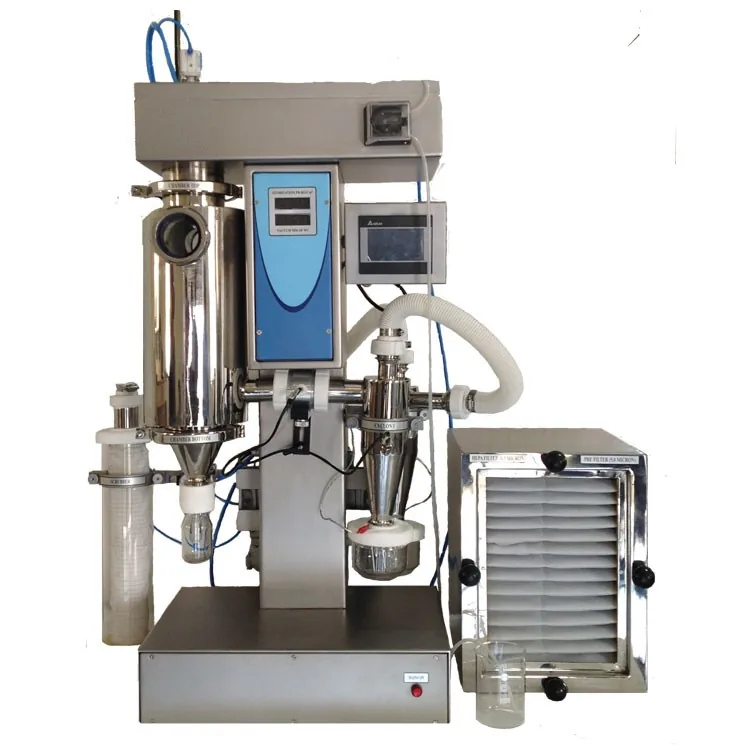
Benchtop Laboratory Spray Dryer
The benchtop laboratory spray dryer converts liquid samples into powder at R&D scale, with a water evaporation capacity of 1 liter per hour and batches starting from 0.1 liter.
Request a quote| Evaporation capacity | 1,000 mL/h water |
|---|---|
| Minimum batch | 0.1 liter |
| Inlet temperature | Ambient to 250 °C |
| Atomization | Two-fluid nozzle, 0.7 mm |
| Control | PLC and touchscreen |
Product description
Spray drying is a method in which a sample in solution or suspension form is sprayed as fine droplets into a stream of hot air and converted into dry powder within seconds. Because the droplets are very small, evaporation is fast and the product does not remain at high temperature for long. For this reason, the method is also used for heat-sensitive active pharmaceutical ingredients, flavor compounds and probiotics.
This benchtop laboratory spray dryer scales the method down to R&D level. It evaporates up to 1 liter of water per hour and can operate with a batch of 0.1 liter, making formulation trials possible with expensive or scarce raw materials. Inlet and outlet temperature, air flow and pump flow are set and monitored on a 7-inch color touchscreen; the screen is protected by username and password to prevent unauthorized use.
The drying chamber and the two cyclones are made of stainless steel. Because the unit can be cleaned in place without disassembly, downtime between sample changes is reduced; a sight glass on the drying chamber allows the spray to be observed visually.
Applications
- Powder preparation and encapsulation trials for active pharmaceutical ingredients and formulations
- Probiotic, prebiotic and nutraceutical product development
- Milk and dairy derivatives, flavor and essence powders
- Specialty chemicals, ceramic, polymer and pigment powders
- Nanoparticle and microparticle production studies
If the sample contains pure organic solvent, the mobile laboratory spray dryer, which operates in a closed loop and is explicitly suitable for solvent feeds, is the safer choice.
Technical assessment
Atomization is performed with a co-current two-fluid nozzle. The standard nozzle is 0.7 mm in SS 316L stainless steel; with 0.5, 1.0, 1.2 and 1.5 mm tips, droplet size and flow can be adapted to the sample. A user-operated nozzle cleaning system prevents clogging with viscous feeds. Atomizing air is supplied by an oil-free compressor at 5–8 bar and 200–800 L/h.
Inlet temperature is adjustable up to 250 °C in 0.1 °C steps and controlled with ±1 °C accuracy. The drying air is heated by a 3 kW electric heater; the aspirator has a capacity of 85 Nm³/h. Inlet air passes through a 5 µm prefilter and a 0.3 µm HEPA filter. The peristaltic feed pump operates with 3 mm silicone tubing at up to 1,250 mL/h, and its flow is adjustable in 1% steps.
The product is collected via twin stainless steel cyclones into two borosilicate glass collection vessels with PTFE lids; fine particles not retained by the cyclone are captured and recovered in the outlet filter. Seals are PTFE and silicone. Alarms are shown on the screen audibly and visually, and two-way data exchange with a computer is possible via the RS 485 port. The unit operates on 220 V, 50 Hz mains power.
Options
Depending on requirements, counter-current spraying, a spray congealing module, an inert nitrogen loop, an ultrasonic nozzle, automatic cleaning of the outlet filters and a borosilicate glass drying chamber and cyclones can be added. The suitability of the options for the sample is evaluated at the quotation stage.
If the drying scale or solvent requirements differ, other models in the same category can be compared in the spray dryers section. The principle and applications of the method are summarized on the laboratory technologies page.
Technical specifications
| Water evaporation capacity | 1,000 mL/h (at maximum drying air, insulated conditions) |
|---|---|
| Minimum batch | 0.1 liter |
| Feed type | Aqueous and aqueous + solvent mixture |
| Inlet temperature | Ambient to 250 °C, 0.1 °C steps, ±1 °C accuracy |
| Spraying | Co-current, two-fluid nozzle 0.7 mm; 0.5 / 1.0 / 1.2 / 1.5 mm tips |
| Clog prevention | User-controlled nozzle cleaning system |
| Drying air | 30–110 Nm³/h |
| Aspirator | 85 Nm³/h, 0 to -250 mmH₂O vacuum, frequency inverter |
| Feed pump | Peristaltic, up to 1,250 mL/h, adjustable in 1% steps, 3 mm silicone tubing |
| Air filtration | 5 µm prefilter + 0.3 µm HEPA |
| Product collection | Twin cyclone, borosilicate glass collection bottles |
| Materials | Drying chamber and cyclones SS 316; collection vessels borosilicate glass, lids PTFE; seals PTFE and silicone |
| Compressed air | Oil-free compressor, 5–8 bar, 200–800 L/h |
| Heater | 3 kW |
| Control | PLC, 7-inch color touchscreen, username and password, audible and visual alarms, RS 485 |
| Power supply | 220–240 V, 50 Hz, single phase |
| Dimensions | Main unit 1200 × 500 × 600 mm (H × W × D); filter box 400 × 400 × 500 mm |
| Weight | Main unit approx. 60 kg, filter box approx. 10 kg |
Values are taken from the manufacturer's published technical documentation. They may vary by configuration and are confirmed against the current datasheet before quotation.
Frequently asked questions
What particle size can be achieved with a spray dryer?
Particle size depends on nozzle diameter, feed concentration, flow rate and drying temperature. A suitable nozzle and parameter range are recommended based on the target particle size and sample information; trials with the sample are advised whenever possible.
Can heat-sensitive samples be dried?
Yes. The droplets remain in the hot air for only a short time and evaporation cools the sample; as a result, the product temperature stays well below the inlet air temperature. Inlet and outlet temperatures can be kept low according to the sample.
Request a quote for this model
A suitable configuration and pricing are prepared based on sample type and workload.
Request a quote