

Spray Dryers
Laboratory Spray Dryer and Spray Congealer
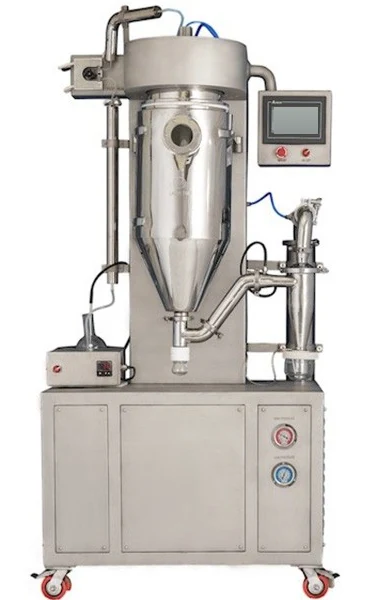
The laboratory spray dryer and spray congealer uses the same drying chamber and cyclone arrangement both to dry solutions in hot gas and to solidify molten feeds in cold gas for microparticle production. The operating mode is selected on a 7-inch touchscreen.
Request a quote| Operating modes | Spray drying and spray congealing |
|---|---|
| Mode selection | Via 7-inch touchscreen |
| Feed | Solution, suspension or melt |
| Melt line | Heated peristaltic pump and heated nozzle |
| Design | Stainless steel cabinet on wheels |
Product description
The laboratory spray dryer and spray congealer combines two different particle production methods in one instrument. In spray drying mode, a solution or suspension is sprayed into a hot gas stream and the solvent evaporates to give a dry powder. In spray congealing mode, a molten feed is sprayed into a cold gas environment; the droplets cool and solidify without evaporation.
Both modes use the same drying chamber, cyclone, bag filter, gas distribution unit and aspirator. In drying mode a hot gas system is connected to the unit, and in congealing mode a cold gas system. The researcher selects the mode on the 7-inch touchscreen, so there is no need to install two separate instruments in the same laboratory space.
A feed melting unit is provided for congealing mode. The melt is conveyed by a heated peristaltic pump to the heated spray nozzle; because the temperature is maintained along the line, the melt does not solidify before reaching the nozzle.
Advantages of spray congealing
Spray congealing is a simple way to obtain particles with the desired particle size distribution without using solvents. Since there is no solvent to evaporate, process time and energy consumption are reduced compared with solvent-based methods.
- Encapsulation of the active ingredient in meltable carriers such as waxes, fatty acids or glycerides
- Development of taste-masking and controlled-release formulations
- Conversion of heat- and moisture-sensitive components into particles by solvent-free processes
- Comparative testing of the same sample by drying and congealing methods
Applications
- Microparticle and controlled-release formulations in pharmaceutical R&D
- Encapsulation of nutraceutical and food ingredients
- Coating of flavors and essences with lipid-based carriers
- Particle production for wax- and polymer-based products
- Conventional spray drying of solutions and suspensions
The same unit concept developed in the laboratory has been implemented by the manufacturer up to a capacity of 25 kg per hour; this allows process parameters established in the laboratory to be transferred to a larger scale.
Spray dryer and spray congealer selection criteria
If only aqueous solutions are to be dried and bench space is limited, the benchtop laboratory spray dryer may be more suitable; if solvent-based feeds and an inert loop are the priority, the mobile laboratory spray dryer may be the better fit. If work with molten feeds is planned, this model offers both methods together.
Evaporation capacity, temperature ranges, power requirements and dimensions are provided at the quotation stage with the manufacturer's current data sheet. The principle of spray drying is summarized on the laboratory technologies page; all models are listed in the spray dryers section.
Technical specifications
| Operating modes | Spray drying (hot gas) and spray congealing (cold gas) |
|---|---|
| Shared components | Drying chamber, cyclone, bag filter, gas distribution unit, aspirator, process control instrumentation |
| Melt feed | Feed melting unit, heated peristaltic pump, heated spray nozzle |
| Control | 7-inch digital touchscreen, mode selection on screen |
| Housing | Stainless steel cabinet on wheels |
| Scale-up | The same unit concept has been implemented by the manufacturer up to 25 kg/h capacity |
| Other values | Capacity, temperature ranges, power, dimensions and weight are provided with the data sheet in the quotation |
Values are taken from the manufacturer's published technical documentation. They may vary by configuration and are confirmed against the current datasheet before quotation.
Frequently asked questions
What is the difference between spray drying and spray congealing?
In spray drying, a solution or suspension is dried with hot gas and the solvent evaporates. In spray congealing, molten material is sprayed into a cold gas environment and the droplets cool and solidify without evaporation.
Which materials are used in congealing mode?
Waxes, fatty acids, glycerides and similar meltable carriers with a suitable melting point are used. The suitability of a material is determined by trial runs based on its melting behavior and viscosity.
Can the same instrument be used for both modes?
Yes. The drying chamber, cyclone and filter arrangement are shared; the mode is selected on the touchscreen. A hot gas system is used for drying and a cold gas system for congealing.
Request a quote for this model
A suitable configuration and pricing are prepared based on sample type and workload.
Request a quote