

Spray Dryers
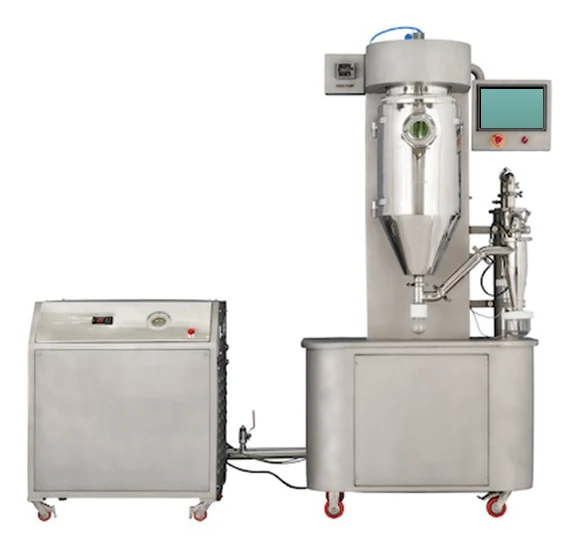
Mobile Laboratory Spray Dryer
The mobile laboratory spray dryer dries aqueous and solvent-based feeds at a capacity of 1 liter per hour, monitoring outlet and product temperature separately and logging data.
Request a quote| Evaporation capacity | 1,000 mL/h water |
|---|---|
| Feed type | Aqueous, aqueous + solvent, solvent |
| Inlet temperature | Ambient to 250 °C |
| Outlet temperature | 30–120 °C |
| Design | Self-contained unit on wheels |
Product description
This laboratory spray dryer integrates the entire system, including the drying chamber, cyclones, filters, control panel and feed preparation, in a single cabinet on wheels. It can be plugged in and used at different locations in the laboratory; it does not require a separate installation area or fixed utilities.
What distinguishes this model from the benchtop version is that it also handles solvent-based feeds. Solutions containing organic solvents can be dried in a closed loop with the optional inert nitrogen loop. When the inert loop is connected, the oxygen percentage is also recorded. The built-in hotplate stirrer on the cabinet keeps a 1-liter feed homogeneous and at the required temperature throughout drying.
The housing is acid-resistant matte stainless steel. The drying chamber has two sight glasses and a flow light, so the uniformity of the spray can be monitored throughout the process. The touchscreen is protected by username and password, and each component can be tested individually from the screen in the event of a fault.
Applications
- Drying of active pharmaceutical ingredients and intermediates containing organic solvents
- Amorphous solid dispersion and encapsulation formulation studies
- Small-scale powder preparation for steroid, hormone and oncology products
- Spray congealing trials for specialty chemical, polymer and wax-based products
- Determination of process parameters before moving to pilot production
Technical assessment
Inlet air from ambient to 250 °C, outlet temperature in the range of 30–120 °C and product temperature in the range of 30–90 °C are monitored by the PLC in 0.1 °C steps. Four PT100 sensors measure the inlet, outlet, hot plate and heater safety cut-off points. Separate monitoring of outlet and product temperature allows the process to be kept safely within limits for heat-sensitive samples.
Atomization is performed with an SS 316L two-fluid nozzle with a Teflon-coated outer surface; tip options are 0.5, 0.7, 0.8, 1.0 and 1.2 mm. Aspirator capacity is 118 Nm³/h. The drying chamber is SS 316 with an insulation jacket and includes sight and illumination glasses; the product is collected in borosilicate glass collection vessels with threaded lids.
The software records trends of inlet, outlet and product temperature and oxygen percentage from the first feed onward. Methods can be saved for different products and limit values assigned; for example, when the outlet temperature limit is exceeded, an audible alarm is given and the process stops. When operating with the inert loop, the cooling temperature is also set from the screen.
Inlet air passes through a 5 µm prefilter; a 0.3 µm HEPA filter is used for closed-system operation. The feed pump uses 3 mm Pharmed silicone tubing, and flow is adjustable in 1% steps. Optionally, counter-current spraying, spray congealing, a hot melt module, an ultrasonic nozzle, automatic cleaning of the outlet filters and a borosilicate glass drying chamber can be added.
Selection criteria
If only aqueous samples are processed and bench space is to be saved, the benchtop laboratory spray dryer is more compact. If the product to be dried comes from a purification step, parallel evaporators can also be considered for fraction drying.
If microparticle production from a molten feed is also planned, the spray dryer and spray congealer model, which combines spray drying and spray congealing in a single unit, can be considered.
Technical specifications
| Water evaporation capacity | 1,000 mL/h (at maximum drying air, insulated conditions) |
|---|---|
| Feed type | Aqueous, aqueous + solvent, solvent |
| Inlet temperature | Ambient to 250 °C |
| Outlet temperature | 30–120 °C |
| Product temperature | 30–90 °C |
| Temperature measurement | 4 × PT100: inlet, outlet, hot plate, heater safety cut-off |
| Spraying | SS 316L, two-fluid, co-current nozzle, Teflon-coated exterior; 0.5 / 0.7 / 0.8 / 1.0 / 1.2 mm tips; automatic declogging |
| Aspirator | 118 Nm³/h, 0 to -250 mmH₂O vacuum, frequency inverter |
| Feed pump | Peristaltic, up to 1,250 mL/h, PLC controlled |
| Feed preparation | Built-in hotplate stirrer, 1 liter |
| Drying chamber | SS 316, insulation jacket, with sight and illumination glasses |
| Product collection | Twin cyclone, borosilicate glass vessels with threaded lids |
| Housing | Acid-resistant matte stainless steel, two sight glasses |
| Closed loop | 0.3 µm HEPA filter for recirculated gas; inert nitrogen loop optional |
| Heater | 3 kW |
| Control | PLC, 7-inch color touchscreen, username and password, method storage, limit alarms, RS 485 |
| Power supply | 220 V, 50 Hz, single phase; max. 12 A |
| Dimensions / weight | 1500 × 1500 × 500 mm (H × W × D) / approx. 150 kg |
Values are taken from the manufacturer's published technical documentation. They may vary by configuration and are confirmed against the current datasheet before quotation.
Frequently asked questions
Can solvent-based samples be dried safely?
The unit is designed for solvent feeds; for flammable solvents, the inert loop option is used, in which the drying air is replaced with nitrogen. The safe configuration is determined at the quotation stage according to the type and proportion of the solvent.
Does it have the same capacity as the benchtop model?
Yes, the water evaporation capacity of both models is 1 liter per hour. The differences lie in solvent feed capability, closed-loop operation, built-in feed preparation, separate outlet and product temperature monitoring and data logging.
Request a quote for this model
A suitable configuration and pricing are prepared based on sample type and workload.
Request a quote