

Konica Minolta
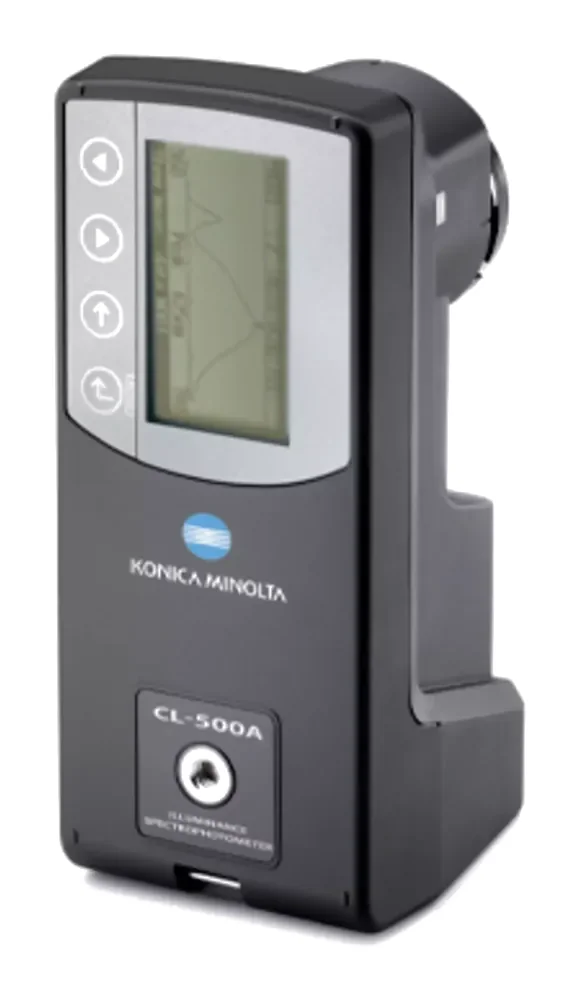
CL-500A Spectral Illuminance Meter
CL-500A is a portable spectral illuminance meter that measures over 360-780 nm with a 1 nm output interval. Compliant with JIS Class AA and DIN 5032-7 Class B, the instrument also performs CRI and spectral distribution evaluation in addition to illuminance measurement.
Request a quote| Spectral range | 360 – 780 nm, 1 nm output |
|---|---|
| Measurement range | 0.1 – 100,000 lx |
| Measured | Lux, CCT, Δuv, CRI (Ra, R1–R15), spectral graph |
| Class | JIS C 1609-1 AA, DIN 5032-7 B |
| Weight | 350 g |
Product description
CL-500A is a compact illuminance spectrophotometer that combines illuminance measurement with spectral analysis. With its optical grating and multi-sensor design, it measures light between 360 and 780 nm; illuminance, color temperature, chromaticity coordinates, color rendering index and spectral irradiance distribution are obtained in a single measurement.
Thanks to its spectral measurement design, it gives more reliable results than filter-based instruments for narrow-band light sources or those with special spectra, such as LEDs, OLEDs, EL and high-pressure lamps. The spectral distribution graph and peak wavelength are displayed directly on the instrument screen; the instrument can therefore also be used without a computer.
Illuminance is measured between 0.1 and 100,000 lx. Accuracy with standard illuminant A is ±2% ±1 digit for illuminance and ±0.0015 for xy chromaticity.
Applications
- Spectral evaluation of next-generation light sources such as LED, OLED and EL lighting
- Control of illuminance, chromaticity, dominant wavelength and color temperature of light sources
- Development, quality control and maintenance of LED signage
- Evaluation of illuminance distribution in LED modules and luminaires
- Building and interior lighting studies
- Periodic maintenance of light booths, color control of projector light sources
Key features
Color rendering index and additional scales
The general color rendering index (Ra) and special indices from R1 to R15 are measured. Alternative color quality scales such as CQS can also be added via software.
Photopic and scotopic illuminance
The spectral sensor allows measurement of scotopic illuminance, which corresponds to night vision, and of the S/P ratio. This value is used in the evaluation of street and outdoor lighting.
MacAdam SDCM display
The standard CL-S10w software includes a template that shows the chromaticity difference of sources such as LEDs and OLEDs in MacAdam SDCM steps. This display expresses color difference in a way consistent with visual evaluation. The software exports data to Excel and offers an LED binning function.
System integration
Connected to a computer via USB, up to 10 units can be operated together for multi-point measurement. A free software development kit (SDK) and a tripod mount allow the instrument to be integrated into automated test and production systems.
Spectral illuminance meter selection criteria
If measurement of the near-infrared region (up to 1000 nm), very low illuminance levels such as 0.01 lx, or a networked multi-point installation via Ethernet is required, the CL-700A should be considered. For practical touchscreen CRI measurement in the field, the CL-70F is sufficient, and for illuminance alone, the T-10A.
Other models in the category are listed under light and display measuring instruments. The calculation method for the color rendering index is defined in CIE publication 13.3.
Technical specifications
| Illuminance meter class | JIS C 1609-1:2006 Class AA; DIN 5032 Part 7 Class B |
|---|---|
| Spectral range | 360 – 780 nm |
| Output wavelength interval | 1 nm |
| Spectral bandwidth | Approx. 10 nm (half bandwidth) |
| Wavelength accuracy | ±0.3 nm |
| Measurement range | 0.1 – 100,000 lx (5 lx and above for chromaticity) |
| Accuracy (illuminant A) | Ev: ±2% ±1 digit; xy: ±0.0015 (10 – 100,000 lx) |
| Repeatability (2σ) | Ev: 0.5% +1 digit; xy: 0.0005 (500 – 100,000 lx) |
| Spectral match (f1') | Within 1.5% of the V(λ) curve |
| Cosine correction (f2) | Within 3% |
| Measurement time | Super fast approx. 0.2 s (when connected to a computer); fast approx. 0.5 s; slow approx. 2.5 s |
| Display modes | XYZ, Ev xy, Ev u'v', dominant wavelength, excitation purity, CCT, Δuv, Ra, Ri (R1–R15), spectral graph, peak wavelength, color differences |
| Memory | 100 measurements |
| Connectivity | USB 2.0 |
| Power | Built-in rechargeable lithium-ion battery (approx. 6 hours when new), AC adapter or USB bus power |
| Dimensions | 70 × 165 × 83 mm |
| Weight | 350 g |
Values are taken from the manufacturer's published technical documentation. They may vary by configuration and are confirmed against the current datasheet before quotation.
Frequently asked questions
Why is a spectral illuminance meter needed?
Filter-based meters imitate the sensitivity curve of the human eye with filters; with sources such as narrow-band LEDs, this approach can produce errors. Because a spectral instrument measures light by separating it into wavelengths, it calculates values such as color temperature and CRI more reliably.
What is the S/P ratio?
The S/P ratio is the ratio of a light source's effect in night vision (scotopic) to its effect in daytime vision (photopic). It is used to evaluate perceived brightness in outdoor and road lighting.
What does a MacAdam SDCM step express?
SDCM expresses, in steps, how visually distinguishable the chromaticity difference between two light sources is. A small step value indicates that the color difference between LEDs is difficult to notice.
From the same category
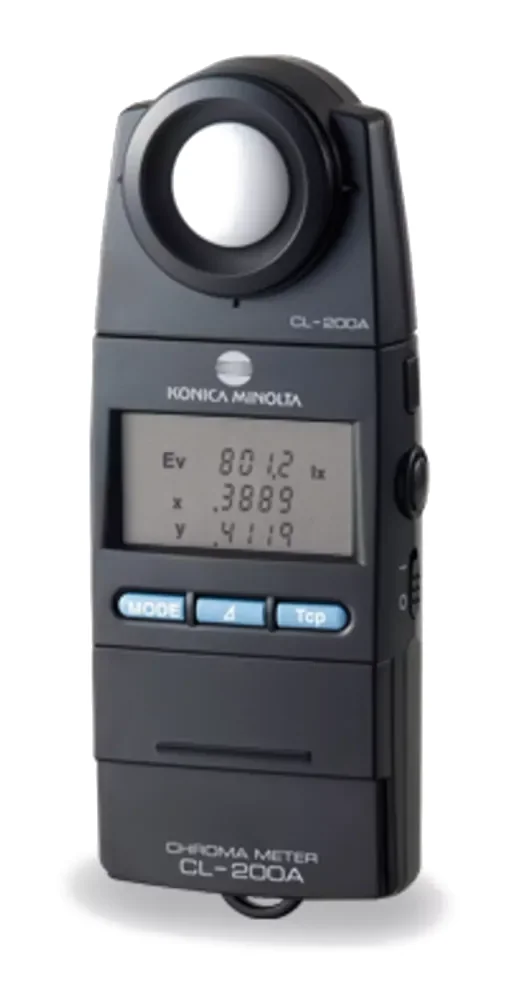
CL-200A Illuminance and Light Color Meter
Portable light meter that measures illuminance, color temperature and chromaticity coordinates in a single instrument.
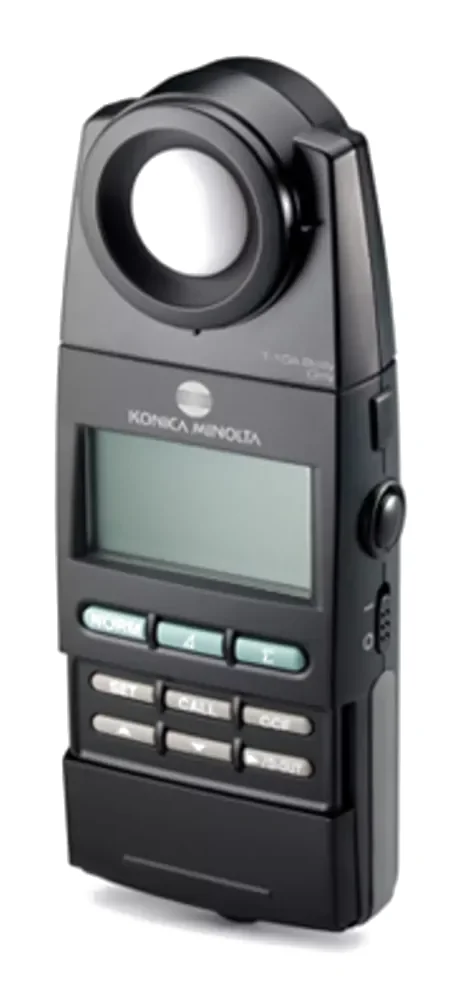
T-10A / T-10MA Illuminance Meter
Digital illuminance meter measuring over 0.01-299,900 lx, with a detachable head and compatibility with PWM-dimmed LEDs.
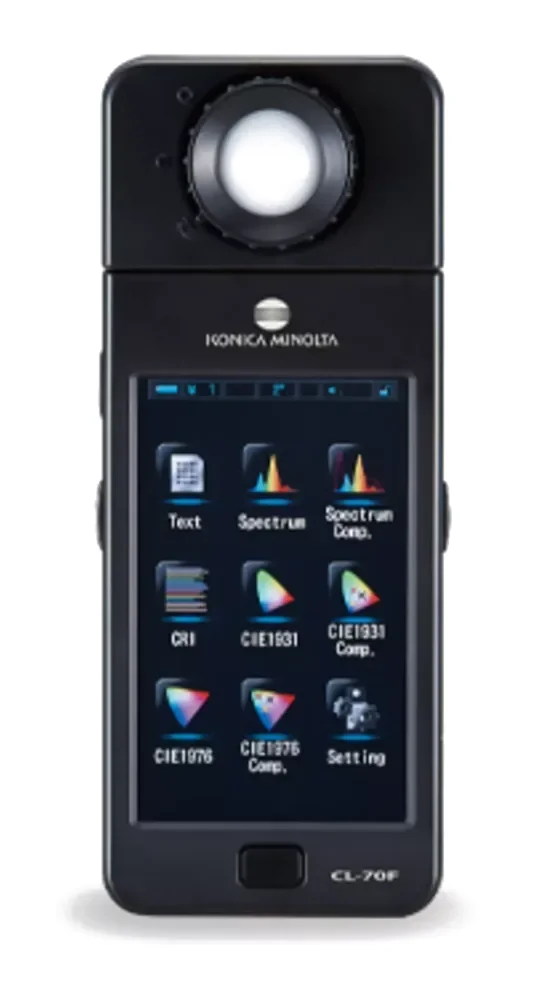
CL-70F CRI Illuminance Meter
Touchscreen instrument with a spectral sensor that measures illuminance, color temperature and color rendering index (CRI).
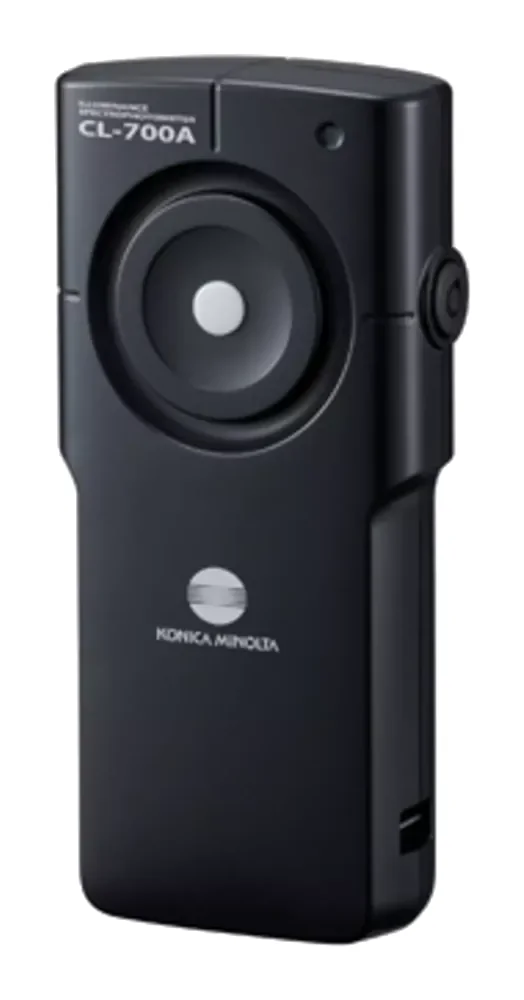
CL-700A Illuminance Spectrophotometer
Illuminance spectrophotometer measuring over 360-1000 nm, starting from 0.01 lx, with Ethernet network connectivity.
Request a quote for this model
A suitable configuration and pricing are prepared based on sample type and workload.
Request a quote