

Light and Display Measurement Instruments
Light measuring instruments numerically determine the quantity, color and quality of the light falling on a surface. The category covers five Konica Minolta instruments, from a basic lux meter to an illuminance spectrophotometer.
Light and Display Measurement Instruments: models
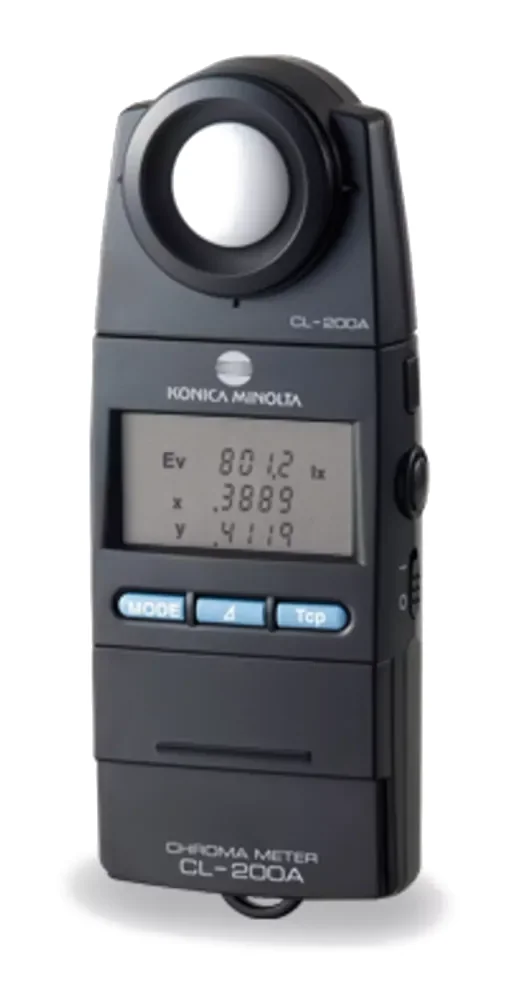
CL-200A Illuminance and Light Color Meter
Portable light meter that measures illuminance, color temperature and chromaticity coordinates in a single instrument.
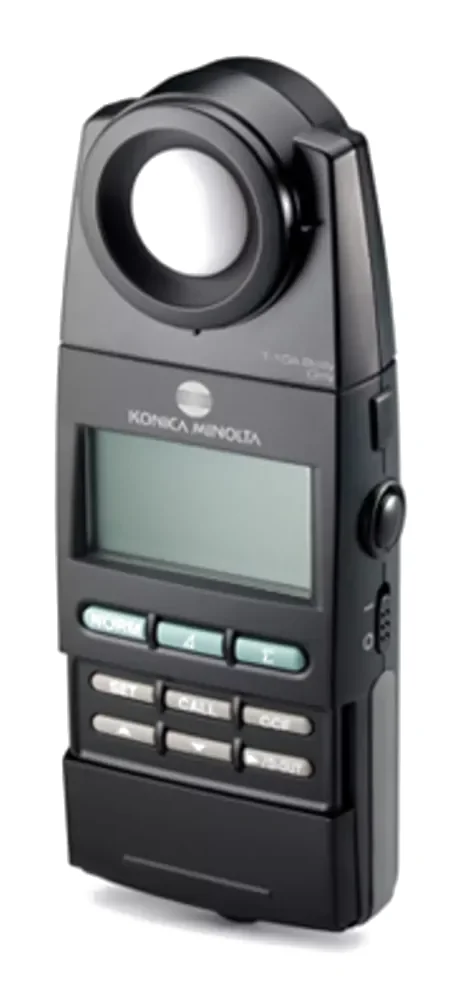
T-10A / T-10MA Illuminance Meter
Digital illuminance meter measuring over 0.01-299,900 lx, with a detachable head and compatibility with PWM-dimmed LEDs.
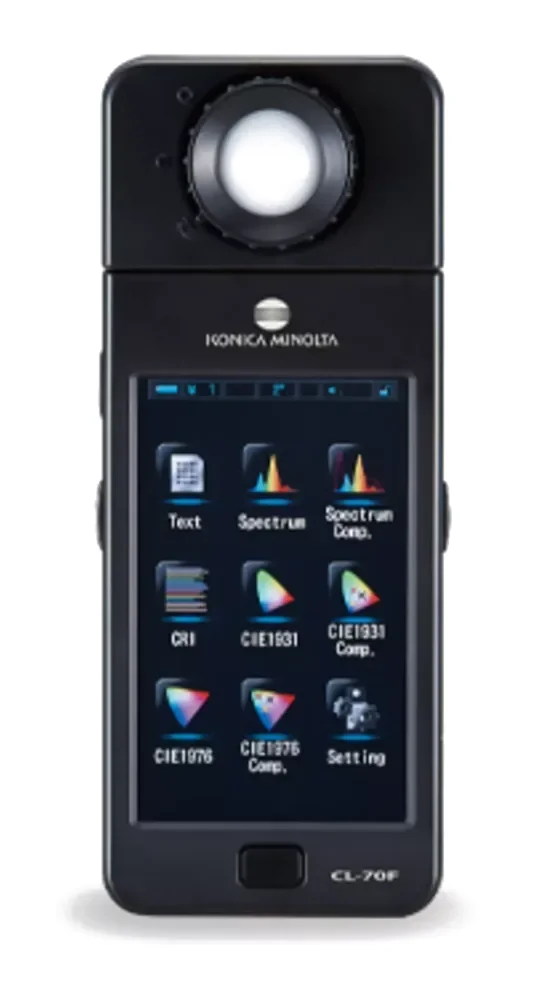
CL-70F CRI Illuminance Meter
Touchscreen instrument with a spectral sensor that measures illuminance, color temperature and color rendering index (CRI).
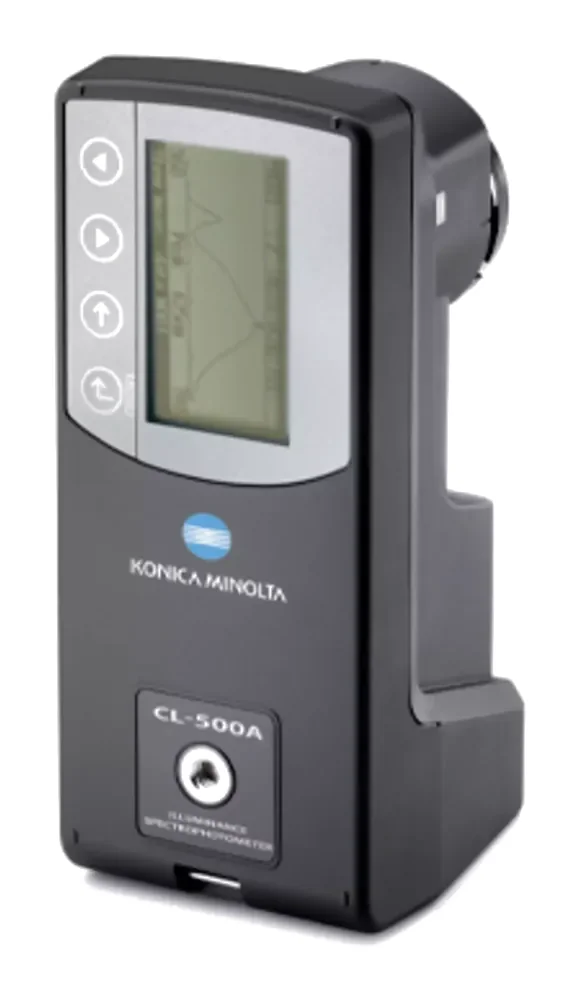
CL-500A Spectral Illuminance Meter
Portable spectral instrument that measures illuminance, color temperature, CRI and spectral distribution of light sources, including LEDs and OLEDs.
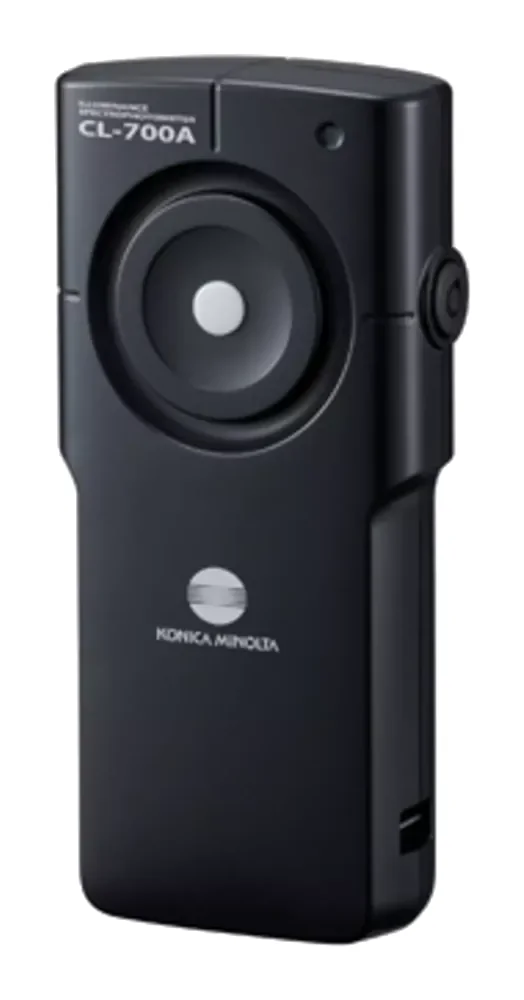
CL-700A Illuminance Spectrophotometer
Illuminance spectrophotometer measuring over 360-1000 nm, starting from 0.01 lx, with Ethernet network connectivity.
Which quantities are measured in light measurement?
- Illuminance (lx): The amount of light falling on a surface; the basic quantity in workplace lighting audits.
- Color temperature (CCT, K): Expresses the warm or cool tone of the light.
- Chromaticity coordinates (xy, u'v'): Define the color of the light in a color space.
- Color rendering index (CRI, Ra): Expresses how naturally a light source renders object colors according to the CIE 13.3 method.
- Spectral distribution: The distribution of light by wavelength; used in LED and specialty lighting development.
The performance classification of illuminance meters is defined in a CIE publication and in standards such as JIS C 1609-1 and DIN 5032-7. Cosine correction in the measuring head ensures that light arriving at an oblique angle is evaluated correctly.
Not all of these quantities are needed in every application. Illuminance is sufficient for a warehouse or corridor audit, whereas in a museum, a store or LED luminaire production, the color of the light and the way it renders object colors are also measured. The right instrument is therefore determined by an assessment that starts with the list of quantities to be reported.
Light measuring instrument selection guide
If only illuminance is to be measured, the T-10A / T-10MA digital lux meter is sufficient; its detachable head is suited to multi-point measurement and PWM-driven LED lighting.
If the color of the light also matters, the tristimulus-based CL-200A provides color temperature and chromaticity coordinates together with illuminance. In applications where the color rendering index is checked in the field, the CL-70F CRI meter with touchscreen is used.
For sources such as LEDs and OLEDs, the CL-500A spectral illuminance meter is preferred when spectral distribution, CRI and color fidelity evaluation are required. The CL-700A is positioned for R&D applications that require very low illuminance levels, a wide wavelength range and multi-point measurement over a network.
The decisive question in selection is which quantity is to be reported: only lux, or also color temperature, CRI or spectrum? A detailed comparison is available in the how to choose a lux meter guide.
Comparison criteria for light measuring instruments
Instruments differ not only in the quantities they measure but also in their measurement conditions. The following criteria are therefore evaluated together during selection.
- Measuring range: Night lighting and emergency lights require very low lux values, while outdoor and stage lighting require high values.
- Spectral match: How closely the sensor follows the sensitivity curve of the human eye determines accuracy, especially with narrow-band sources such as LEDs.
- Head design: A detachable or cabled head keeps the operator's shadow away from the measurement and enables multi-point measurement.
- Data management: PC connectivity, data logging and reporting features reduce workload in audits and production quality control.
- Standard class: Official audit reports require the instrument to meet the relevant standard class.
For example, a lighting audit of an office and final inspection on an LED production line can be performed with the same instrument; however, since the latter also requires color and spectral data, a more comprehensive instrument becomes more cost-effective.
Applications
- Lighting level audits in workplaces, offices, schools and hospitals
- Production quality control of LED luminaires and lighting products
- Lighting design and commissioning measurements
- Spectral evaluation of plant growth lights and special-purpose lighting
- Light source characterization in R&D laboratories
A summary of measurement methods is available on the laboratory technologies page, and instruments related to color measurement are listed in the color and gloss measuring instruments category.
Points to observe for accurate measurement
The measuring head should be held level with the plane to be measured, and the operator's shadow and reflection must not interfere with the measurement. Instruments with a detachable head offer an advantage in field measurements for this reason.
After the light source is switched on, it is allowed to stabilize; discharge lamps and some LED drivers in particular give different values during the first minutes. For measurements to be reported, the calibration status of the instrument and the measurement conditions are recorded.
Frequently asked questions
What is the difference between a lux meter and a spectral light meter?
A lux meter measures only illuminance. A spectral light meter measures the distribution of light by wavelength and calculates values such as illuminance, color temperature, CRI and color fidelity from this data.
Which instrument is sufficient for a workplace lighting audit?
If the audit covers only illuminance, a lux meter of the appropriate class is sufficient. If color temperature is also to be reported, an illuminance and color meter is preferred.
What should be considered when measuring LED lighting?
PWM-driven LEDs flicker rapidly; the instrument must be suitable for these sources. If color quality is to be evaluated, an instrument capable of measuring CRI and spectral distribution is selected.
How often should light measuring instruments be calibrated?
The calibration interval is determined by the intensity of use and the requirements of the quality system; annual calibration is common practice. Audit reports require a valid calibration certificate.
Related guides
Selecting the right model together
Based on sample type, measuring range and workload, a suitable model and configuration are recommended with a clear rationale.
Request a quote