

Konica Minolta
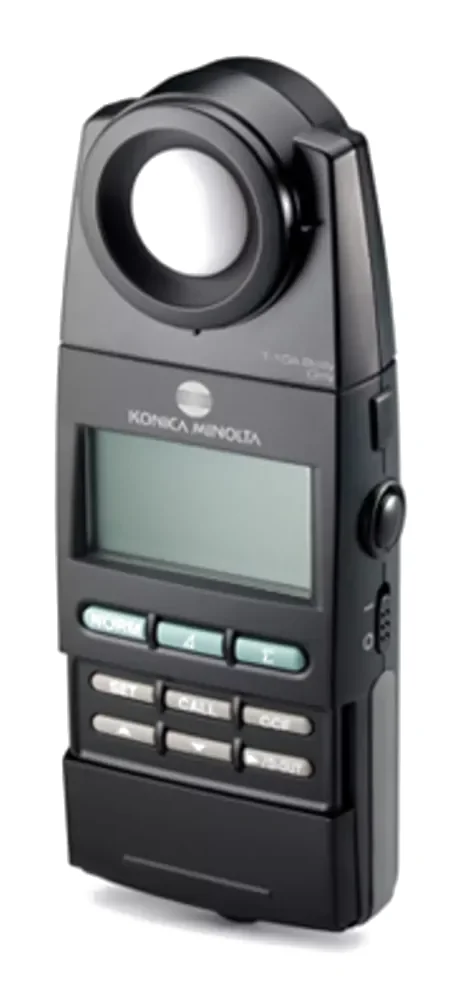
T-10A / T-10MA Illuminance Meter
T-10A is a multifunction digital illuminance meter that measures illuminance between 0.01 and 299,900 lx. The T-10MA model, with its small-diameter, cabled mini receptor head, allows measurements in confined spaces.
Request a quote| Measurement range | 0.01 – 299,900 lx |
|---|---|
| Class | JIS C 1609-1:2006 AA, DIN 5032-7 B |
| Accuracy | ±2% ±1 digit |
| Receptor | T-10A Ø25 mm, T-10MA Ø14 mm (with 1 m cable) |
| Multi-point measurement | Up to 30 receptor heads |
Product description
T-10A is a multifunction digital illuminance meter used as a reference in lighting measurement. Illuminance is measured in lux or foot-candles between 0.01 and 299,900 lx with automatic range selection. The instrument meets the requirements of JIS C 1609-1:2006 Class AA and DIN 5032 Part 7 Class B.
In addition to the absolute illuminance value, the difference and percentage ratio relative to a target value, integrated illuminance, integration time and average illuminance are also calculated. The target value is defined either by measurement or by entry from the keypad.
The T-10MA model has a mini receptor head with a diameter of 14 mm and a 1 m cable. This head is designed for measurements in narrow and enclosed spaces where the standard head does not fit.
Applications
- Official lighting inspections and testing organizations
- ANSI lumen measurement of projectors
- R&D at lighting manufacturers and quality control of household lighting products
- Lighting maintenance and repair checks in factories, offices and hospitals
- Monitoring of light levels in agriculture and forestry applications
- Comparative checks of commercial light sources
Key features
Accurate measurement of PWM-dimmed LEDs
The receptor design ensures accurate measurement of LED lighting dimmed by pulse-width modulation (PWM). This feature is decisive in modern buildings where dimmable LED luminaires are common.
Detachable head and multi-point measurement
With optional adapters, the receptor head can be detached from the body to eliminate shadows and reflections caused by the user. With additional heads, 30 measurement points can be connected to a single instrument and all functions are measured in matrix form.
Analog and digital output
Connected to a computer via USB, the instrument can be used for remote control and data logging. The analog output allows connection to test setups in which illuminance is monitored continuously. Frequently used functions are accessed with three buttons; other settings are located under the sliding cover.
Illuminance meter selection criteria
If light color and color temperature are to be measured in addition to illuminance, the CL-200A is more suitable. For applications requiring the color rendering index (CRI) and spectral distribution, the CL-70F or CL-500A should be considered.
The standard head is preferred for general lighting measurements, while the T-10MA mini head is preferred for measurements inside equipment or in confined spaces. Both heads can be used with the same body.
Other models in the category are listed under light and display measuring instruments. The performance characteristics of illuminance meters are defined in the CIE publication on illuminance and luminance meters.
Technical specifications
| Type | Multifunction digital illuminance meter with detachable receptor head |
|---|---|
| Illuminance meter class | JIS C 1609-1:2006 Class AA; DIN 5032 Part 7 Class B |
| Receptor | Silicon photocell; T-10A diffuser window Ø25 mm, T-10MA Ø14 mm (1 m cable) |
| Spectral match (f1') | Within 6% of the V(λ) curve |
| Cosine correction | Within ±1% at 10°, ±2% at 30°, ±6% at 50°, ±7% at 60°, ±25% at 80° |
| Unit | Lux (lx) or foot-candle (fcd), selectable |
| Measurement range | 0.01 – 299,900 lx / 0.001 – 29,990 fcd, auto-ranging |
| Integrated illuminance | 0.01 – 999,900 × 10³ lx·h; 0.001 – 9,999 hours |
| Measurement functions | Illuminance, illuminance difference, illuminance ratio (%), integrated illuminance, integration time, average illuminance |
| Accuracy | ±2% ±1 digit of displayed value |
| Temperature and humidity drift | Within ±3% ±1 digit |
| User calibration | Color correction factor (CCF) setting |
| Outputs | Digital: USB; analog: 1 mV/digit, 3 V at maximum reading |
| Power | 2 × AA batteries or optional AC adapter; over 72 hours of continuous measurement with alkaline batteries |
| Operating environment | -10 – 40 °C, below 85% relative humidity (at 35 °C), non-condensing |
Values are taken from the manufacturer's published technical documentation. They may vary by configuration and are confirmed against the current datasheet before quotation.
Frequently asked questions
What does an illuminance meter measure?
An illuminance meter measures the amount of visible light falling on a surface, i.e. the illuminance level. The result is given in lux (lx); one lux corresponds to a luminous flux of one lumen falling on one square meter.
What do JIS Class AA and DIN Class B mean?
These classes indicate that properties of the illuminance meter such as spectral match, cosine correction and linearity meet the limits defined in the standard. Instruments with a specified class are expected to be used for official measurements and reports.
What is the difference between the T-10A and T-10MA?
Both models use the same body; the difference is in the receptor head. The T-10A has a standard head with a diameter of 25 mm, while the T-10MA has a mini head with a diameter of 14 mm and a 1 m cable.
Are measurements reliable on dimmable LEDs?
The T-10A receptor is designed to measure accurately under LED lighting dimmed by PWM; it therefore provides reliable results on dimmed LED luminaires as well.
From the same category
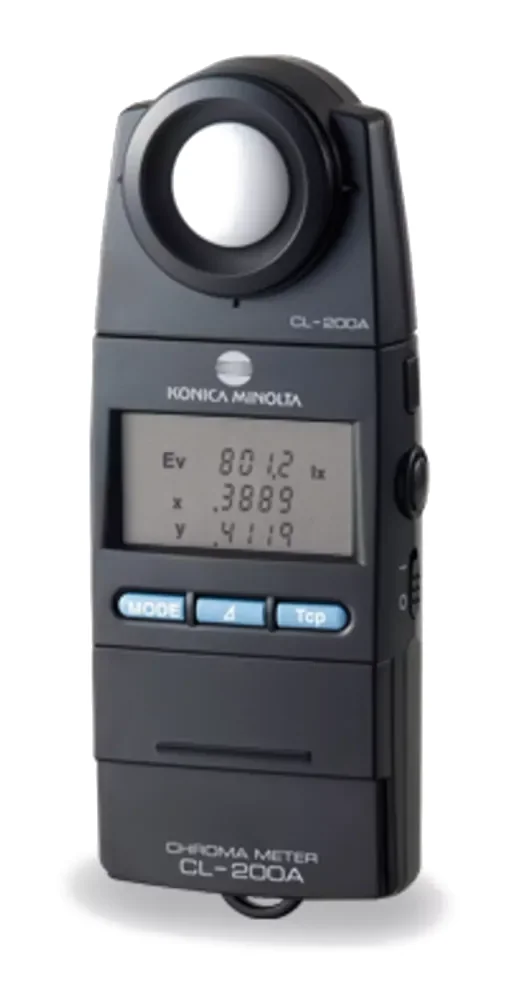
CL-200A Illuminance and Light Color Meter
Portable light meter that measures illuminance, color temperature and chromaticity coordinates in a single instrument.
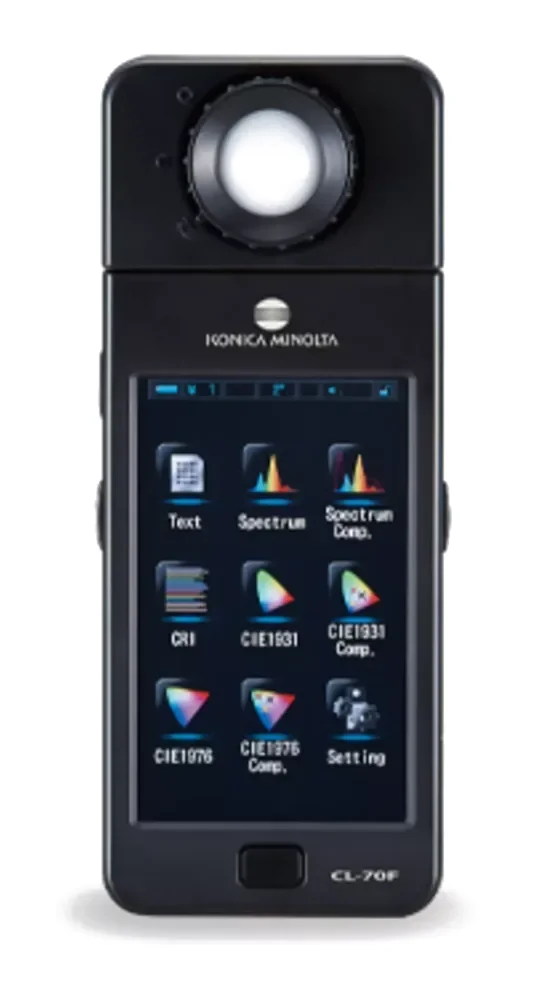
CL-70F CRI Illuminance Meter
Touchscreen instrument with a spectral sensor that measures illuminance, color temperature and color rendering index (CRI).
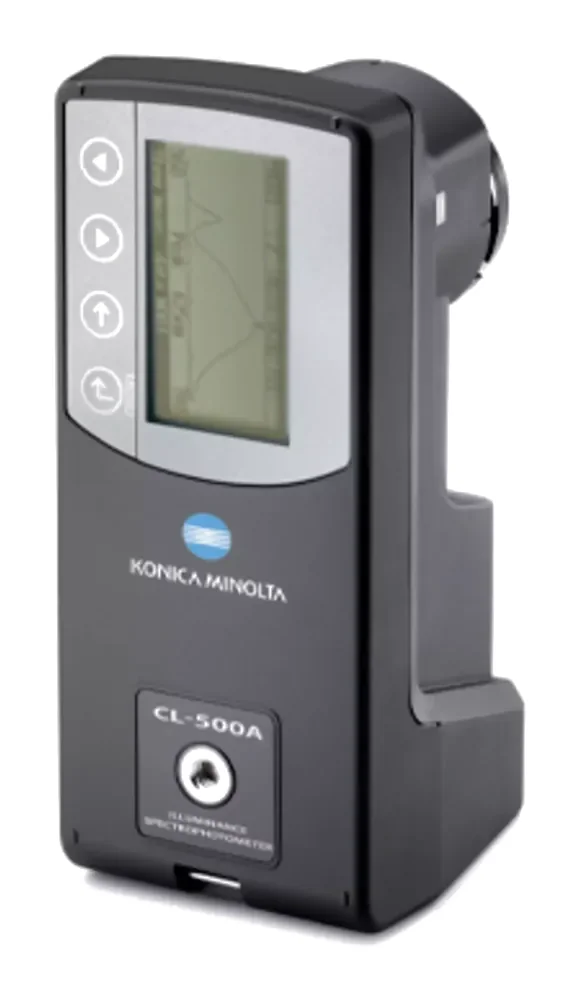
CL-500A Spectral Illuminance Meter
Portable spectral instrument that measures illuminance, color temperature, CRI and spectral distribution of light sources, including LEDs and OLEDs.
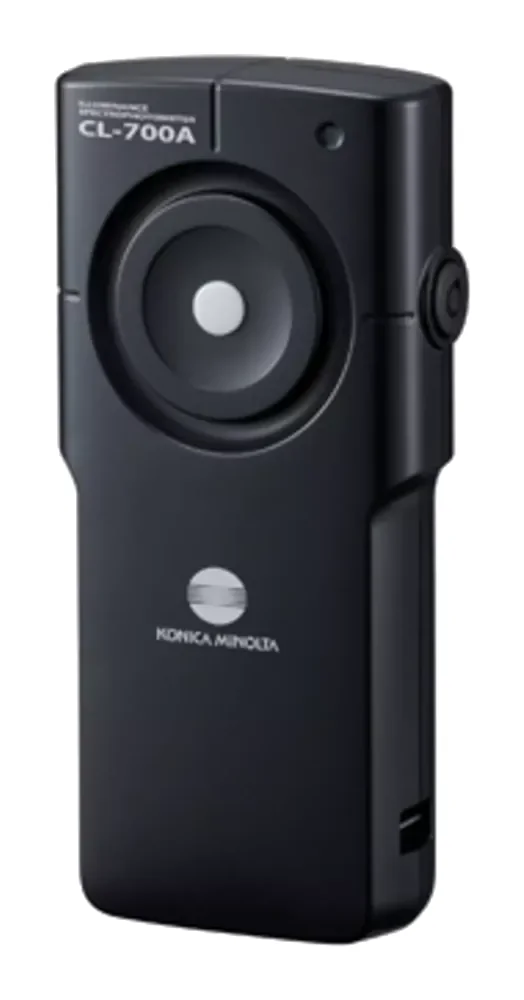
CL-700A Illuminance Spectrophotometer
Illuminance spectrophotometer measuring over 360-1000 nm, starting from 0.01 lx, with Ethernet network connectivity.
Request a quote for this model
A suitable configuration and pricing are prepared based on sample type and workload.
Request a quote