What does a lux meter measure?
A lux meter measures the amount of light falling on a surface, that is, the illuminance level, in lux (lx). One lux corresponds to a luminous flux of one lumen falling on one square meter. The measurement is weighted according to the V(λ) curve, which describes the sensitivity of the human eye to different wavelengths; for this reason, a lux meter quantifies not physical radiation but the light perceived by the eye.
Workplace lighting audits, verification of adequate light in offices and production areas, and on-site checking of lighting projects are the main applications of a lux meter. However, with the spread of LED lighting, not only the quantity of light but also its color and quality have become parameters that need to be measured.
Parameters that determine accuracy in lux meter selection
Two lux meters can show different values under the same light. The source of this difference is mostly how closely the sensor matches the sensitivity of the eye and how it evaluates obliquely incident light.
Spectral match (f1')
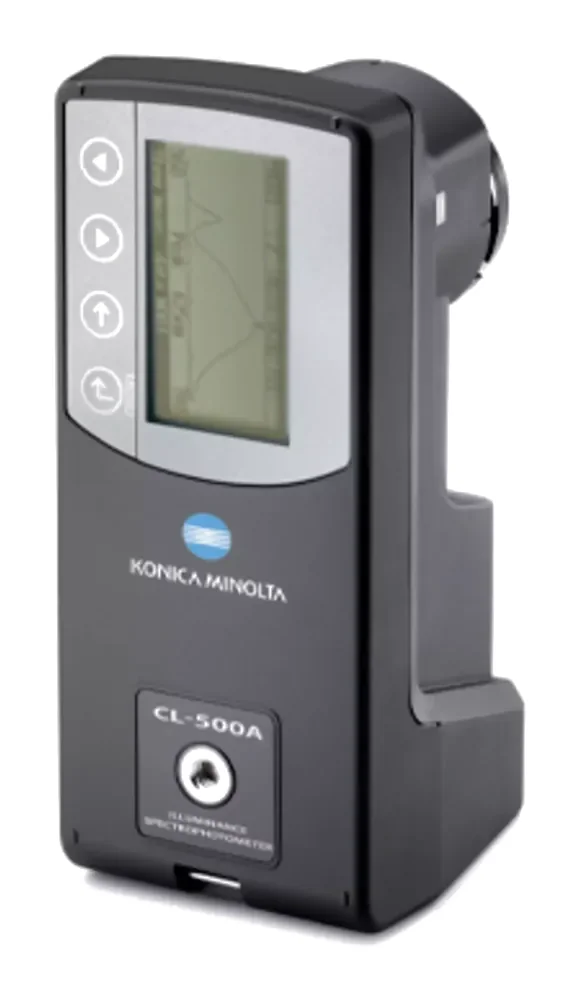
This indicates the deviation of the sensor response from the V(λ) curve. The smaller the value, the more consistent the results the instrument gives under different light sources. For example, this deviation is specified within 1.5% for the CL-500A spectral illuminance meter, while a value of around 6% is common for tristimulus-based instruments.
Cosine correction (f2)
Light does not always reach the sensor perpendicularly. To correctly evaluate light arriving laterally from ceiling luminaires, the sensor head is equipped with a cosine-corrected diffuser. The smaller this value, the more reliable the measurement under wide-angle lighting.
Instrument class
Lux meters are classified according to their accuracy. In the Japanese JIS C 1609-1 standard, class AA denotes the highest accuracy and class A general-purpose precision measurement; the German DIN 5032-7 standard has a similar class system. International comparison criteria are defined in the CIE publication on the performance of illuminance and luminance meters.
For audit and reporting measurements, stating the instrument class and calibration date in the report allows the result to be compared with another measurement.
Illuminance, color temperature and CRI: which measurement with which instrument?
Light meters can be considered in three groups according to the quantity they measure. The selection is based on the parameter that needs to be reported.
- Illuminance level only: A classic lux meter is sufficient. The T-10A / T-10MA digital lux meter is used in both field audits and production control thanks to its measuring range starting from 0.01 lx, detachable receptor head and compatibility with PWM-driven LEDs.
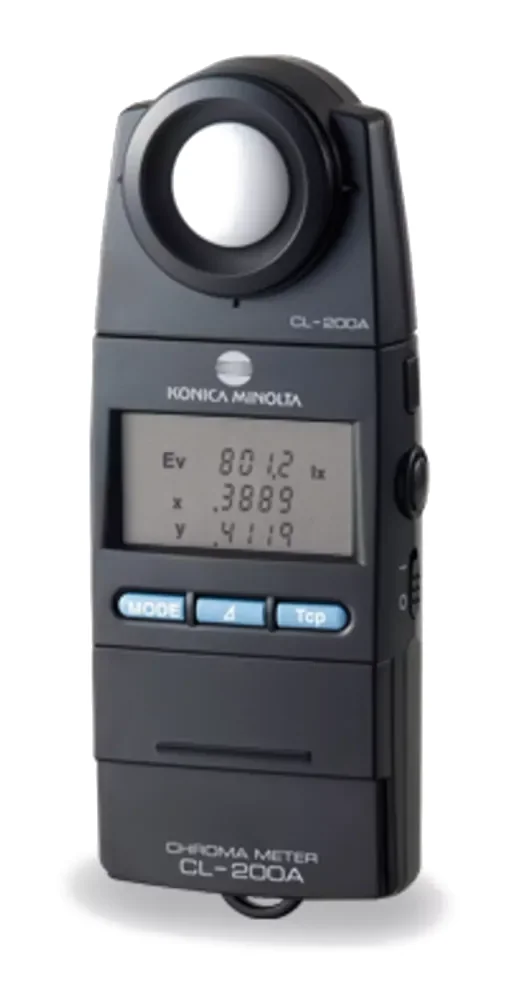
- Illuminance and light color: If color temperature (CCT), Δuv and chromaticity coordinates are needed, a tristimulus-based light meter is preferred. The CL-200A color temperature meter provides xy and u'v' coordinates together with the lux value.
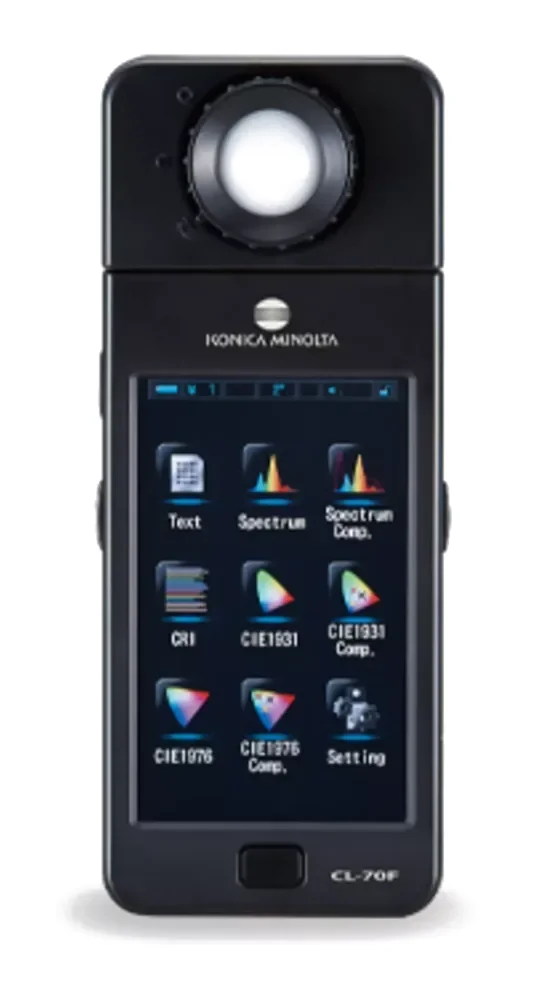
- Color rendering and spectrum: If CRI (Ra and Ri values) or spectral distribution is needed, an instrument with a spectral sensor is required. The CL-70F CRI meter and the CL-500A belong to this group.
Color temperature defines the warm or cool appearance of light in Kelvin. CRI expresses how accurately a light source renders object colors compared with a reference source. Ra is the average of the first eight test colors; the R9 value, representing saturated red, is also monitored separately in food, textile and museum lighting.
Color temperature and object color measurement are often confused. To measure surface color, a color meter or spectrophotometer is used, not a light meter; the difference is explained in the article the difference between a spectrophotometer and a colorimeter.
Light meter selection by application
Workplace and building lighting audits
In spaces such as offices, warehouses, production areas and schools, the aim is to document whether the illuminance on the working plane meets the target value. Measurement speed, portability and data logging are key here. A lux meter with a detachable head keeps the shadow of the person measuring away from the result and makes measurement easier in confined spaces.
LED and luminaire manufacturing
On the production line, every luminaire is expected to emit the same light color. For this reason, color temperature and Δuv are monitored in addition to illuminance. Instruments that measure chromaticity coordinates are used to catch batch-to-batch color deviations; where spectrum comparison is needed, a spectral instrument is preferred.
Photography, film and broadcast lighting
The color and color rendering of the light in front of the camera determine image quality. Instruments that can measure both flash and continuous light and show CRI and color temperature together offer a practical solution in this field.
Plant cultivation and research
What affects plant growth is not the light perceived by the eye but photosynthetically active radiation. For this reason, in greenhouse and vertical farming applications, the PPFD value is reported instead of lux, and measurement over a wide spectral range is required.
When are spectral light measuring instruments needed?
A spectral instrument measures light by separating it into wavelengths and calculates illuminance, color temperature and color rendering values from this spectrum. This approach reveals situations such as different LEDs having the same CCT value but showing different color quality.
- Batch control and spectrum comparison in LED and luminaire manufacturing
- Reporting next-generation color quality metrics such as TM-30 in lighting design
- Photosynthetic photon flux density (PPFD) measurement in plant growth lighting
- Spectral verification of displays, backlights and indicator lighting
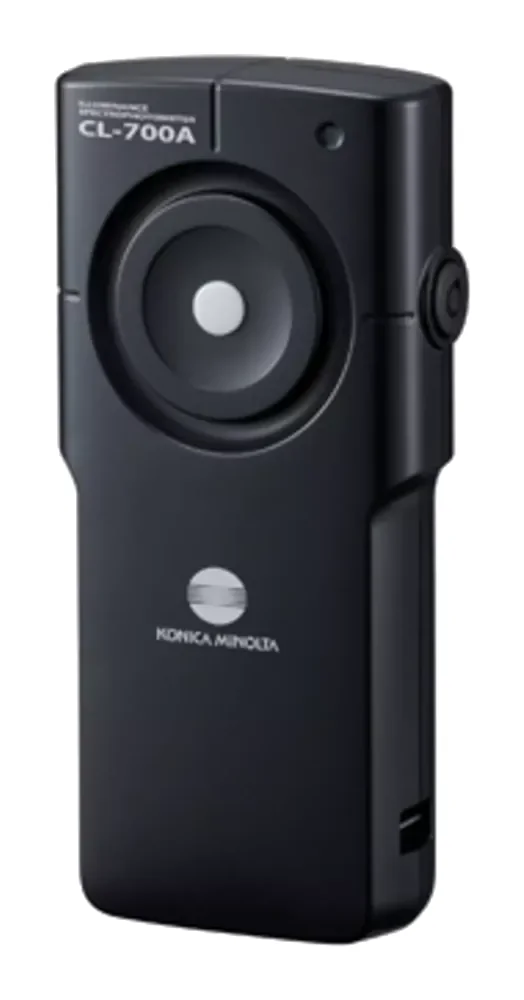
For these needs, the CL-700A illuminance spectrophotometer stands out with its 360–1000 nm range and TM-30, TLCI and PPFD calculations. Thanks to its Ethernet connection, it is also used for continuous monitoring at fixed measurement points.
Multi-point measurement and correct measurement practice
In large areas, illuminance uniformity cannot be evaluated from a single point. On instruments that support detachable receptor heads, several heads are read simultaneously; the CL-200A and T-10A can be expanded to up to 30 receptor heads in this way. This allows changes at all points to be monitored simultaneously while luminaires are being adjusted.
- The measurement height is stated in the report; the working plane and floor level give different results.
- The shadow of the person measuring, or light reflected from their clothing, affects the result; a head with an extension cable reduces this error.
- Newly switched-on lamps are allowed to stabilize their light output before measurement.
- In areas where daylight is mixed in, the time of measurement and weather conditions are recorded.
All light measuring instruments are summarized on the light and display measuring instruments page, and measurement principles on the laboratory technologies page.
Common lux meter mistakes
- Not holding the sensor head parallel to the measurement plane; even a tilt of a few degrees can change the result.
- Neglecting zero adjustment and head cleaning; dirt and fingerprints on the diffuser lower the reading.
- Using an instrument that cannot correctly evaluate fast flicker in PWM-driven LEDs.
- Directly comparing the results of two instruments of different classes.
- Changing the measurement points and height at every audit; the same grid should be used for regular monitoring.
In repeated audits, measurement points are marked on a floor plan. This makes it possible to distinguish whether a change in illuminance is caused by luminaire aging or by measurement position.
Quick checklist for lux meter selection
- Quantity to be reported: lx, CCT, Δuv, CRI, TM-30 or PPFD
- Required instrument class and calibration traceability
- Measuring range: very low illuminance (emergency, night) or very high illuminance (daylight, stage)
- Light source type: PWM-driven LED, flash or continuous light
- Single-point or simultaneous multi-point measurement
- Data transfer: USB, network connection, software and memory
The answers to these questions largely clarify the choice between an entry-level lux meter and a spectral measurement system. If color and surface measurement are also required, color and gloss measuring instruments can be evaluated within the same quality control workflow.
Frequently asked questions
Can smartphone apps be used instead of a lux meter?
Phone cameras and ambient light sensors are not calibrated for V(λ) match and cosine correction. They can give a rough idea; however, audits, project handover or quality control require a calibrated lux meter of a defined class.
Why do different lux meters show different values when measuring LEDs?
An LED spectrum consists of narrow peaks. A sensor with poor spectral match weights these peaks differently from the sensitivity of the eye, and the deviation increases. Instruments with high spectral match or spectral measurement reduce this difference.
Which instrument is needed to measure CRI?
CRI is calculated from the spectrum of the light. For this reason, a tristimulus-based color temperature meter is not sufficient; a CRI meter with a spectral sensor or a spectral illuminance meter is used.
How often should a lux meter be calibrated?
Sensors and filters age over time. Although it varies with intensity of use and the quality system, annual calibration is common practice; for regulated measurements, the calibration certificate is retained.