How is color converted into numbers?
The color of a surface depends on the light source, the reflective properties of the surface and the observer. The International Commission on Illumination (CIE) standardized these three elements, making it possible to express color numerically. The measured color is converted into XYZ tristimulus values and from there into color spaces such as L*a*b*. The basis of the method is defined in the CIE Colorimetry publication.
All color measuring instruments produce these numerical values. The difference between them lies in how they arrive at the values and how much information can be extracted from the measurement.
How does a colorimeter (color meter) work?
A colorimeter works with three-filter sensors that mimic the color perception of the human eye. For this reason it is also called a tristimulus color meter. In a single measurement, the instrument directly provides XYZ values and the color difference (ΔE*ab) calculated from them.
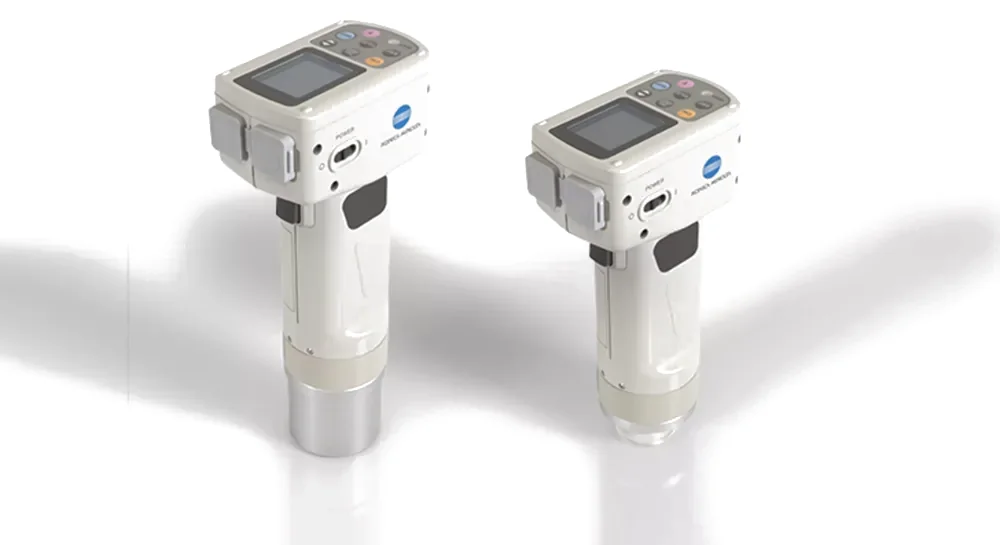
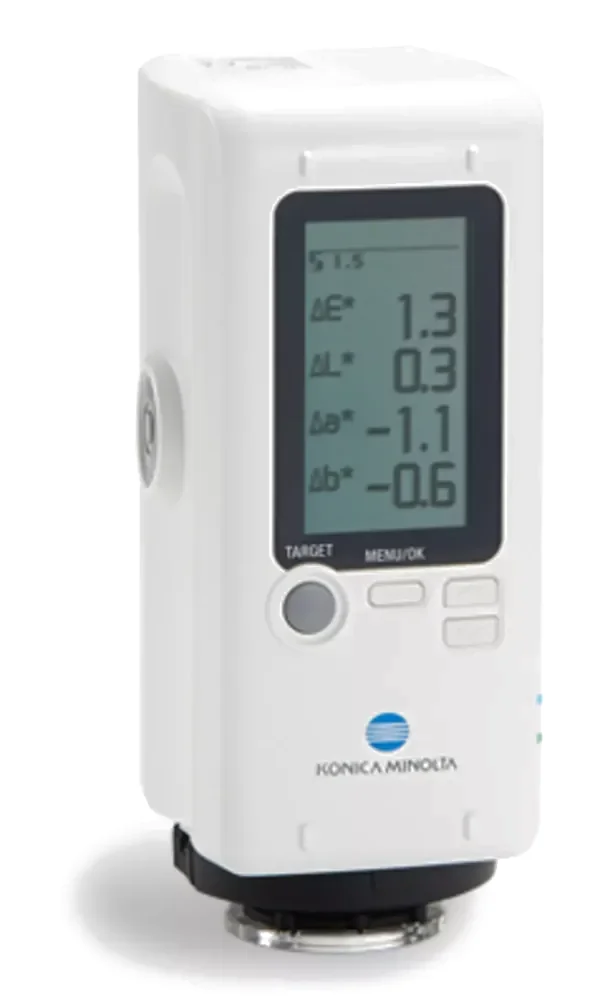
The strength of a colorimeter is its simplicity and speed. It is suitable for comparison against a reference sample on the production line and for obtaining the average color of powder or granular products. For example, the CR-400 / CR-410 portable color meter measures with d/0° geometry and gives results under illuminants C and D65. For simpler pass/fail checks, the CR-10 Plus compact color reader can be used.
A colorimeter gives results under a limited number of illuminants. For this reason, it cannot always distinguish two samples that look different under different lights.
How does a spectrophotometer work?
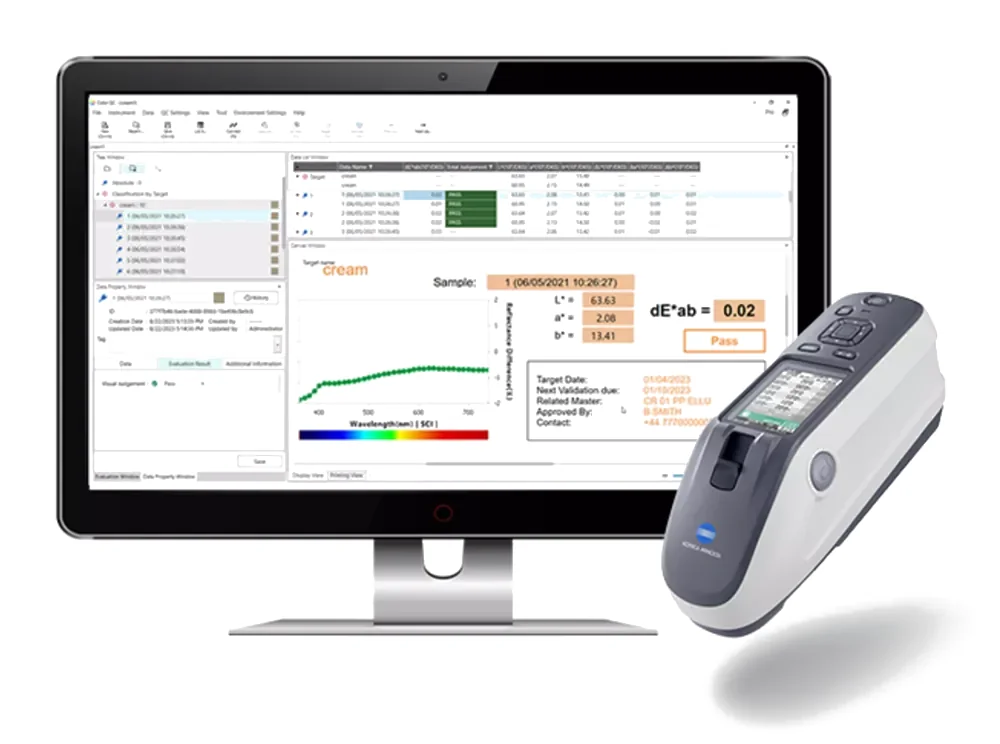
A spectrophotometer measures how much light the sample reflects at each wavelength in the visible range. The result is a reflectance curve; color values are calculated from this curve for the desired illuminant and observer angle. In this way, the color under D65, A or F-series illuminants is obtained separately from the same measurement.
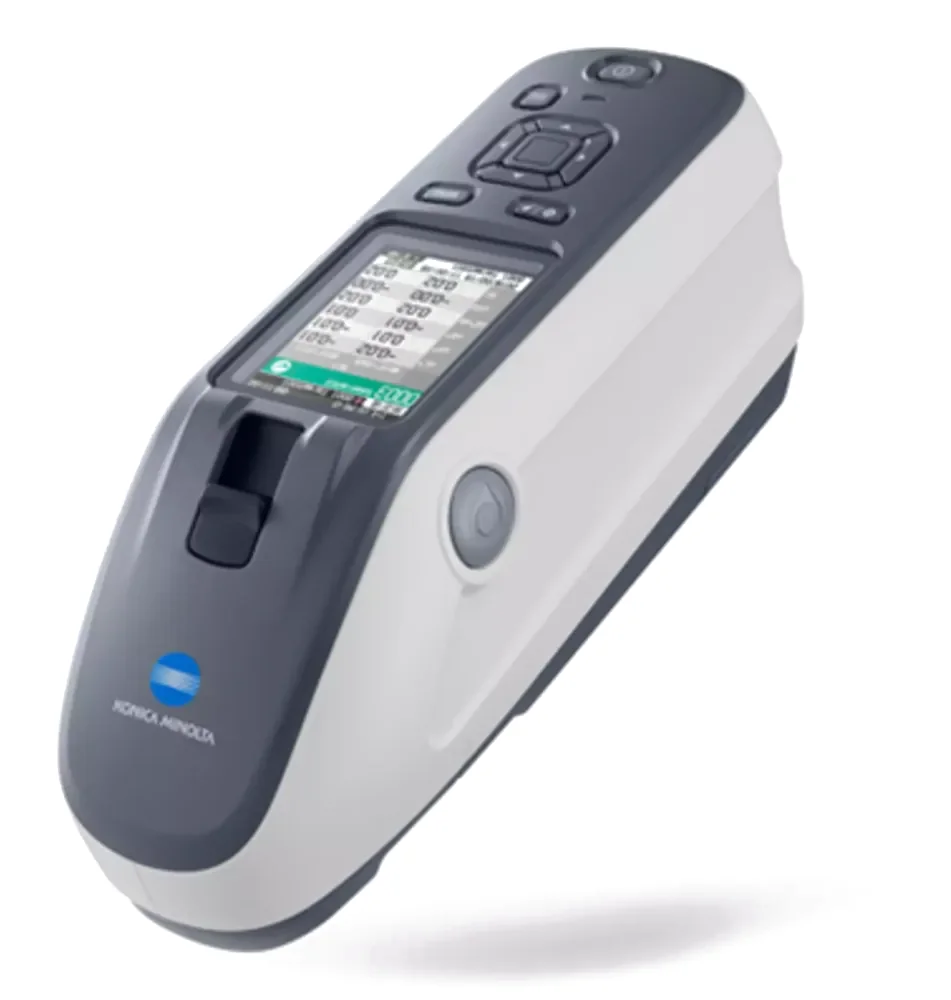
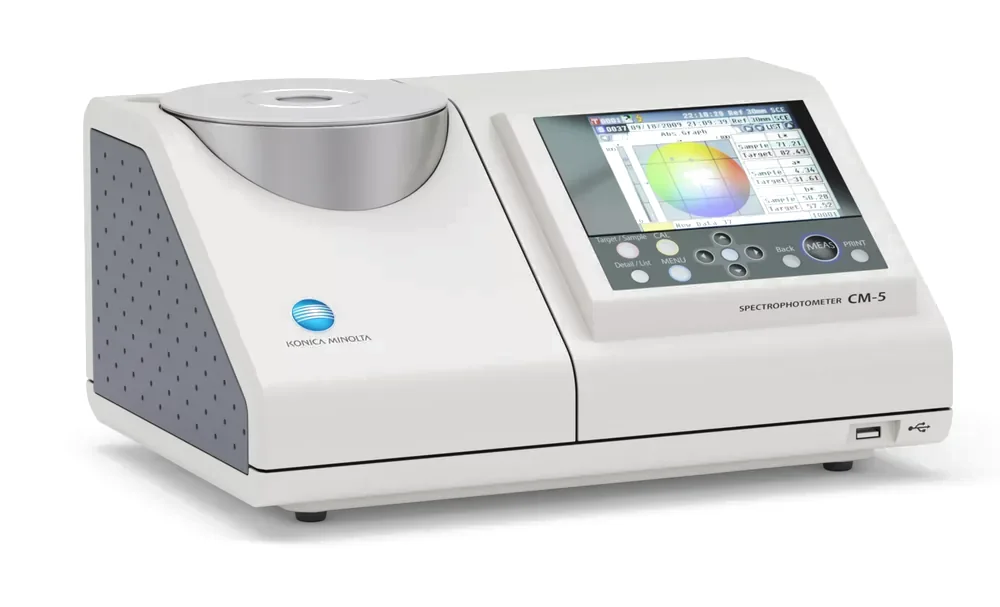
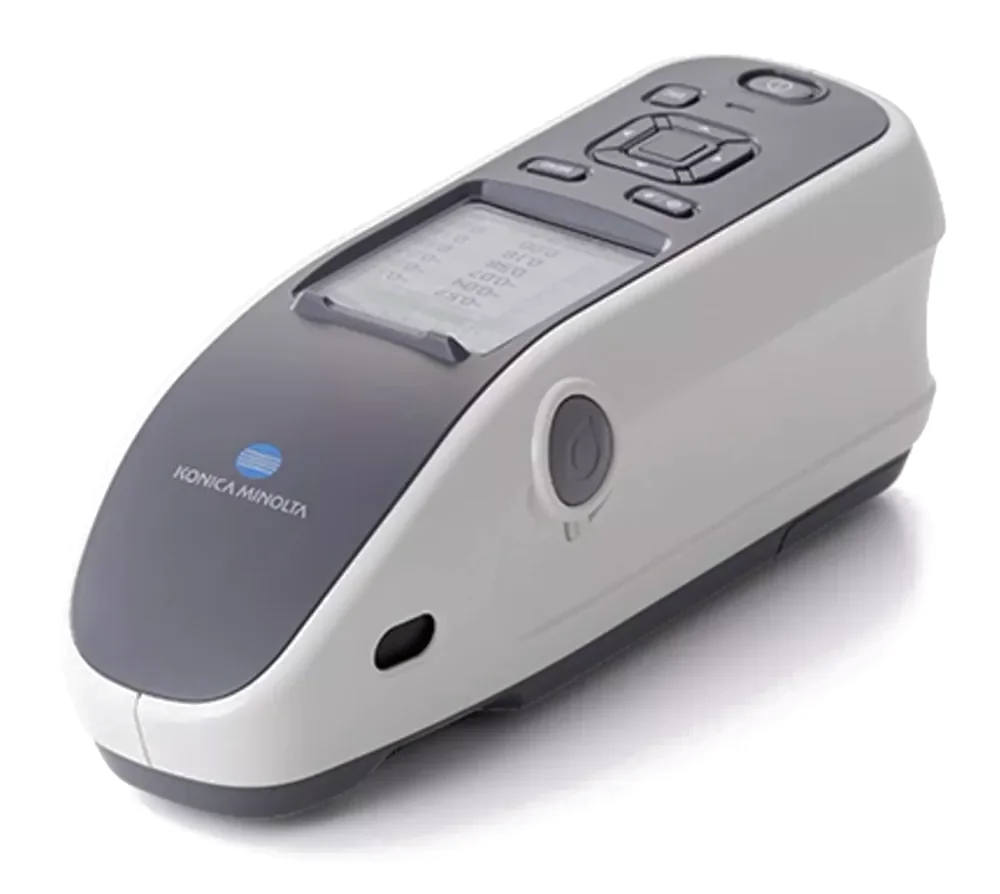
Beyond calculating color values, spectral data is also used for formulation correction, color matching and metamerism analysis. Calculation methods are defined in the ASTM E308 standard. Examples include the CM-25d portable spectrophotometer for field use and the CM-5 top-port spectrophotometer for liquid and solid samples in the laboratory.
Metamerism: the most important difference
Metamerism is when two samples look the same under one light and different under another. This is usually caused by the samples being colored with different pigments. For example, a plastic part and a painted metal surface may appear to match under store lighting but differ in daylight.
Because a colorimeter measures under a single illuminant, it may find the two samples identical. A spectrophotometer, on the other hand, directly shows that the reflectance curves are different and calculates the color difference under different illuminants separately. For this reason, a spectrophotometer is preferred for color matching, supplier approval and formulation development.
Spectrophotometer vs colorimeter: which to choose and when?
- A colorimeter is sufficient for: comparing products made from the same material and pigment against a reference, pass/fail checks, and fast color monitoring of food and incoming raw materials.
- A spectrophotometer is required for: color matching of parts made from different materials, formulation development, metamerism control, products containing optical brighteners, and a common color standard across multiple sites or suppliers.
- Both together: the standard is set with a spectrophotometer in the laboratory, and fast monitoring is done with a colorimeter on the production line.
Measurement geometry is also decisive in the selection. d/8° geometry can measure with the specular component included (SCI) or excluded (SCE) and is used to evaluate the true color of the material. 45°/0° geometry is closer to the way the eye perceives a surface; the CM-25cG spectrophotometer with circumferential illumination is an example of this approach. If surface gloss is also important, the angle selection in gloss measurement guide provides direction.
Measurement geometry: d/8° and 45°/0°
Regardless of instrument type, how light is directed onto the sample and from which angle it is read affects the result. Two main geometry families are used in color measurement.
- d/8° (sphere geometry): The sample is illuminated from all directions inside an integrating sphere and read at an 8° angle. It is less affected by surface texture and is suitable for evaluating the color of the material. It is common in textile, plastics and paint formulations.
- 45°/0° (directional geometry): Light arrives at a 45° angle and is read perpendicularly. Because it excludes specular reflection, it is close to the appearance seen by the eye. It is preferred for printing, packaging and surfaces where appearance is the priority.
Results obtained with the two geometries are not interchangeable. The difference is pronounced especially on textured or glossy surfaces. For this reason, when a color standard is defined, the measurement geometry, illuminant and observer angle are specified together. For metallic and effect-pigment paints, a single geometry is not enough; these surfaces are measured from different viewing angles with a multi-angle spectrophotometer.
The path to the right instrument
Sample preparation and measurement conditions
How the sample is measured determines the result as much as the choice of instrument. Two measurements taken with the same instrument can diverge if the sample preparation differs.
- Powder and granular samples are measured in a container that ensures a constant fill level and a flat surface.
- For translucent samples, the background (white or black) is kept constant and stated in the report.
- On textured surfaces, measurements are taken at several points and in different directions, and their average is used.
- For temperature-sensitive colors (thermochromic effect), the measurement temperature is recorded.
Choosing a measurement area appropriate to the sample size is also important. A small measurement aperture gives a more representative result for small parts, and a large aperture for non-homogeneous samples.
Tolerances and data management
The purpose of color quality control is not only to measure, but to decide whether the measured difference is acceptable. For this decision, a tolerance is defined for each product. Instead of ΔE*ab, color difference formulas such as CMC or CIEDE2000, which give results closer to visual perception, can also be used.
Managing tolerances, reference standards and measurement history in a single software package ensures that supplier and customer work with the same data. The spectral data provided by a spectrophotometer offers more flexibility than a colorimeter in this kind of data management.
Instrument and software selection
It is recommended to start instrument selection from the sample type: flat and opaque surfaces, powders, granules, liquids or transparent films require different measurement setups. Next, the tolerance level, measurement frequency and how the data will be reported are determined. All color measurement options are compared on the color and gloss measuring instruments page.
SpectraMagic NX2 color measurement software can be used for tolerance evaluation and reporting of measurement data. A general overview of color measurement technology is on the laboratory technologies page.
Frequently asked questions
Can values measured with a colorimeter be compared with a spectrophotometer?
When the same illuminant, observer angle and measurement geometry are used, the values are close; however, if instrument types and geometries differ, the results are not directly comparable. For a common standard, all parties must use the same measurement conditions.
What do SCI and SCE mean?
SCI measurement also takes into account light specularly reflected from the surface and gives the material color independent of gloss. SCE excludes the specular component and is closer to the appearance seen by the eye.
What should the ΔE*ab value be?
The acceptable color difference varies by industry and product. The tolerance is determined between customer and supplier together with visual assessment; there is no single universal value.
Which instrument is used to measure the color of liquid samples?
Transparent liquids are measured in transmittance mode. For this measurement, benchtop spectrophotometers with a cuvette compartment or benchtop color meters that measure transmittance are used.