

Konica Minolta
CR-10 Plus Compact Color Reader
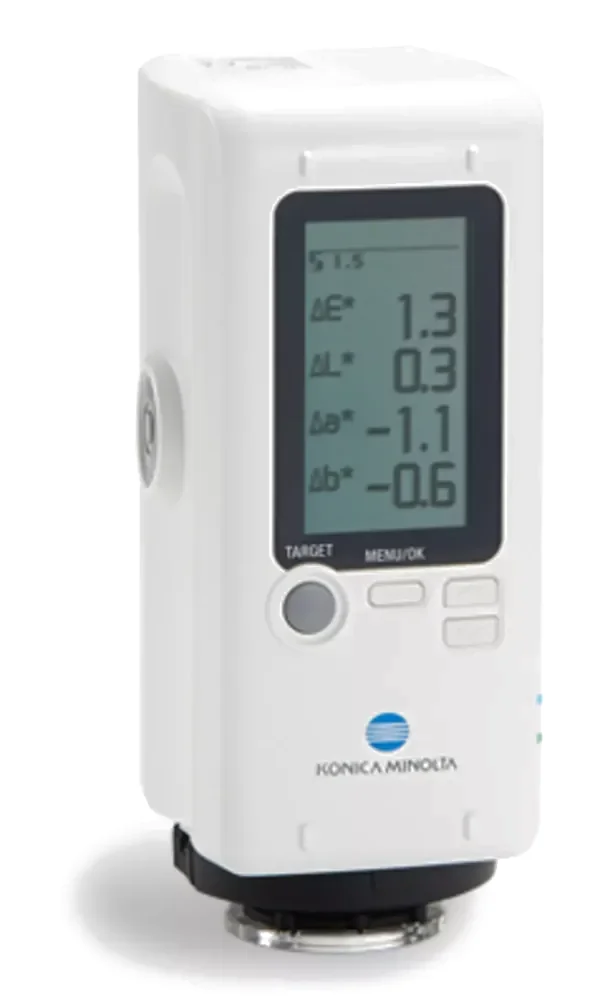
The CR-10 Plus is a compact color reader designed for color difference control. With its Ø8 mm aperture, it gives the ΔE*ab difference between a reference and a sample within seconds under D65 illuminant and 10° observer conditions.
Request a quote| Optical geometry | 8°:di, SCI |
|---|---|
| Measurement aperture | Ø8 mm; optional Ø5 mm |
| Illuminant / observer | D65 / 10° |
| Repeatability | Within ΔE*ab 0.1 standard deviation |
| Weight | Approx. 420 g (without batteries) |
Product description
The CR-10 Plus is a compact color reader designed to take color control beyond the laboratory. The reference sample is measured first; the display then shows how far the inspected sample deviates from this reference as ΔL*, Δa*, Δb* and ΔE*ab.
Measurement is performed with 8°:di geometry, specular component included (SCI). A pulsed xenon lamp and six silicon photocells are used; three photocells are for measurement and three for monitoring the illumination. The standard aperture is Ø8 mm, and a Ø5 mm measurement set for small parts is offered as an option.
The instrument runs on 4 AA batteries, USB bus power or an optional AC adapter. 1,000 target and measurement data sets are stored in memory.
Applications
The manufacturer positions the instrument for rapid color difference control, primarily in the plastics and food industries.
- Color difference control of plastic parts and pellets against a reference
- Rapid color control of food products on the production line
- Comparison of supplier samples with the approved sample at goods receipt
- Preliminary checks at points without a spectrophotometer
Technical evaluation of the compact color reader
The measurement range is L* 10 to 100. In measurements on the standard white plate, repeatability remains within ΔE*ab 0.1 standard deviation; the minimum interval between two measurements is approximately 3 seconds. Approximately 2,000 measurements at 10-second intervals can be taken on alkaline batteries.
The instrument operates only under D65 illuminant and 10° observer conditions; absolute color values for targets are displayed as L*a*b* or L*C*h. This design positions the instrument as a tool for comparison against a reference.
Color readers do not provide evaluation under different illuminants or spectral data. A spectrophotometer should be used for products with suspected metamerism or for color formulation.
A color reader is used for comparison against a reference rather than for absolute color measurement. The approved reference sample is therefore stored protected from light and dirt and renewed at regular intervals. During measurement, the instrument is held perpendicular to the sample with the aperture fully covered; on glossy surfaces, the measurement position is kept the same each time.
Selection criteria
For monitoring the bake color of baked goods on the BCU scale, the BC-10 Plus on the same platform is suitable. If large-area averaging is required for powder and granular samples, the CR-410 with Ø50 mm aperture should be considered; if spectral data and SCI/SCE measurement are required, the CM-23d should be considered.
Other models in the category are listed under color and gloss measuring instruments. Color difference is expressed as ΔE*ab in the CIE 1976 L*a*b* color space.
Technical specifications
| Optical geometry | 8°:di, SCI (DIN 5033 Teil 7, JIS Z 8722 condition d, ISO 7724/1, CIE No.15, ASTM E1164) |
|---|---|
| Light source | Pulsed xenon lamp |
| Detector | 6 silicon photocells (3 for measurement, 3 for illumination monitoring) |
| Measurement / illumination area | Ø8 / Ø11 mm; optional Ø5 / Ø5 mm |
| Display | L*a*b* or L*C*h (target); ΔL*, Δa*, Δb*, ΔC*, ΔH*, ΔE*ab |
| Measurement range | L*: 10–100 |
| Illuminant / observer | D65 / 10° |
| Repeatability | Within ΔE*ab 0.1 standard deviation |
| Minimum measurement interval | Approx. 3 s |
| Memory | 1,000 (target and measurement data) |
| Power | 4 × AA batteries, USB bus power or optional AC adapter |
| Battery life | Approx. 2,000 measurements with alkaline batteries (10 s interval) |
| Dimensions | 66 × 158 × 85 mm |
| Weight | Approx. 420 g (without batteries) |
| Operating environment | 0–40 °C, below 85% relative humidity, non-condensing |
Values are taken from the manufacturer's published technical documentation. They may vary by configuration and are confirmed against the current datasheet before quotation.
Frequently asked questions
When is a color reader sufficient?
A color reader is sufficient for routine work where an approved reference sample exists and the difference of the inspected product from this reference is monitored. If absolute color definition, evaluation under different light sources or formulation work is required, a spectrophotometer should be preferred.
Can small parts be measured?
The standard measurement area is Ø8 mm. For smaller surfaces, the optional measurement set with Ø5 mm aperture can be used.
What is the difference between a colorimeter and a spectrophotometer?
A colorimeter measures tristimulus values directly with three filters approximating the color sensitivity of the human eye; it is a fast and economical solution for color difference control. A spectrophotometer measures reflectance wavelength by wavelength; it is required for tasks such as evaluation under different illuminants, metamerism analysis and color formulation.
From the same category
CM-26dG / CM-26d Portable Spectrophotometer
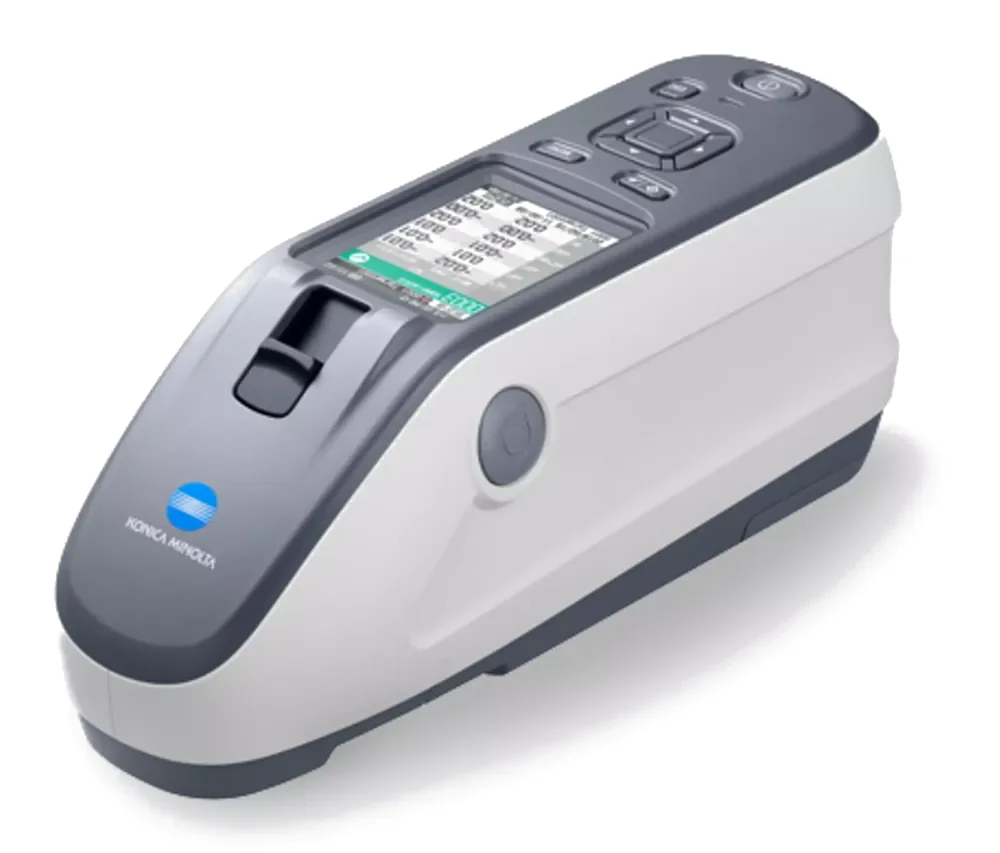
Portable spectrophotometer that captures color and 60° gloss in a single measurement and measures SCI and SCE simultaneously.
CM-25d Portable Spectrophotometer
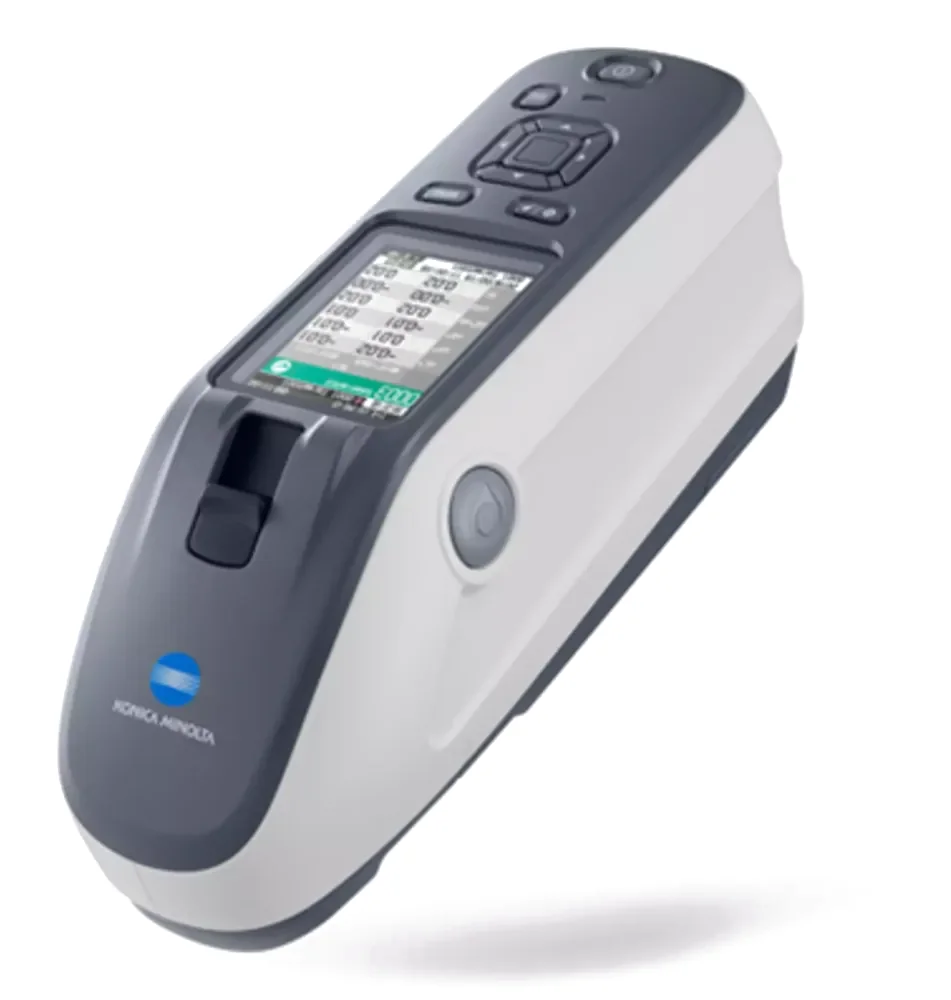
Single-aperture portable spectrophotometer that measures SCI and SCE simultaneously and operates in the 400–700 nm range.
CM-23d Portable Spectrophotometer
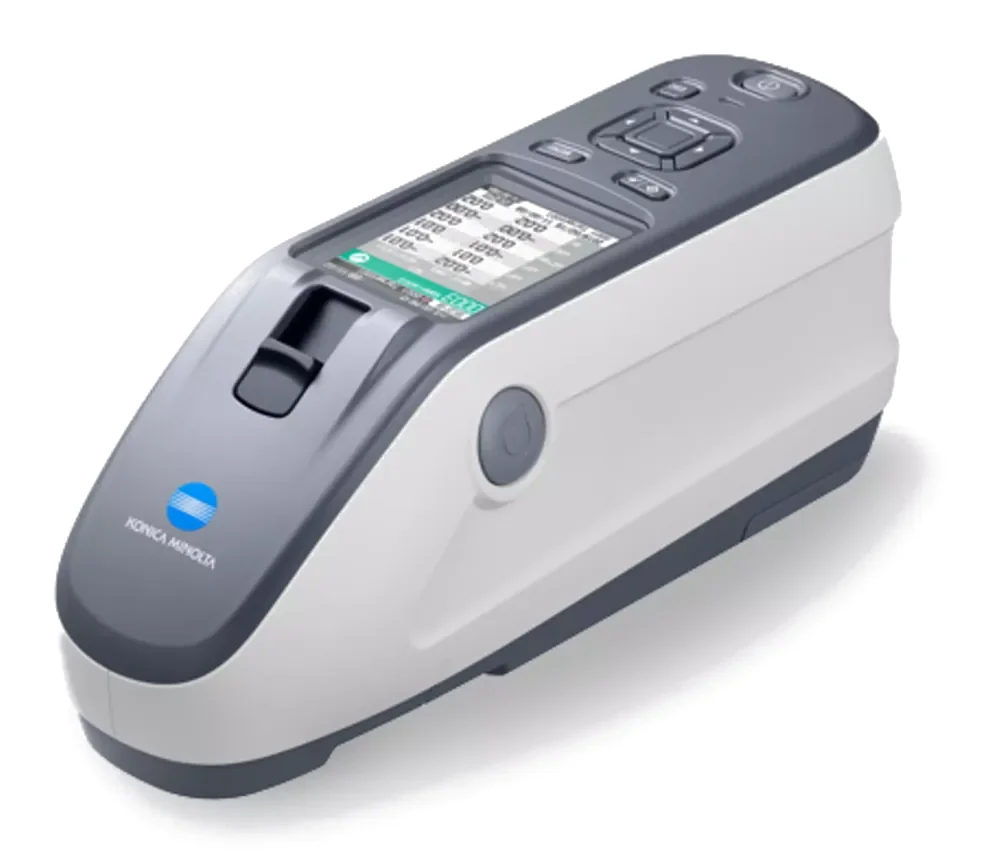
Entry-level portable spectrophotometer that measures SCI and SCE values together for basic color quality control.
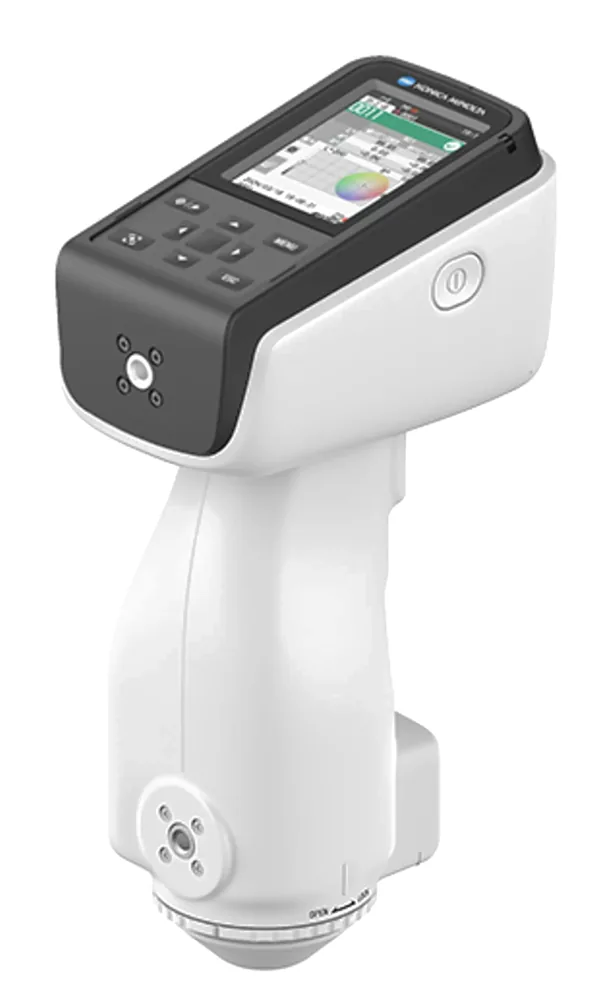
CM-17d / CM-16d Portable Spectrophotometer
Next-generation portable spectrophotometer with vertical body, camera viewfinder and interchangeable apertures.
Request a quote for this model
A suitable configuration and pricing are prepared based on sample type and workload.
Request a quote