

Konica Minolta
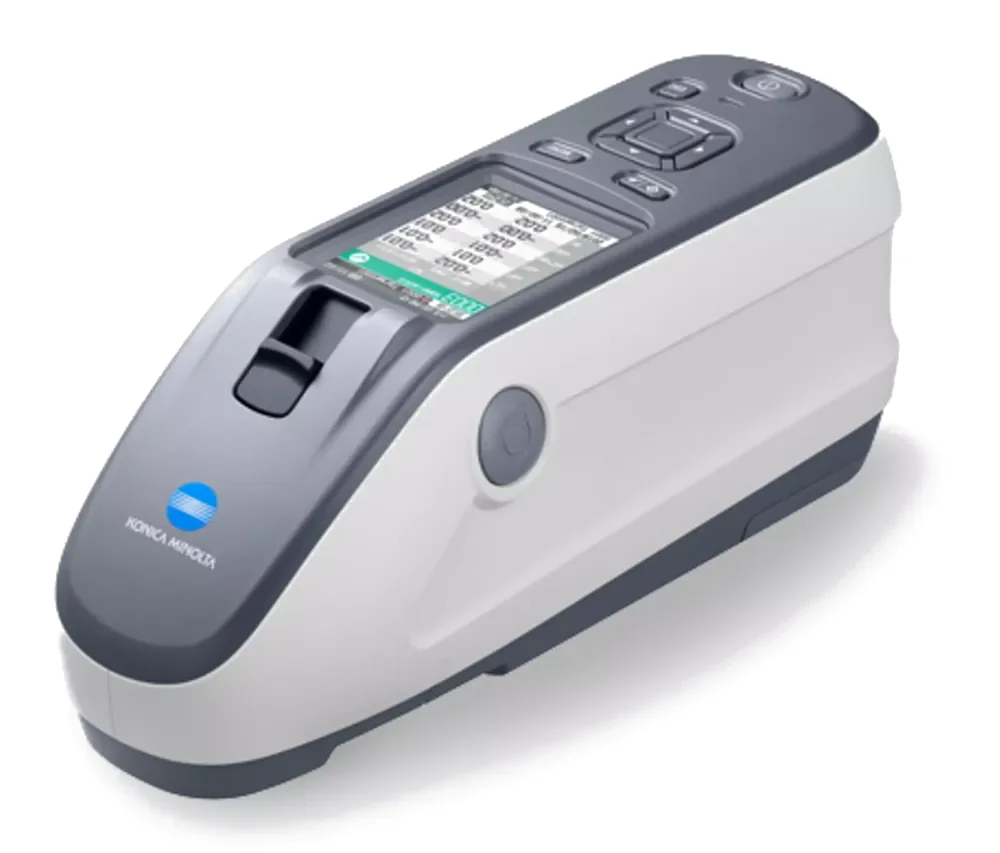
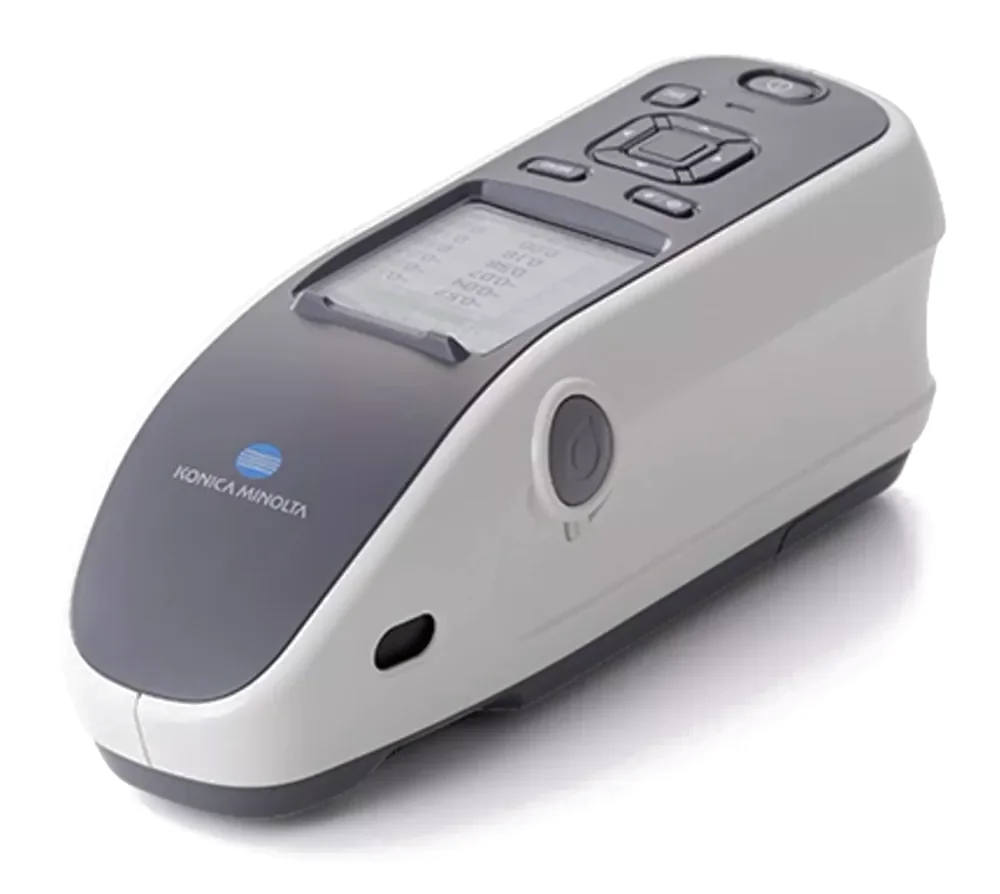
CM-26dG / CM-26d Portable Spectrophotometer
CM-26dG is a spectrophotometer with a gloss sensor that measures SCI and SCE values simultaneously in d:8° geometry and provides a 60° gloss value in the same measurement; CM-26d is the version of the same platform without gloss measurement. A 360–740 nm spectral range and ΔE*ab 0.12 inter-instrument agreement support the management of a common color standard across the supply chain.
Request a quote| Optical geometry | di:8° / de:8°, SCI and SCE simultaneous |
|---|---|
| Spectral range | 360–740 nm, 10 nm pitch |
| Gloss (CM-26dG) | 60°, 0–200 GU |
| Inter-instrument agreement | ΔE*ab 0.12 |
| Measurement aperture | MAV Ø8 mm / SAV Ø3 mm |
Product description
CM-26dG is a portable spectrophotometer developed to measure color and gloss at the same point with a single trigger. Values with the specular component included (SCI) and excluded (SCE) are captured simultaneously in di:8° and de:8° geometry; the dG version adds a 60° gloss value. For applications that do not require gloss measurement, the CM-26d version with the same housing is available.
Evaluating color and gloss together reveals how the surface is perceived by the eye in a single data set. If two parts produced with the same pigment differ in gloss, their SCI values will be similar while their SCE values diverge; the gloss value directly shows the source of this difference.
The instrument works with two measurement apertures: Ø8 mm (MAV) and Ø3 mm (SAV). Small parts, narrow edges and patterned surfaces are measured with SAV, and homogeneous surfaces with MAV.
CM-26dG and CM-26d are next-generation instruments that replace the CM-2600d model, used for many years in quality control laboratories. A rechargeable battery, USB connectivity and numerical UV adjustment have become standard with this generation.
Applications
The applications published by the manufacturer are textiles, plastics, building materials, pharmaceuticals and personal care, chemicals, and paint and coatings.
- Color and gloss quality control in plastic part and masterbatch production
- Comparison of paint and coating batches with a standard sample
- Supplier approval and incoming inspection for textiles and building materials
- Monitoring the same color standard across different sites
- Shade and color deviation control on ceramic and wood surfaces
- Whiteness and color consistency of home appliance panels and detergent products
Key features
Spectral measurement and UV control
A dual 40-element silicon photodiode array measures in the 360–740 nm range at 10 nm pitch. A pulsed xenon lamp is used; measurements can be taken with UV included (UV 100%) and UV excluded (UV 0%). For white samples containing optical brighteners, the difference between the two conditions shows the fluorescent contribution.
Repeatability and inter-instrument agreement
Color repeatability is ΔE*ab 0.02 as a standard deviation, and inter-instrument agreement is ΔE*ab 0.12 (MAV, SCI, 12 BCRA Series II tiles). These values are decisive for ensuring that instruments at different locations give closely matching results on the same sample.
Gloss measurement (CM-26dG)
60° gloss is measured in a geometry compliant with ISO 2813, ASTM D523 and DIN 67530, over a range of 0–200 GU with 0.01 GU resolution. The measurement area is Ø10 mm for MAV and Ø3 mm for SAV.
Data and connectivity
Memory for 1,000 standards and 5,000 samples, a 2.7 inch color display and a USB 2.0 connection are provided. Wireless LAN and Bluetooth connectivity are added with the optional CM-A300 module. Data are managed with SpectraMagic NX2 software.
Selection criteria for a spectrophotometer with gloss sensor
If gloss measurement and the 360–740 nm range are not required, the CM-25d, which operates in the 400–700 nm range, is a simpler alternative. If viewing the measurement point with a camera is desired, the vertical-body CM-17d should be considered. For a reference instrument in the laboratory to be used together with transmittance measurement, the CM-36dG benchtop series is suitable.
CM-26dG and CM-26d share the same housing and optical platform; the version is selected according to whether gloss data will be used in the quality control procedure.
Different geometry and aperture options can be compared in the color and gloss measuring instruments catalog. Color values are calculated according to the illuminant and observer conditions defined by the CIE colorimetry principles.
Technical specifications
| Model | CM-26dG (color + 60° gloss), CM-26d (color only) |
|---|---|
| Illumination / viewing | di:8° / de:8°, SCI and SCE simultaneous |
| Standards | ISO 7724/1, CIE No.15 (2004), ASTM E1164, DIN 5033 Teil 7, JIS Z 8722 c |
| Integrating sphere | Ø54 mm |
| Detector | Dual 40-element silicon photodiode array |
| Spectral range | 360–740 nm, 10 nm pitch, approx. 10 nm half bandwidth |
| Reflectance range | 0–175%, resolution 0.01% |
| Light source | Pulsed xenon lamp |
| Measurement aperture | MAV Ø8 mm, SAV Ø3 mm |
| Measurement time | CM-26dG approx. 1 s (including gloss), CM-26d approx. 0.7 s |
| Repeatability | ΔE*ab 0.02 (standard deviation) |
| Inter-instrument agreement | ΔE*ab 0.12 (MAV, SCI, 12 BCRA Series II) |
| Gloss (CM-26dG) | 60°, 0–200 GU, 0.01 GU resolution; ISO 2813, ASTM D523, DIN 67530 |
| Observer / illuminant | 2° and 10°; A, C, D50, D65, F2–F12, ID50, ID65, LED series and user-defined |
| Memory | 1,000 standards, 5,000 samples |
| Connectivity | USB 2.0; WLAN and Bluetooth with optional CM-A300 |
| Power | Replaceable Li-ion battery, USB or AC adapter |
| Dimensions / weight | 81.2 × 93.3 × 228.6 mm; approx. 660 g (dG), 630 g (d) |
Values are taken from the manufacturer's published technical documentation. They may vary by configuration and are confirmed against the current datasheet before quotation.
Frequently asked questions
What is the difference between SCI and SCE measurement?
SCI includes the light specularly reflected from the surface in the measurement and gives the color of the material independently of surface gloss. SCE excludes this component and gives a result closer to the appearance perceived by the eye. CM-26dG provides both values in the same measurement.
What is the difference between CM-26dG and CM-26d?
Both models have the same color measurement optics. CM-26dG additionally measures gloss in 60° geometry over a range of 0–200 GU; CM-26d measures color only.
Is a separate instrument needed for gloss?
If 60° geometry is sufficient, CM-26dG combines color and gloss in a single instrument. If 20° measurement for high gloss or 85° measurement for matte surfaces is required, a separate gloss meter should be considered.
Which software is used to transfer data?
The instrument connects to a computer via USB 2.0, and standards management, reporting and data analysis are performed with SpectraMagic NX2 software.
Which model replaced the CM-2600d?
The CM-2600d has been replaced by the CM-26dG and CM-26d models. CM-26dG is preferred for applications where a 60° gloss value is reported along with color, and CM-26d where only color is measured.
From the same category
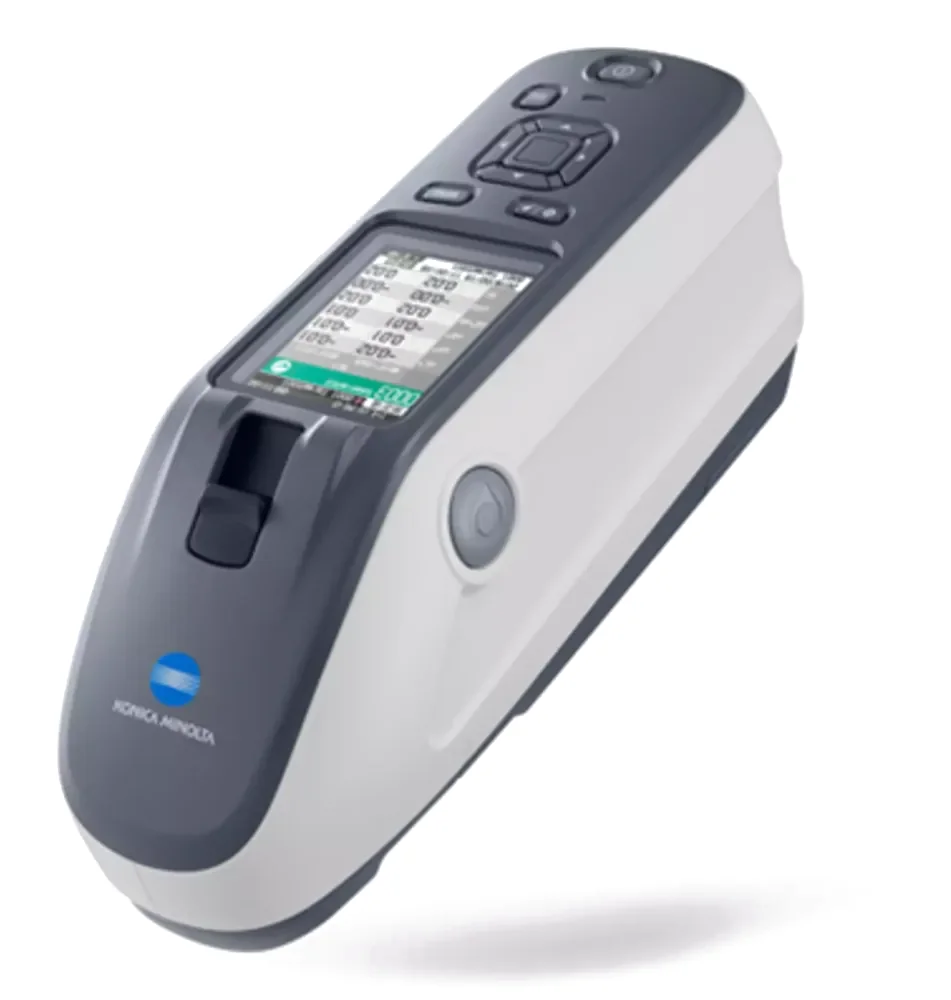
CM-25d Portable Spectrophotometer
Single-aperture portable spectrophotometer that measures SCI and SCE simultaneously and operates in the 400–700 nm range.
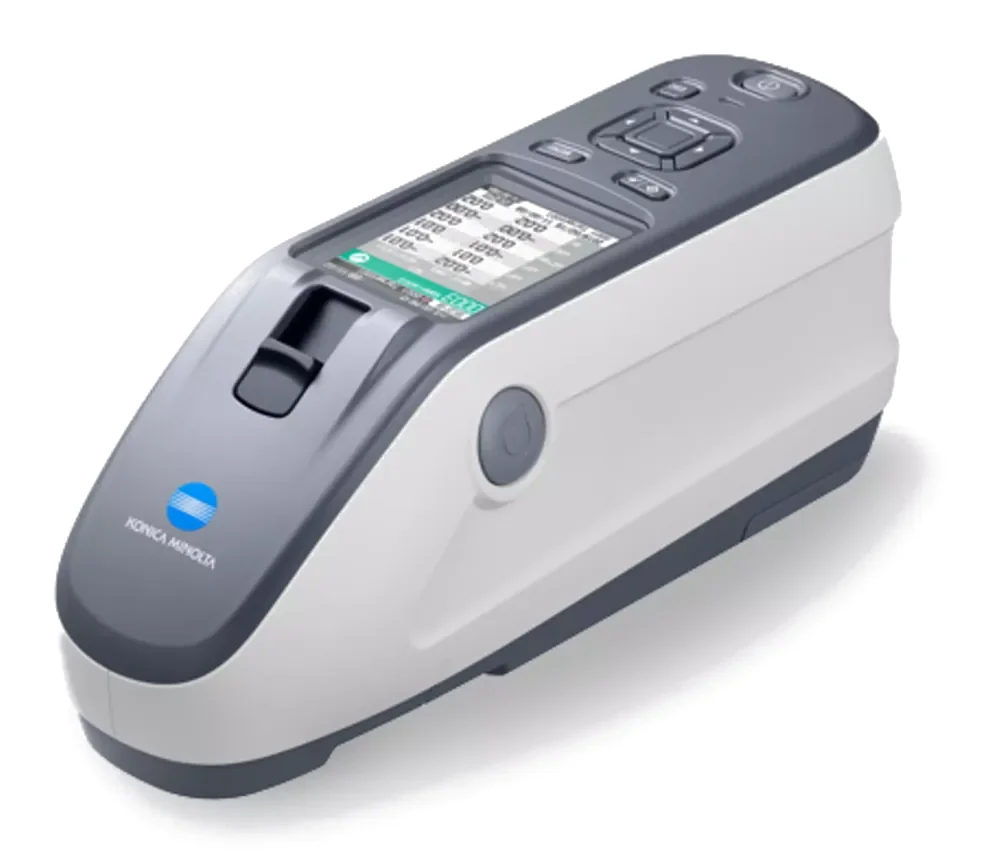
CM-23d Portable Spectrophotometer
Entry-level portable spectrophotometer that measures SCI and SCE values together for basic color quality control.
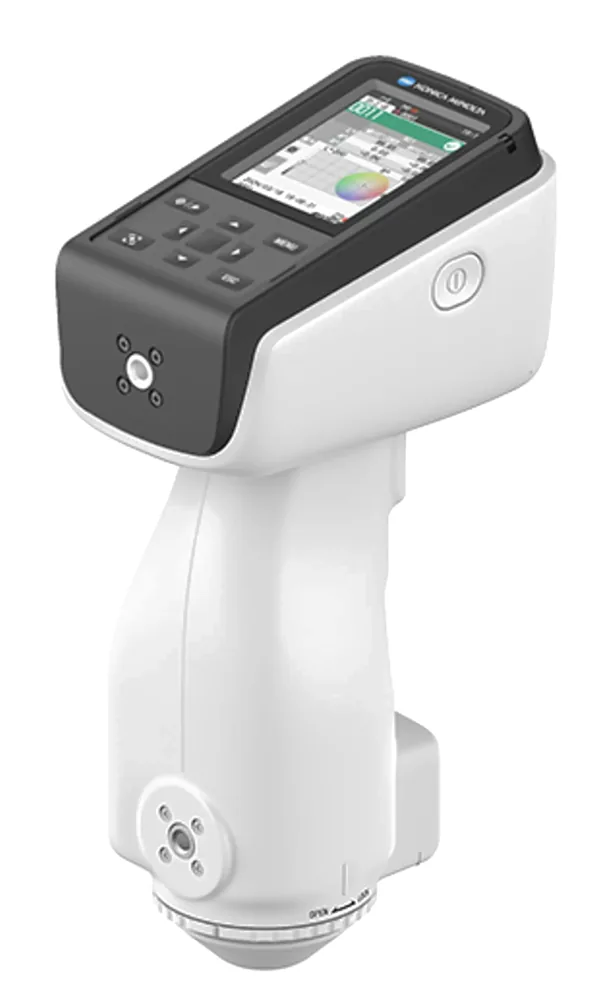
CM-17d / CM-16d Portable Spectrophotometer
Next-generation portable spectrophotometer with vertical body, camera viewfinder and interchangeable apertures.
CM-25cG Color and Gloss Spectrophotometer
Portable spectrophotometer that captures color in 45°c:0° geometry and 60° gloss in a single measurement.
Request a quote for this model
A suitable configuration and pricing are prepared based on sample type and workload.
Request a quote