

Konica Minolta
CR-400 / CR-410 Chroma Meter (Colorimeter)
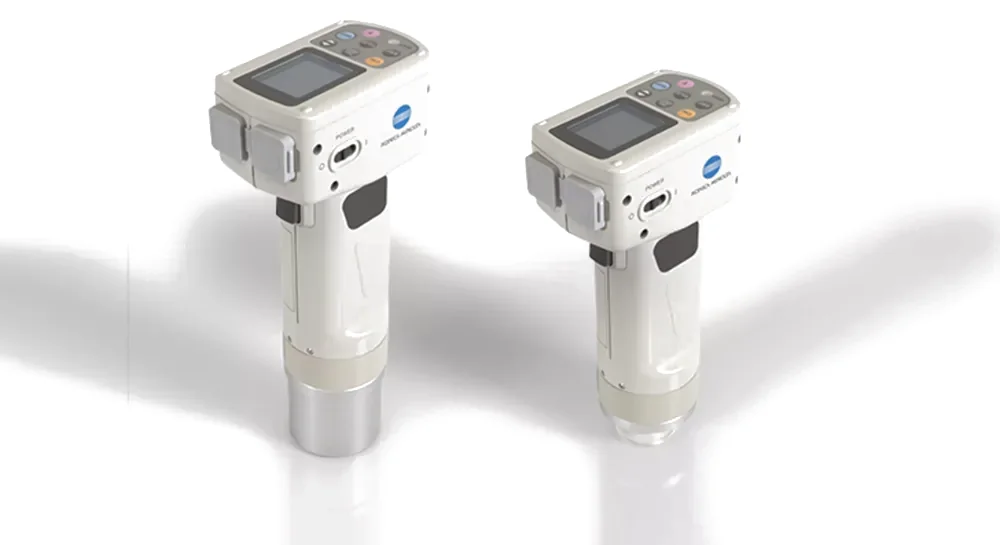
The CR-400 and CR-410 are portable colorimeter (tristimulus colorimeter) models operating with d:0° geometry. The CR-400, with its Ø8 mm aperture, measures small surfaces, while the CR-410, with its Ø50 mm aperture, delivers an average color value for powder, granular and textured samples.
Request a quote| Optical geometry | d:0°, specular component included |
|---|---|
| Measurement aperture | CR-400 Ø8 mm · CR-410 Ø50 mm |
| Repeatability | Within ΔE*ab 0.07 standard deviation |
| Illuminant / observer | C and D65 · 2° |
| Weight | Approx. 550 g / 570 g |
Product description
The CR-400 and CR-410 are two portable colorimeters built on the same platform. The sample is illuminated diffusely and viewed at 0°; tristimulus values are calculated directly with six silicon photocells. Results are reported in color spaces such as L*a*b*, L*C*h, Hunter Lab, XYZ and Yxy, and color difference is reported with the ΔE*ab, CMC and CIE2000 formulas.
The main difference between the two models is the measurement aperture. The CR-400's Ø8 mm aperture is suitable for small, even surfaces. The CR-410's Ø50 mm aperture averages a large area of flour, grain, granular raw materials or textured products, reducing the effect of color variation within the sample on the result.
The instrument can be used on its own as a measuring head, or connected to the DP-400 data processor to gain printer output, statistics and page-based data management. There are 20 calibration channels; in addition to white calibration, 19 user calibrations can be defined.
It is an economical solution for applications that do not require spectral data. The CR-410, with its large Ø50 mm aperture, makes it easier to obtain an average value for non-uniform food samples.
Applications
The manufacturer positions it for the food, building materials and chemical industries. It is preferred for work where fast, reproducible color difference checks that can be performed in the field are sufficient.
- Incoming inspection of food raw materials and finished products
- Average color measurement of powder, granular and grain samples (CR-410)
- Batch-based color consistency monitoring for building materials
- Whiteness and yellowness index (WI, YI) control of chemical products
- Pass/fail assessment against a reference on the production line
- Color grading of vegetables and fruit
- Rapid color control of textile products
Technical evaluation
In 30 measurements taken at 10-second intervals on the white calibration plate, repeatability remains within ΔE*ab 0.07 standard deviation. Inter-instrument agreement, averaged over 12 BCRA Series II color tiles, is specified as ΔE*ab 0.6 for the CR-400 and ΔE*ab 0.8 for the CR-410.
Measurement time is 1 second, and the minimum interval between two measurements is 3 seconds. The instrument runs on 4 AAA batteries or an AC adapter; approximately 800 measurements can be taken on batteries. Data is transferred to a computer or data processor via RS-232.
Optional accessories extend the scope: the CR-A50 granular materials attachment is used for powders and particulate materials, and glass and plastic cells are used for reflectance measurement of opaque liquids. Because cell and holder compatibility varies by model, it is checked before ordering.
Portable colorimeter selection criteria
If an industry-specific index is required for coffee or tomato products, the CR-410C and CR-410T, which use the same Ø50 mm head, should be considered. If benchtop transmittance measurement is also required, the CR-5 is suitable; for a more compact solution for quick color difference checks only, the CR-10 Plus is suitable.
If evaluation under different illuminants, spectral data or color formulation is needed, a spectrophotometer such as the CM-23d or CM-26dG should be selected instead of a colorimeter.
Measurement data can be recorded, evaluated against tolerances and reported with SpectraMagic NX2.
Other models in the category are listed under color and gloss measuring instruments. Color difference is expressed as ΔE*ab in the CIE 1976 L*a*b* color space.
Technical specifications
| Optical geometry | d:0° (diffuse illumination, 0° viewing, specular component included; JIS Z 8722); CR-410 wide-area illumination |
|---|---|
| Detector | 6 silicon photocells |
| Light source | Pulsed xenon lamp |
| Display range | Y: 0.01–160.00% (reflectance) |
| Measurement / illumination area | CR-400: Ø8 / Ø11 mm · CR-410: Ø50 / Ø53 mm |
| Repeatability | Within ΔE*ab 0.07 standard deviation |
| Inter-instrument agreement | CR-400: ΔE*ab 0.6 · CR-410: ΔE*ab 0.8 (average of 12 BCRA Series II tiles) |
| Observer / illuminant | CIE 2° · C, D65 |
| Color spaces and indices | XYZ, Yxy, L*a*b*, Hunter Lab, L*C*h, Munsell, CMC, CIE1994, CIE2000, WI, YI |
| Measurement time | 1 s; minimum measurement interval 3 s |
| Memory | 1,000 measurements; 100 target colors; 20 calibration channels |
| Interface | RS-232 (data processor or computer) |
| Power | 4 × AAA batteries or AC adapter AC-A305; approx. 800 measurements on batteries |
| Dimensions | CR-400: 102 × 217 × 63 mm · CR-410: 102 × 244 × 63 mm |
| Weight | Approx. 550 g (CR-400) / 570 g (CR-410), including batteries |
| Operating environment | 0–40 °C, below 85% relative humidity, non-condensing |
Values are taken from the manufacturer's published technical documentation. They may vary by configuration and are confirmed against the current datasheet before quotation.
Frequently asked questions
What is the difference between a colorimeter and a spectrophotometer?
A colorimeter measures tristimulus values directly with three filters approximating the color sensitivity of the human eye; it is a fast and economical solution for color difference control. A spectrophotometer measures reflectance wavelength by wavelength; it is required for tasks such as evaluation under different illuminants, metamerism analysis and color formulation.
Should the CR-400 or the CR-410 be selected?
For even, small surfaces, the CR-400 with its Ø8 mm aperture is sufficient. For powder, granular, grain or samples with non-uniform color distribution, the CR-410 with its Ø50 mm aperture gives more reproducible results because it averages a larger area.
Can the instrument be used without a computer?
Yes. The measuring head display shows color values, color difference and the pass/fail result; 1,000 measurements are stored in memory. The DP-400 data processor can be used for statistics and printer output, and SpectraMagic NX2 software for reporting on a computer.
From the same category
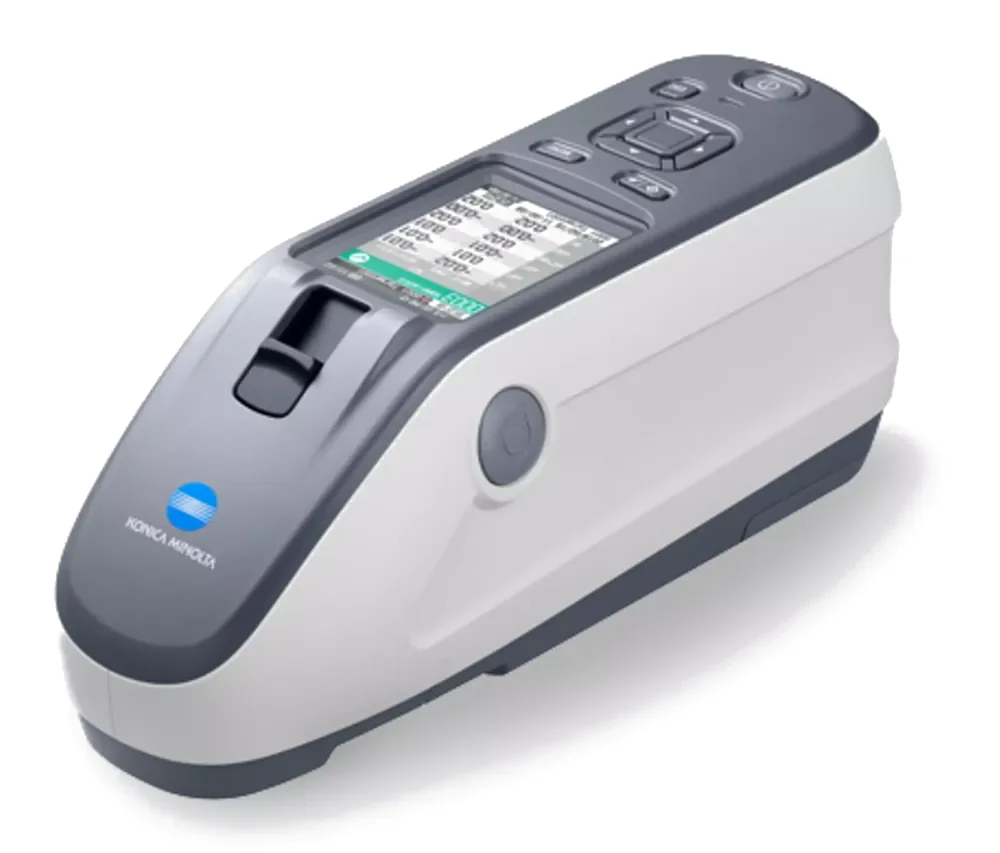
CM-26dG / CM-26d Portable Spectrophotometer
Portable spectrophotometer that captures color and 60° gloss in a single measurement and measures SCI and SCE simultaneously.
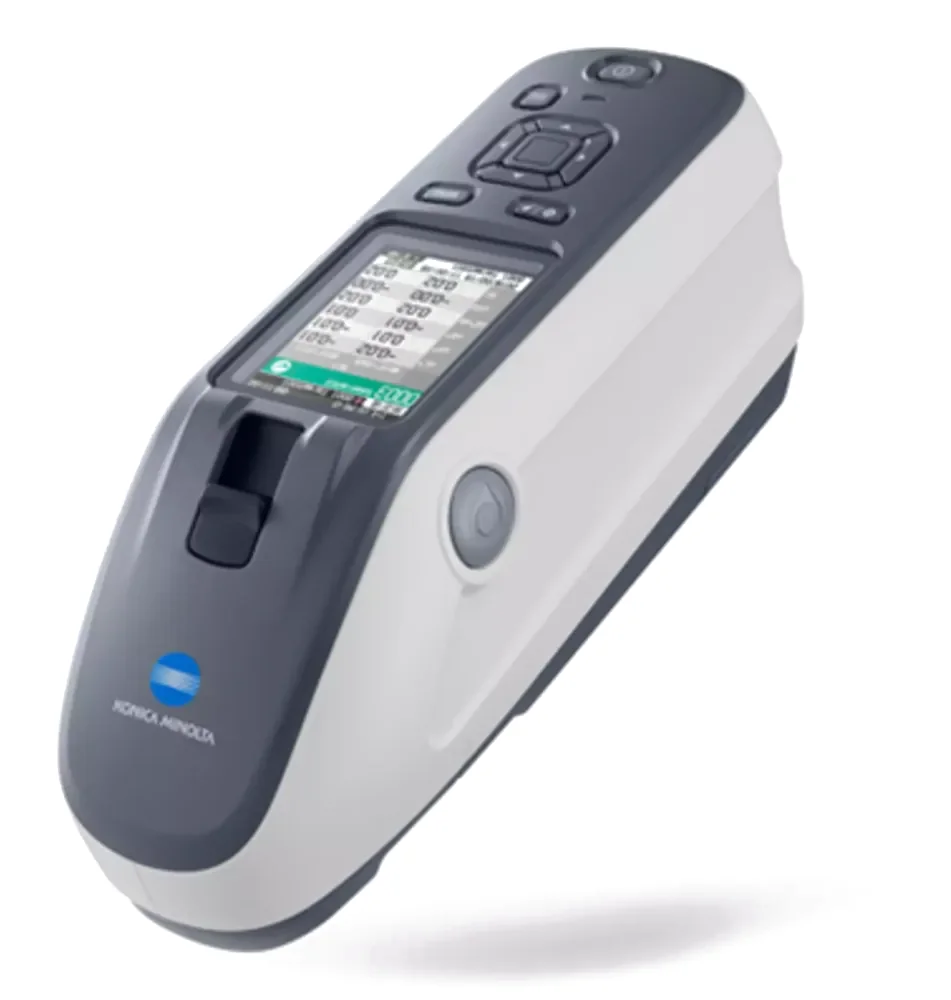
CM-25d Portable Spectrophotometer
Single-aperture portable spectrophotometer that measures SCI and SCE simultaneously and operates in the 400–700 nm range.
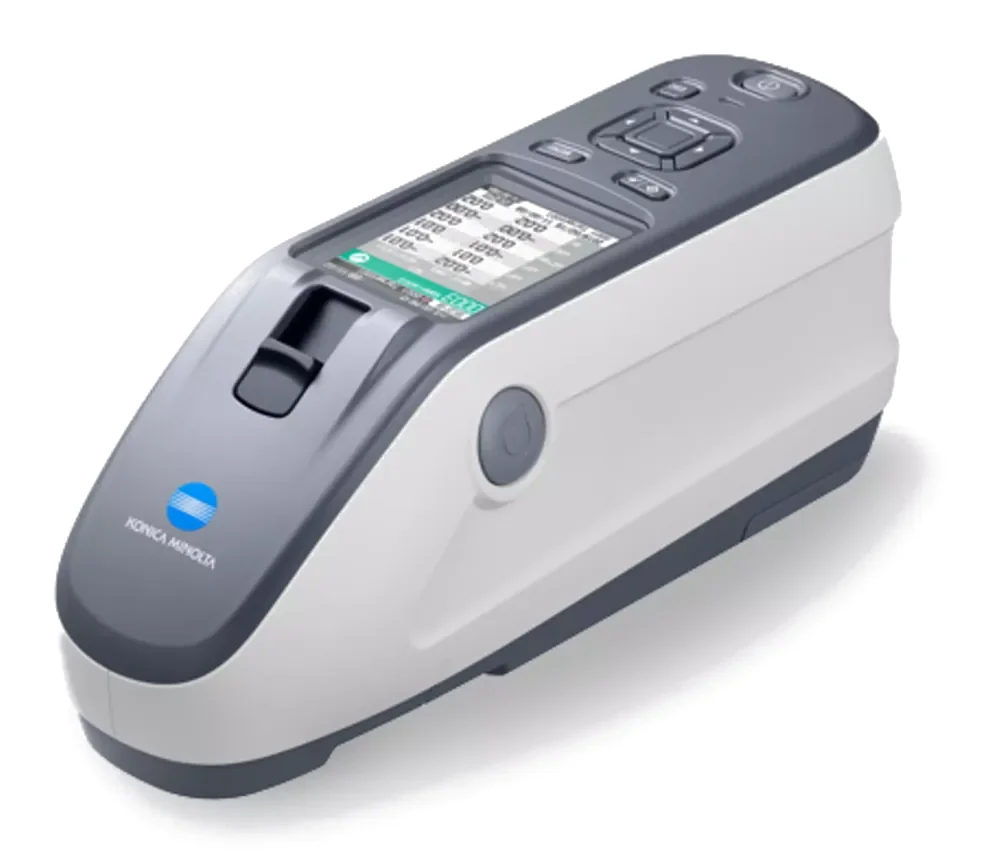
CM-23d Portable Spectrophotometer
Entry-level portable spectrophotometer that measures SCI and SCE values together for basic color quality control.
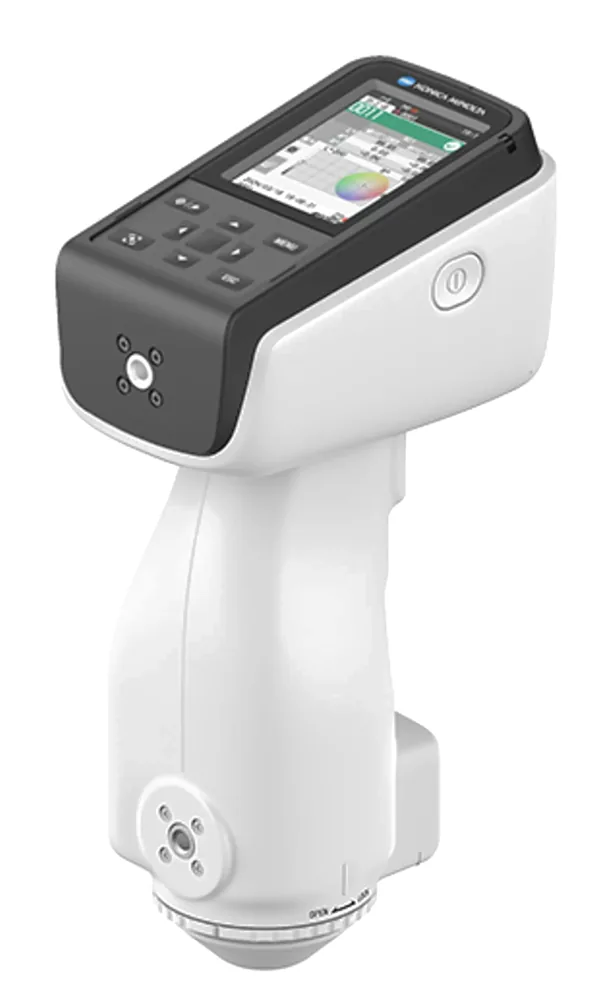
CM-17d / CM-16d Portable Spectrophotometer
Next-generation portable spectrophotometer with vertical body, camera viewfinder and interchangeable apertures.
Request a quote for this model
A suitable configuration and pricing are prepared based on sample type and workload.
Request a quote