

Konica Minolta
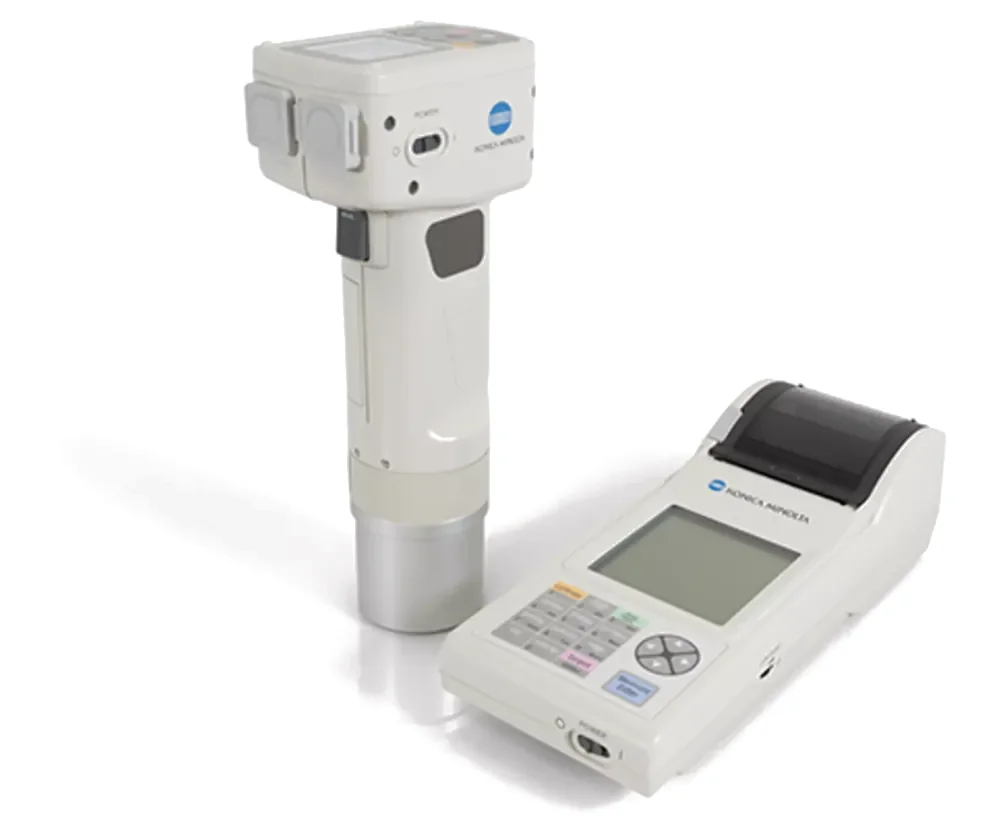
CR-410T Tomato Products Colorimeter
The CR-410T is a tomato colorimeter built on the CR-410 platform and running software adapted for tomato products. Using the USDA-approved tomato color index, it classifies the color of raw tomatoes, paste, sauce, juice and ketchup with a single value.
Request a quote| Index | USDA-approved tomato color index |
|---|---|
| Measurement aperture | Ø50 mm |
| Products | Raw tomatoes, paste, sauce, juice, ketchup |
| Repeatability | Within ΔE*ab 0.07 standard deviation |
| Weight | Approx. 570 g |
Product description
In tomato products, color is the main parameter determining both consumer perception of quality and product grading. The CR-410T is a version of the CR-410 colorimeter with Ø50 mm aperture adapted for tomatoes, and its firmware includes the tomato color index approved by the United States Department of Agriculture (USDA).
The index reduces the color measurement to a single number indicating the grade of the processed tomato product. This simplifies batch-to-batch comparison; the operator does not need to interpret color coordinates. Color values, color difference and tolerance results are also shown on the instrument's backlit display.
A sample container specific to tomato products and a red color standard are supplied with the instrument. The sample container ensures the same presentation condition for every measurement, while the red standard is used to verify that the instrument operates correctly in this color region.
Applications
- Supplier-based color grading when purchasing raw tomatoes
- Batch control in tomato paste and purée production
- Finished product quality control of sauce, ketchup and tomato juice
- Shared color assessment between the production line and the quality laboratory
Technical evaluation of the tomato colorimeter
The measurement geometry is wide-area illumination with 0° viewing; six silicon photocells and a pulsed xenon lamp are used. Repeatability on the white plate is within ΔE*ab 0.07 standard deviation, and inter-instrument agreement averaged over 12 BCRA Series II tiles is ΔE*ab 0.8.
The instrument runs on AAA batteries or an AC adapter; this flexibility allows measurements to be taken in the field or at the receiving point just as in the laboratory. A measurement takes 1 second, and the minimum interval between two measurements is 3 seconds.
For dark, viscous products such as paste and sauce, filling the container without air bubbles and to the same height is decisive for the reproducibility of results.
For dark, dense products such as paste and sauce, measurement is performed with the sample container filled completely, without air gaps. Close values when the same sample is stirred in the container and measured again indicate that sample preparation has been done correctly. For raw tomatoes, the average of several fruits is taken because of natural variation between fruits.
Selection criteria
If other food products besides tomatoes are also to be measured, the general-purpose CR-400 / CR-410 should be considered. The CR-410C for coffee and the BC-10 Plus for baked goods are industry-specific alternatives.
Other models in the category are listed under color and gloss measuring instruments.
Technical specifications
| Base instrument | CR-410 measuring head with tomato software |
|---|---|
| Color index | USDA-approved tomato color index |
| Optical geometry | Wide-area illumination, 0° viewing, specular component included |
| Detector | 6 silicon photocells |
| Light source | Pulsed xenon lamp |
| Measurement / illumination area | Ø50 / Ø53 mm |
| Repeatability | Within ΔE*ab 0.07 standard deviation |
| Inter-instrument agreement | ΔE*ab 0.8 (average of 12 BCRA Series II tiles) |
| Observer / illuminant | CIE 2° · C, D65 |
| Measurement time | 1 s; minimum measurement interval 3 s |
| Memory | 1,000 measurements; 100 target colors |
| Power | 4 × AAA batteries or AC adapter; approx. 800 measurements on batteries |
| Dimensions | 102 × 244 × 63 mm |
| Weight | Approx. 570 g, including batteries |
| Supplied with | Tomato sample container and red color standard |
Values are taken from the manufacturer's published technical documentation. They may vary by configuration and are confirmed against the current datasheet before quotation.
Frequently asked questions
What does the tomato color index show?
The index expresses the color of a processed tomato product as a single number on a USDA-approved scale. This value allows the product's color grade and batch-to-batch consistency to be assessed quickly.
Can dark products such as tomato paste be measured?
Yes. The manufacturer positions the instrument for raw tomatoes, paste, sauce, tomato juice and ketchup. For dark products, filling the sample container the same way for every measurement is recommended.
What is the difference between a colorimeter and a spectrophotometer?
A colorimeter measures tristimulus values directly with three filters approximating the color sensitivity of the human eye; it is a fast and economical solution for color difference control. A spectrophotometer measures reflectance wavelength by wavelength; it is required for tasks such as evaluation under different illuminants, metamerism analysis and color formulation.
From the same category
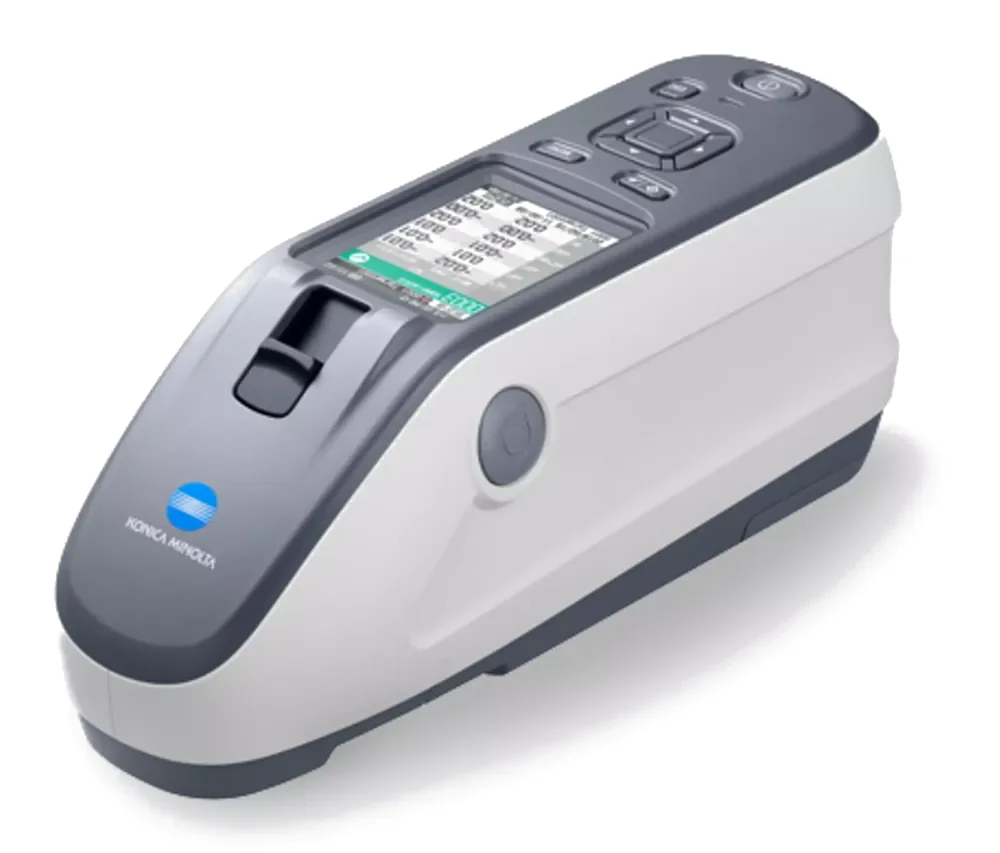
CM-26dG / CM-26d Portable Spectrophotometer
Portable spectrophotometer that captures color and 60° gloss in a single measurement and measures SCI and SCE simultaneously.
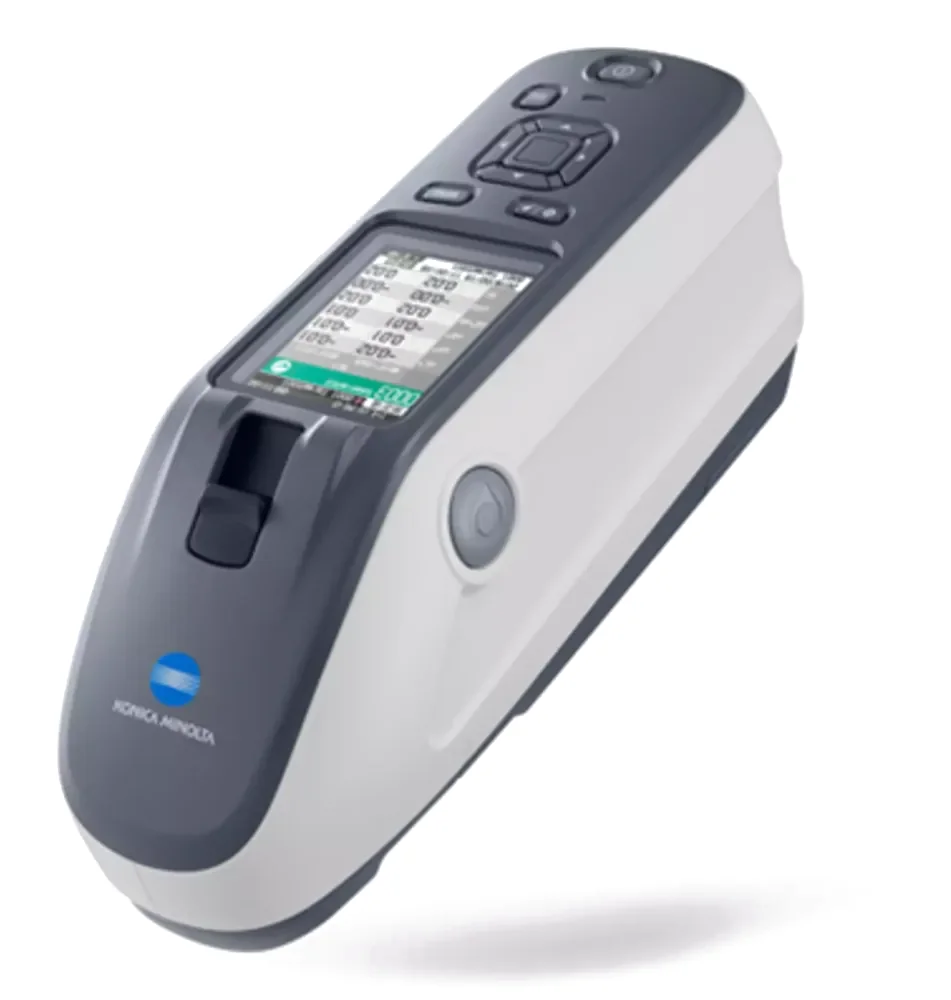
CM-25d Portable Spectrophotometer
Single-aperture portable spectrophotometer that measures SCI and SCE simultaneously and operates in the 400–700 nm range.
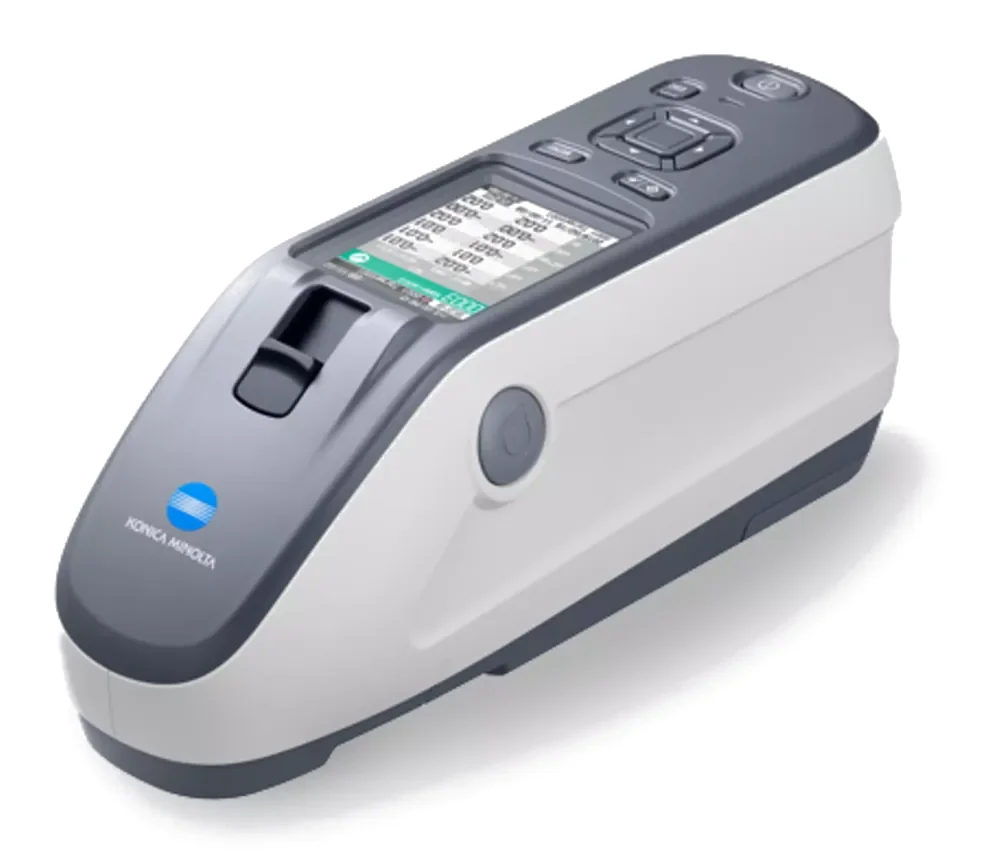
CM-23d Portable Spectrophotometer
Entry-level portable spectrophotometer that measures SCI and SCE values together for basic color quality control.
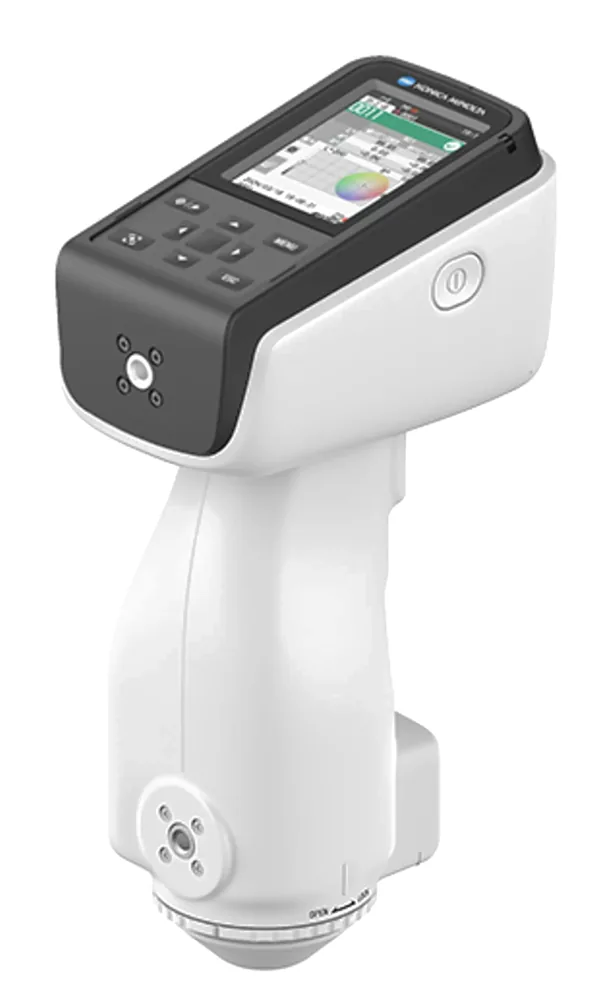
CM-17d / CM-16d Portable Spectrophotometer
Next-generation portable spectrophotometer with vertical body, camera viewfinder and interchangeable apertures.
Request a quote for this model
A suitable configuration and pricing are prepared based on sample type and workload.
Request a quote