

DLAB
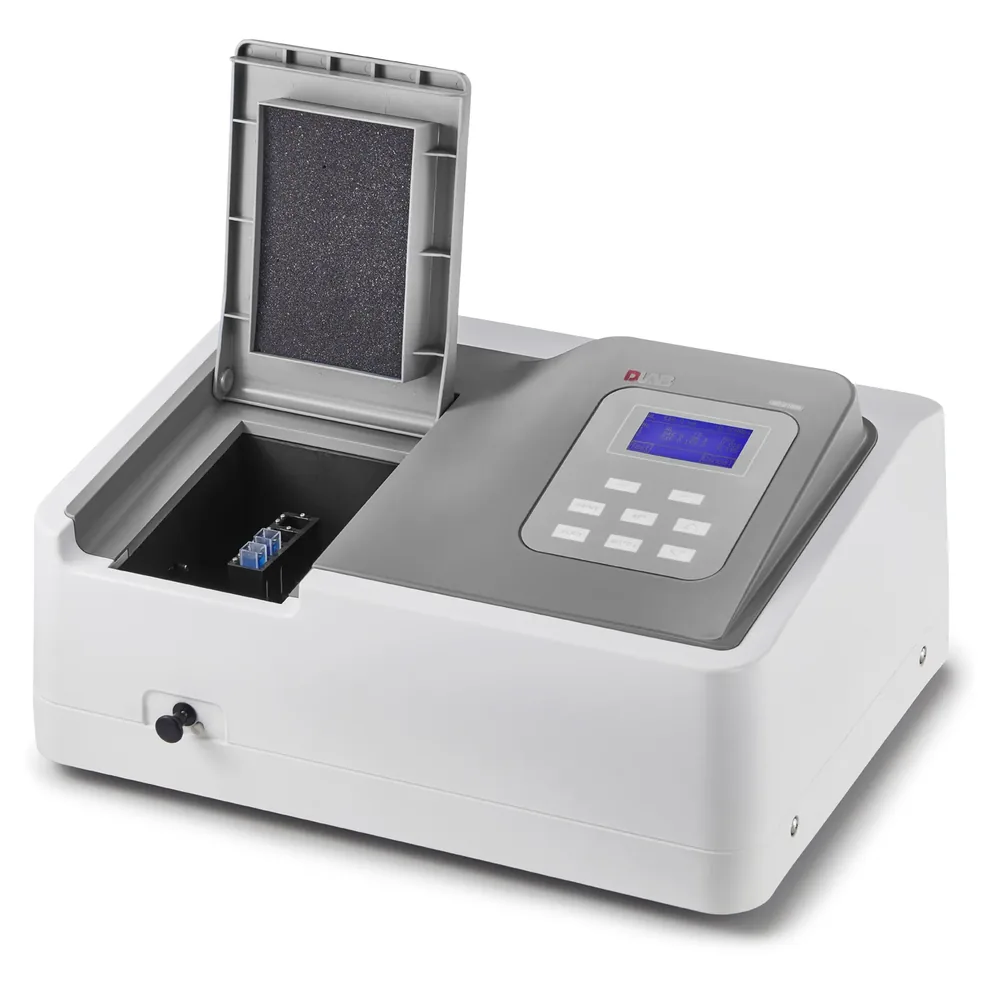
SP-V Visible Spectrophotometer
The SP-V series visible spectrophotometer is a family of single-beam instruments that determines concentration by measuring the absorbance and transmittance of solutions. The SP-V1000, SP-V1100 and touchscreen SP-UV2101 models differ in wavelength range and spectral bandwidth.
Request a quote| Optical system | Single-beam |
|---|---|
| Wavelength range | From 325–1000 nm to 190–1100 nm (depending on model) |
| Spectral bandwidth | 4.0 / 2.0 / 1.0 nm |
| Photometric range | -0.3 to 3.0 A |
| Display | Dot-matrix LCD or 10.1-inch touchscreen |
Product description
A visible spectrophotometer measures how much of the light passing through a sample is absorbed and converts this value into concentration via the Beer-Lambert relationship. With its tungsten lamp and single-beam optics, the SP-V series is designed for routine quantitative analysis of colored solutions.
The series consists of three models. The SP-V1000 is the entry-level basic instrument. The SP-V1100 offers a narrower bandwidth and a wider wavelength range. The SP-UV2101 extends down to the 190–1100 nm range with tungsten and deuterium lamps; its 10.1-inch touchscreen allows scanning, kinetic and multi-wavelength measurements to be performed without a computer.
These instruments measure the optical density of liquid samples; they do not measure surface color. If color values and color differences are required for solid surfaces, color and gloss measuring instruments are the more appropriate choice.
Model comparison
| Model | Wavelength range | Bandwidth | Wavelength accuracy | Light source | Display |
|---|---|---|---|---|---|
| SP-V1000 | 325–1000 nm | 4.0 nm | ±2 nm | Tungsten | Dot-matrix LCD |
| SP-V1100 | 320–1100 nm | 2.0 nm | ±0.5 nm | Tungsten | Dot-matrix LCD |
| SP-UV2101 | 190–1100 nm | 1.0 nm | ±0.3 nm (full range) | Tungsten and deuterium | 10.1-inch touchscreen |
The SP-V1000 and SP-V1100 operate with a four-position cuvette holder for a 10 mm path length; each instrument weighs 11 kg. The SP-UV2101 features a four-cell holder, three scanning speeds (high, medium and slow) and a stray light value of 0.03 %T.
Applications
- Parameter determination with colorimetric test kits in water and wastewater laboratories
- Analyses based on color-forming reactions in food and beverage quality control
- Absorbance and calibration curve exercises in teaching laboratories
- Quantitative measurement of compounds absorbing in the visible range in chemistry laboratories
Nucleic acid and protein measurements absorbing in the UV range (around 200 nm) are outside the range of the SP-V1000 and SP-V1100. For these applications, the SP-UV2101 or single-beam UV-Vis spectrophotometers should be considered.
Recommendations for accurate measurement
The calibration curve should be prepared with the same solvent and the same cuvette type as the sample. Keeping absorbance between approximately 0.1 and 1.0 A ensures that readings are taken in the linear region; darker samples are diluted before measurement.
- The instrument is warmed up before measurement for lamp stability
- The optical surfaces of the cuvette are protected from fingerprints and scratches
- A blank reading is taken first in each series
Visible spectrophotometer selection criteria
The first selection criterion is the wavelength requirement. For methods working only in the visible range, the SP-V1000 is sufficient. For analyses requiring narrower peaks and lower stray light, the SP-V1100 is preferred. If scanning, kinetic and data logging functions and software compatibility are the priority, the SP-UV2101 comes to the fore.
For long-term measurements in which reference and sample must be read simultaneously, double-beam UV-Vis spectrophotometers deliver more stable results. All models in the category are listed in the UV-Vis spectrophotometers section; the general framework of the measurement principles is explained on the technologies page.
Technical specifications
| Optical system | Single-beam |
|---|---|
| Light source | Tungsten lamp; tungsten and deuterium lamps on the SP-UV2101 |
| Wavelength range | SP-V1000: 325–1000 nm; SP-V1100: 320–1100 nm; SP-UV2101: 190–1100 nm |
| Spectral bandwidth | 4.0 nm / 2.0 nm / 1.0 nm |
| Wavelength repeatability | ≤1 nm / ≤0.3 nm / ≤0.1 nm |
| Photometric range | -0.3 to 3.0 A; 0–200 %T (SP-V1000 and SP-V1100) |
| Photometric accuracy | SP-V1000: ±0.003 A (at 0.5 A); SP-V1100: ±0.002 A (at 0.5 A); SP-UV2101: ±0.0015 A (0–0.5 A) |
| Stray light | ≤0.2 %T / ≤0.05 %T (at 360 nm) / ≤0.03 %T |
| Stability | ≤0.002 A/h (SP-V); ≤0.001 A/h (SP-UV2101), at 500 nm |
| Sample holder | 4 positions, 10 mm path length |
| Display | Dot-matrix LCD; 10.1-inch color touchscreen on the SP-UV2101 |
| Data output | USB and printer port |
| Power supply | 110/220 V AC, 50/60 Hz; 80 W (SP-V), 120 W (SP-UV2101) |
| Dimensions | 475 × 360 × 225 mm (SP-V); 570 × 440 × 210 mm (SP-UV2101) |
| Weight | 11 kg (SP-V); 20 kg (SP-UV2101) |
Values are taken from the manufacturer's published technical documentation. They may vary by configuration and are confirmed against the current datasheet before quotation.
Frequently asked questions
Do a visible spectrophotometer and a color measuring instrument do the same job?
No. A visible spectrophotometer measures how much light a transparent solution absorbs and calculates concentration. A color measuring instrument converts the light reflected from a surface into color coordinates such as L*a*b*. Color and gloss measuring instruments are used for surface color.
Can DNA or protein be measured with the SP-V1000?
Because the lower limit of the SP-V1000 is 325 nm, nucleic acid and protein measurements at 260 and 280 nm cannot be performed. For these measurements, the SP-UV2101, which extends down to 190 nm, or UV-Vis models should be selected.
Which cuvettes are used?
The series works with standard cuvettes with a 10 mm path length. Glass or plastic cuvettes are sufficient in the visible range; quartz cuvettes are required for measurements in the UV range with the SP-UV2101.
Request a quote for this model
A suitable configuration and pricing are prepared based on sample type and workload.
Request a quote