

DLAB
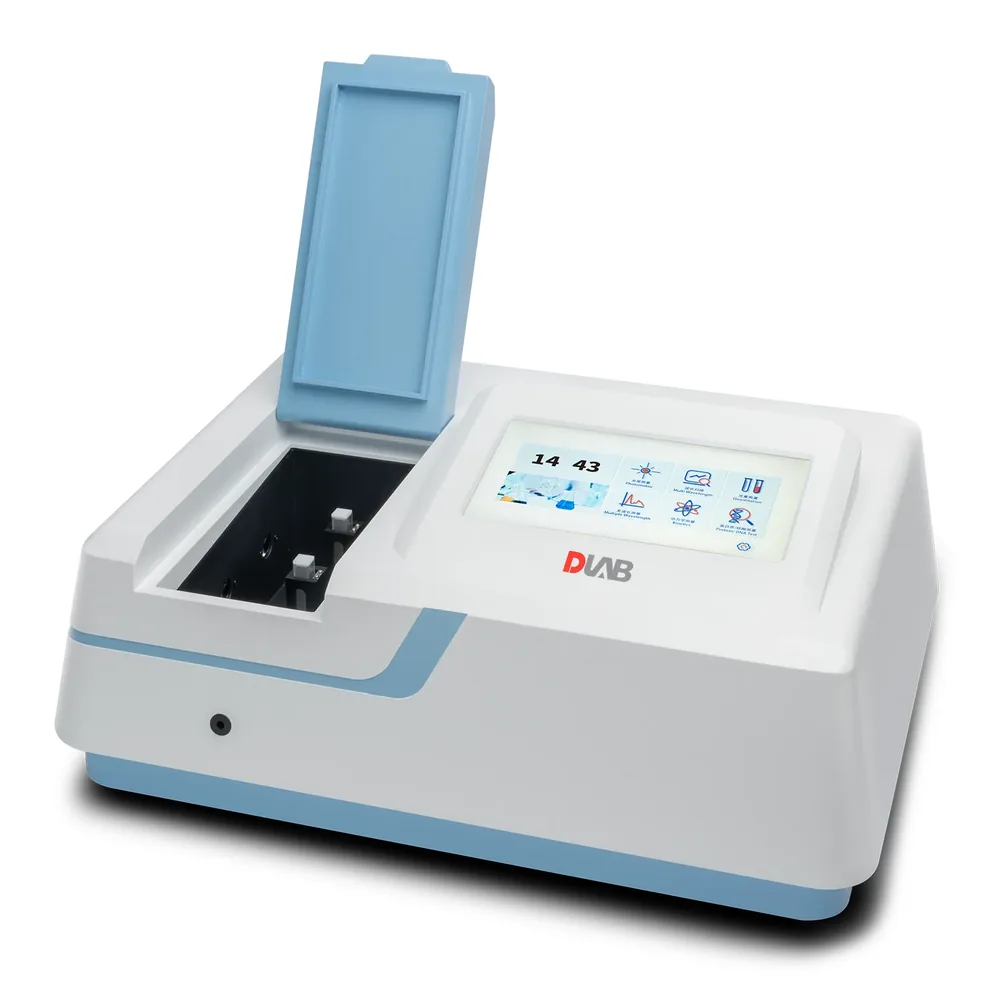
SP-UV3100 and SP-XUV5100 Double-Beam UV-Vis Spectrophotometer
The double-beam UV-Vis spectrophotometer family measures reference and sample simultaneously, delivering stable results in long-term analyses. The SP-UV3101 and SP-UV3102 use deuterium and tungsten lamps, while the SP-XUV5101 and SP-XUV5102 use a xenon lamp; all models operate over 190–1100 nm with a 10.1-inch touchscreen.
Request a quote| Optical system | Double-beam |
|---|---|
| Wavelength range | 190–1100 nm |
| Spectral bandwidth | 1.0 nm or 2.0 nm |
| Light source | Deuterium and tungsten or xenon lamp |
| Display | 10.1-inch color touchscreen |
Product description
In a double-beam UV-Vis spectrophotometer, the light is split into two paths: one passes through the reference, the other through the sample, and the two signals are compared at the same time. Because small drifts in lamp intensity and electronics affect both measurements equally, the result is largely unaffected by these drifts.
The series includes four models. The SP-UV3101 and SP-UV3102 operate with the classic deuterium and tungsten lamp pair. The SP-XUV5101 and SP-XUV5102 use a single xenon lamp, which covers the ultraviolet and visible ranges with one source. In both pairs, the 1 series has a 1.0 nm bandwidth and the 2 series a 2.0 nm bandwidth.
All models operate stand-alone with a 10.1-inch touchscreen; when used with PC software, user management and record-keeping functions for GLP/GMP requirements are enabled.
Model comparison
| Model | Light source | Bandwidth | Photometric accuracy (0–0.5 A) | Stray light |
|---|---|---|---|---|
| SP-UV3101 | Deuterium and tungsten | 1.0 nm | ±0.0015 A | ≤0.02 %T |
| SP-UV3102 | Deuterium and tungsten | 2.0 nm | ±0.002 A | ≤0.03 %T |
| SP-XUV5101 | Xenon | 1.0 nm | ±0.0015 A | ≤0.02 %T |
| SP-XUV5102 | Xenon | 2.0 nm | ±0.002 A | ≤0.03 %T |
Stray light values are given at 220 and 360 nm. For all four models, wavelength accuracy is ±0.3 nm over the full range, repeatability is ≤0.1 nm and stability is ≤0.001 A/h at 500 nm.
Applications
- Spectrum scanning and identification tests in pharmaceutical quality control
- Enzyme kinetics and time-dependent reaction monitoring
- Nucleic acid and protein analyses in research laboratories
- Multi-wavelength quantitative methods in chemistry laboratories
For routine single-point measurements, single-beam UV-Vis spectrophotometers are a more economical alternative.
Key features
- Photometric measurement, quantitative analysis, spectrum scanning, kinetics, DNA/protein and multi-wavelength tests on the main unit
- User management, audit trail and data traceability in the PC software
- Three scanning speeds: high, medium and slow
- 1 cm fixed cuvette holder and low stray light at 220 and 360 nm
Reducing the scanning speed allows sharp peaks to be recorded more accurately; fast scanning is suitable for preliminary kinetic trials and rough spectrum checks. Quartz cuvettes should be planned as standard consumables for UV-Vis measurements.
Double-beam UV-Vis spectrophotometer selection criteria
A narrow bandwidth (1.0 nm) is preferred in pharmacopeial methods in which sharp peaks are resolved and in scans requiring high resolution. For general-purpose analyses, a 2.0 nm bandwidth is sufficient.
The lamp type determines the operating arrangement. The deuterium and tungsten pair is a common, well-known design. The xenon lamp covers the entire range with a single source and eliminates the need for lamp switching. The difference between spectrophotometry and color measurement is explained in the guide Difference between a spectrophotometer and a colorimeter. Other models are listed in the UV-Vis spectrophotometers category.
Technical specifications
| Optical system | Double-beam |
|---|---|
| Light source | SP-UV31xx: tungsten and deuterium lamps; SP-XUV51xx: xenon lamp |
| Wavelength range | 190–1100 nm |
| Spectral bandwidth | 1.0 nm (3101, 5101); 2.0 nm (3102, 5102) |
| Wavelength accuracy | ±0.1 nm (at 656.1 nm); ±0.3 nm full range |
| Wavelength repeatability | ≤0.1 nm |
| Scanning speed | High, medium, slow |
| Photometric range | -0.3 to 3 A |
| Photometric repeatability | ±0.001 A (0–0.5 A); ±0.0015 A (0.5–1 A) |
| Stability | ≤0.001 A/h, at 500 nm |
| Sample holder | Fixed cuvette holder, 1 cm |
| Display | 10.1-inch color touchscreen (1024 × 600) |
| Data output | USB and printer port |
| Power supply | 110/220 V, 50/60 Hz, 120 W |
| Dimensions and weight | 570 × 440 × 210 mm; 20 kg |
Values are taken from the manufacturer's published technical documentation. They may vary by configuration and are confirmed against the current datasheet before quotation.
Frequently asked questions
What advantage does the xenon lamp model offer?
The xenon lamp covers the ultraviolet and visible ranges with a single source; there is no switchover from deuterium to tungsten. This eliminates the signal jump that can occur at the switchover point, and only one lamp needs replacing.
How is the choice made between 1.0 nm and 2.0 nm bandwidth?
If pharmacopeial methods require a narrow bandwidth or closely spaced peaks must be resolved, the 1.0 nm models are selected. For general quantitative analyses, the 2.0 nm models provide sufficient accuracy.
Why is warm-up time important on a double-beam instrument?
As the lamp and electronics reach equilibrium, the signal becomes stable. The manufacturer specifies the stability value after a one-hour warm-up; observing this period is recommended for precise measurements.
Request a quote for this model
A suitable configuration and pricing are prepared based on sample type and workload.
Request a quote