

DLAB
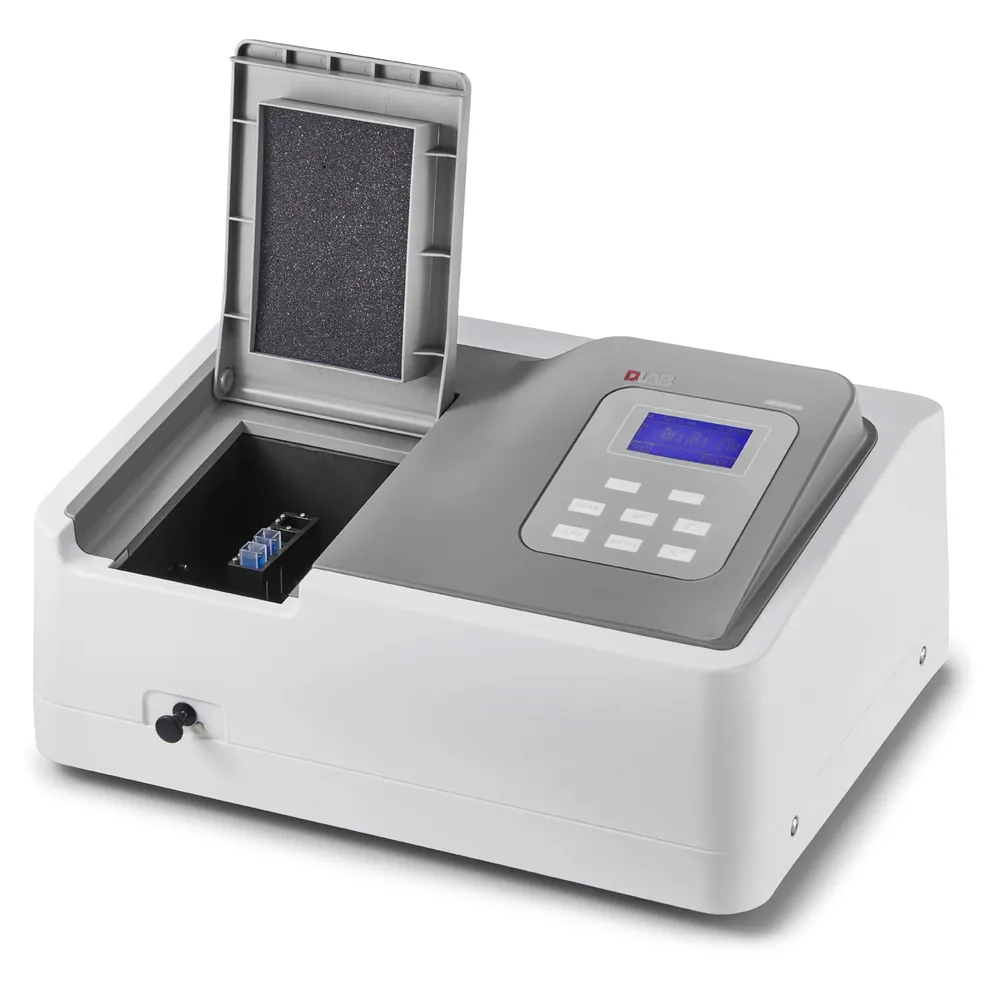
SP-UV Single-Beam UV-Vis Spectrophotometer
The SP-UV series single-beam UV-Vis spectrophotometer measures absorbance in the ultraviolet and visible ranges using deuterium and tungsten lamps together. With ranges starting at 190 or 200 nm, the SP-UV1000, SP-UV1100 and touchscreen SP-UV2102 models combine DNA, protein and chemical determinations in a single instrument.
Request a quote| Optical system | Single-beam |
|---|---|
| Light source | Deuterium and tungsten lamps |
| Wavelength range | 200–1000 nm or 190–1100 nm |
| Spectral bandwidth | 4.0 nm or 2.0 nm |
| Photometric range | -0.3 to 3.0 A |
Product description
A UV-Vis spectrophotometer measures the absorption of a sample in the ultraviolet and visible ranges. Because the ultraviolet range covers the absorption of nucleic acids at 260 nm and proteins at 280 nm, it is a fundamental analytical tool in biology and pharmaceutical laboratories.
The SP-UV series has a single-beam design: light is measured first with the reference and then with the sample. Switching between the two lamps is automatic. The SP-UV1000 is a basic UV-Vis instrument covering 200–1000 nm. The SP-UV1100 extends the range to 190–1100 nm and reduces the bandwidth to 2.0 nm. The SP-UV2102 combines the same range with a 10.1-inch touchscreen and scanning and kinetic functions.
The instruments measure solutions; color measuring instruments for surface color are a separate product group.
Model comparison
| Model | Wavelength range | Bandwidth | Wavelength accuracy | Stray light | Display |
|---|---|---|---|---|---|
| SP-UV1000 | 200–1000 nm | 4.0 nm | ±2 nm | ≤0.2 %T (360 nm) | Dot-matrix LCD |
| SP-UV1100 | 190–1100 nm | 2.0 nm | ±0.5 nm | ≤0.05 %T (220 and 360 nm) | Dot-matrix LCD |
| SP-UV2102 | 190–1100 nm | 2.0 nm | ±0.3 nm (full range) | ≤0.05 %T (220 and 360 nm) | 10.1-inch touchscreen |
The classic models (SP-UV1000 and SP-UV1100) store 200 data groups and 200 standard curves and retain data in the event of a sudden power failure. The touchscreen SP-UV2102 performs photometric measurement, quantitative analysis, spectrum scanning, kinetics and DNA/protein tests on the main unit; when used with PC software, user management and record-keeping functions are added.
Applications
- DNA and RNA purity checks in molecular biology (260/280 ratio)
- Protein determination and enzyme kinetics studies
- Quantitative analysis of UV-absorbing compounds in pharmaceutical and chemistry laboratories
- UV and visible range methods in water analysis
In laboratories that check samples before PCR and electrophoresis, these instruments are used in the same workflow as the PCR thermal cycler and the horizontal electrophoresis tank.
Recommendations for accurate measurement
In the UV range, the solvent's own absorption affects the result. For this reason, the blank solution is prepared from the same solvent as the sample and read again in each measurement series. In nucleic acid measurements, the 260/280 ratio provides a quick indication of protein contamination.
- Quartz cuvettes are used in the 200–340 nm range
- The instrument is run for a while to warm up the deuterium lamp
- Samples with absorbance above 2 A are diluted
Single-beam UV-Vis spectrophotometer selection criteria
If nucleic acid and protein measurements are to be performed, the SP-UV1100 or SP-UV2102 with a lower limit of 190 nm should be selected. A 2.0 nm bandwidth allows narrow absorption peaks to be read more accurately. For routine methods working only above 200 nm, the SP-UV1000 is an economical option.
For long-term kinetic measurements and analyses requiring high stability, double-beam UV-Vis spectrophotometers are more suitable. Laboratories working only in the visible range can consider visible spectrophotometers. All options are listed in the UV-Vis spectrophotometers category.
Technical specifications
| Optical system | Single-beam |
|---|---|
| Light source | Tungsten lamp and deuterium lamp |
| Wavelength range | SP-UV1000: 200–1000 nm; SP-UV1100 and SP-UV2102: 190–1100 nm |
| Spectral bandwidth | 4.0 nm (SP-UV1000); 2.0 nm (SP-UV1100, SP-UV2102) |
| Wavelength repeatability | ≤1 nm / ≤0.3 nm / ≤0.1 nm |
| Photometric range | -0.3 to 3.0 A |
| Photometric accuracy | ±0.003 A / ±0.002 A (at 0.5 A) / ±0.002 A (0–0.5 A) |
| Stability | ≤0.002 A/h (classic models); ≤0.001 A/h (SP-UV2102), at 500 nm |
| Sample holder | 4 positions, 10 mm path length |
| Scanning speed | High, medium, slow (SP-UV2102) |
| Display | Dot-matrix LCD; 10.1-inch touchscreen on the SP-UV2102 |
| Data output | USB and printer port |
| Power supply | 110/220 V AC, 50/60 Hz, 120 W |
| Weight | 14.6 kg (classic models); 20 kg (SP-UV2102) |
Values are taken from the manufacturer's published technical documentation. They may vary by configuration and are confirmed against the current datasheet before quotation.
Frequently asked questions
What is the difference between single-beam and double-beam UV-Vis?
In a single-beam instrument, the reference and sample are read in sequence; small changes in lamp intensity can be reflected in the result. In a double-beam instrument, the reference and sample are measured simultaneously, which increases stability in long measurements. For routine single-point measurements, a single-beam design is sufficient.
Which model is suitable for DNA measurement?
For measurements at 260 nm and 280 nm, the SP-UV1100 or SP-UV2102 with a lower limit of 190 nm is suitable. The SP-UV2102 offers a DNA/protein test function on the main unit.
Which cuvette should be used for UV measurement?
In the 200–340 nm range, quartz cuvettes should be used because glass and standard plastic cuvettes absorb the light. In the visible range, glass or optical plastic cuvettes are sufficient.
Can the instrument be used without a computer?
Yes. The classic models operate stand-alone with their display and keypad; the SP-UV2102 performs all functions, including scanning and kinetics, from its touchscreen.
Request a quote for this model
A suitable configuration and pricing are prepared based on sample type and workload.
Request a quote