

DLAB
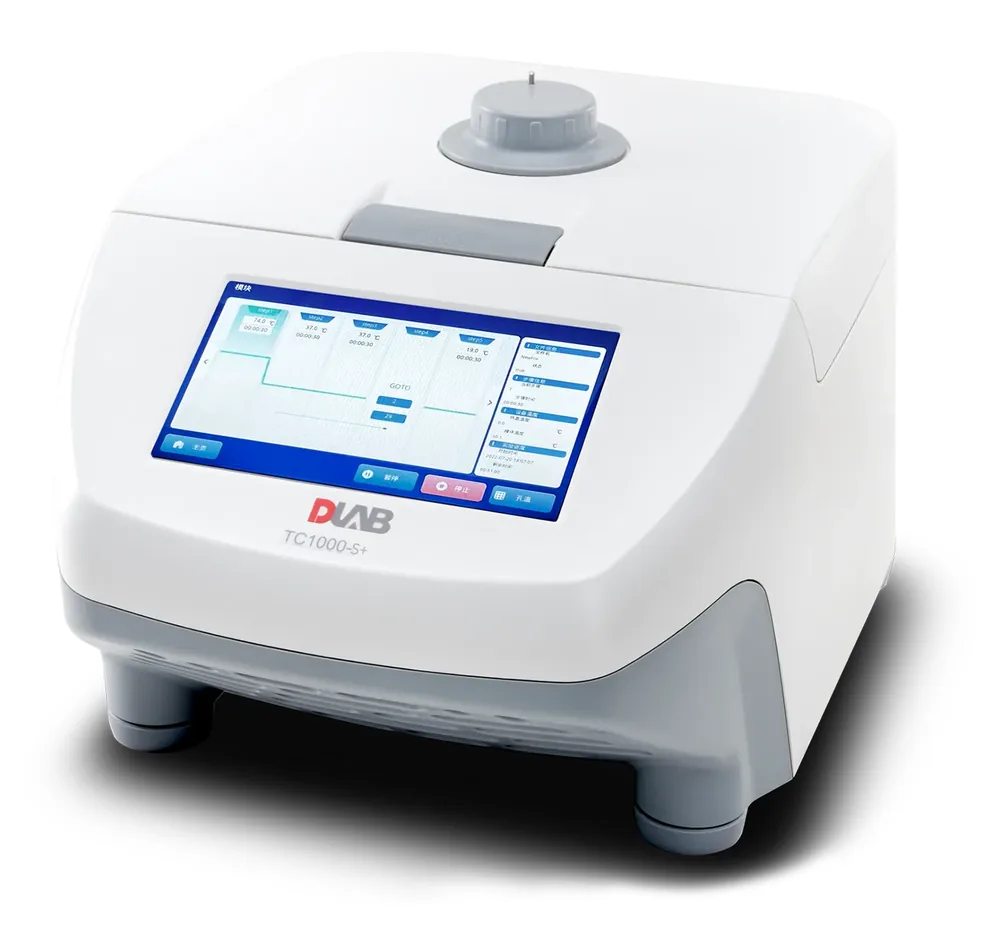
TC1000 and TC2000 PCR Thermal Cycler
The TC1000 and TC2000 series PCR thermal cycler runs DNA amplification programs with 0.2 mL tubes, 8-tube strips and 96-well plates at a temperature control accuracy of ±0.1 °C. The series includes the standard TC1000-S+, the gradient TC1000-G-Pro and the TC2000-G1/G2/G3 models, which run more than one program at the same time.
Request a quote| Sample capacity | 96 × 0.2 mL (TC2000-G2: 48, G3: 32-well modules) |
|---|---|
| Block temperature | 0–105 °C |
| Lid temperature | 30–115 °C |
| Heating and cooling | Up to 5 °C/s |
| Gradient | 1–42 °C (TC1000-G-Pro, TC2000-G1) |
Product description
A PCR thermal cycler is a thermal cycling instrument that repeats the denaturation, annealing and extension steps required for the polymerase chain reaction for programmed durations. In the DLAB TC series, the block is heated and cooled by high-performance Peltier elements and independent heating segments; thanks to auxiliary heating that reduces temperature deviation in the edge wells, block uniformity is specified as ±0.2 °C at 55 °C.
The series is structured in three tiers, from routine amplification to new primer optimization. The TC1000-S+ comes with a 7-inch touchscreen for standard programs. The TC1000-G-Pro creates a temperature gradient across the same block; thanks to its Wi-Fi module and USB connection, multiple instruments can be monitored from a single computer. The TC2000 family, with its 10.1-inch display and multi-channel design, runs different protocols at the same time.
Model comparison
| Model | Block configuration | Gradient range | Display | Program capacity |
|---|---|---|---|---|
| TC1000-S+ | 96 × 0.2 mL, single block | None | 7-inch touchscreen | 30 steps, 99 cycles, more than 200 files |
| TC1000-G-Pro | 96 × 0.2 mL, single block | 1–42 °C | 7-inch touchscreen | 30 steps, 99 cycles |
| TC2000-G1 | 96 × 0.2 mL, single channel | 1–42 °C | 10.1-inch touchscreen | 30 steps, 199 cycles |
| TC2000-G2 | 48 × 0.2 mL modules, dual channel | 1–25 °C | 10.1-inch touchscreen | 30 steps, 199 cycles |
| TC2000-G3 | 32 × 0.2 mL modules, triple channel | 1–25 °C | 10.1-inch touchscreen | 30 steps, 199 cycles |
On all models, the heating temperature is 0–105 °C, the lid temperature is 30–115 °C and the maximum heating and cooling rate is 5 °C/s. The gradient is defined within a 30–105 °C setting range and is switched off when 0 is entered.
Applications
- Template preparation for gene cloning, genotyping and pre-sequencing
- Annealing temperature optimization for new primers and reaction mixes (gradient models)
- Touchdown PCR and long PCR protocols
- Pre-amplification in mutation analysis and gene expression studies
- Pathogen detection by end-point PCR in food, agriculture and environmental laboratories
- Shared laboratories in which multiple users work with different programs (TC2000-G2 and G3)
The instruments are used with disposable 0.2 mL PCR tubes, 8-tube strips and non-skirted or semi-skirted 96-well plates. A brief spin before loading plates and strips collects droplets from the tube walls at the bottom; the D1008 and D1012UA mini centrifuge is a suitable complement for this task.
PCR thermal cycler selection criteria
- Optimization requirements: If routine amplification is performed with established protocols, the TC1000-S+ is sufficient; when working with a new primer or enzyme system, the gradient TC1000-G-Pro or TC2000-G1 is preferred.
- Number of simultaneous programs: If two or three different temperature profiles are to be run at the same time, the TC2000-G2 or G3 meets the need for multiple blocks with a single instrument.
- Sample volume: For high-throughput work requiring a full 96 wells, the single-block models are more efficient; for many small batches, the multi-channel models are more efficient.
- Data and user management: If user accounts, passwords, USB data transfer and network monitoring are required, the TC1000-G-Pro and TC2000 models should be considered.
The amplified product is usually checked on an agarose gel; for this step, DL-SUB horizontal electrophoresis tanks and DEP electrophoresis power supplies can be planned together. Other molecular biology instruments are listed under PCR instruments and electrophoresis systems; for method information, see the laboratory technologies page.
Technical specifications
| Compatible consumables | 0.2 mL PCR tube, 0.2 mL 8-tube PCR strip, 0.2 mL 96-well PCR plate |
|---|---|
| Block module | 96 × 0.2 mL; TC2000-G2 48 × 0.2 mL, TC2000-G3 32 × 0.2 mL |
| Heating temperature | 0–105 °C |
| Lid temperature | 30–115 °C |
| Temperature control accuracy | ±0.1 °C |
| Temperature display resolution | 0.1 °C |
| Block uniformity (55 °C) | ±0.2 °C |
| Maximum heating and cooling rate | 5 °C/s |
| Gradient setting range | 30–105 °C (gradient models) |
| Gradient span | 1–42 °C (TC1000-G-Pro, TC2000-G1); 1–25 °C (TC2000-G2, G3) |
| Block material | Aluminum |
| Display | 7-inch LCD 1024 × 600 (TC1000); 10.1-inch LCD 1280 × 800 (TC2000) |
| Program | 30 steps; 99 cycles (TC1000), 199 cycles (TC2000) |
| Power failure protection | Yes, the program resumes where it stopped |
| Power | 600 W (TC1000, TC2000-G1); 1000 W (G2); 1500 W (G3) |
| Dimensions and weight | 296 × 370 × 295 mm, 9.5 kg (TC1000); 310 × 422 × 264 mm, 11 kg (TC2000) |
Values are taken from the manufacturer's published technical documentation. They may vary by configuration and are confirmed against the current datasheet before quotation.
Frequently asked questions
What is the gradient function used for?
The gradient applies different annealing temperatures from one end of the block to the other. This allows the optimal annealing temperature for a new primer pair to be determined in a single run, eliminating the need for separate trials.
Do the channels on the TC2000-G2 and G3 models operate independently?
On these models, the block is divided into two or three zones, and each zone can run its own temperature program. This design allows small batches and different protocols to be run at the same time.
What happens to the program during a power failure?
The instruments have power failure protection; when power is restored, interrupted cycles resume automatically. Nevertheless, using an uninterruptible power supply is recommended for critical samples.
Which plate types can be used?
0.2 mL PCR tubes, 8-tube strips and 96-well PCR plates can be used. The TC2000 models support non-skirted and semi-skirted plates; the self-adjusting lid adapts to different tube heights.
Request a quote for this model
A suitable configuration and pricing are prepared based on sample type and workload.
Request a quote