

Advion Interchim Scientific
Plate Express
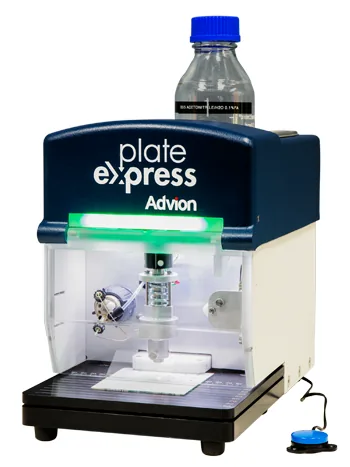
Plate Express is an automated TLC-MS interface that acquires a mass spectrum directly from a spot on a TLC plate. The instrument works together with the expression CMS mass spectrometer and confirms compound identity in under a minute without sample preparation.
Request a quote| Function | Direct mass analysis from a TLC spot |
|---|---|
| Connected instrument | expression CMS mass spectrometer |
| Time | Under one minute per spot |
| Preparation | No sample preparation required |
| Control | Mass Express software, laser alignment |
Product description
Which compound a spot on a TLC plate belongs to cannot be determined by looking at the plate. In the conventional method, the spot is scraped off the plate, dissolved and introduced into a mass spectrometer; this process is time-consuming and leads to sample loss.
Plate Express positions the extraction head directly over the spot; the compound is taken up from the plate with solvent and transferred to the mass spectrometer. Scraping, dissolving and syringe injection steps are no longer needed.
A laser pointer is used to align the spot; the process is software-controlled and automated. The manufacturer refers to this technique as TLC/CMS.
Advantages of the TLC-MS interface
For complex mixtures, TLC alone is insufficient. Two compounds can have the same Rf value and cannot be distinguished visually; mass information removes this ambiguity.
- Confirmation within minutes of whether a reaction has given the expected product
- Identification of by-products and impurities
- Determination of the spot belonging to the target compound before purification
- Component screening in natural product extracts
Plate Express does not operate on its own; it is used together with the expression CMS mass spectrometer, and the two instruments are priced together.
TLC-MS workflow
Working with Plate Express consists of three steps. First, the TLC plate is developed and the spots are located with the TLC-FlashReader plate reader or under a UV lamp. The plate is then placed in the interface and the spot of interest is aligned with the laser pointer. Finally, the extraction head takes up the compound from the plate and the expression CMS compact mass spectrometer records the mass spectrum.
This workflow allows the target compound to be confirmed before purification; the method is then transferred to flash chromatography systems. All TLC solutions are listed in the TLC systems section.
Correct use and common mistakes
The extraction solvent should be chosen so that it can take up the compound from the plate and support ionization; an unsuitable solvent leads to a weak signal. In addition, alignment should be performed carefully on plates where spots are very close together; otherwise, compound from a neighboring spot may contaminate the spectrum. Completely removing the development solvent from the plate also reduces background signal.
Measuring a known reference compound on the same plate before analysis makes it easier to verify signal level and alignment. This check is especially recommended when switching to a new solvent system or a different plate type.
Technical assessment of the TLC-MS interface
The manufacturer does not publish numerical technical data for this product; dimensions, weight and solvent flow values are obtained in writing from the manufacturer when needed.
Before adopting TLC-MS, a demo with the user's own samples is recommended; the ionization behavior of the compound determines how usable the result is.
Frequently asked questions
Does Plate Express operate on its own?
No. The interface is used together with the expression CMS mass spectrometer, and the two instruments are priced together.
How long does the analysis of one spot take?
Analysis is completed in under one minute per spot, and no sample preparation is required.
When is TLC-MS preferred?
It is preferred in situations where TLC alone is insufficient, such as distinguishing compounds that run at the same Rf value, rapidly confirming a reaction product and identifying by-products.
Request a quote for this model
A suitable configuration and pricing are prepared based on sample type and workload.
Request a quote