How does moisture determination by loss on drying work?
In thermogravimetric moisture determination, the sample is weighed, dried at a defined temperature and weighed again. The difference is reported as moisture content. This approach is widely used for food, feed, plastic granules, chemical powders and pharmaceutical raw materials; for plastics, the method is defined in the ASTM D6980 standard.
Weight loss covers not only water but all volatile components removed by heat. For samples containing alcohol, solvent residues or heat-degradable components, the result is therefore interpreted as "volatile matter".
Drying oven method: the reference, but slow
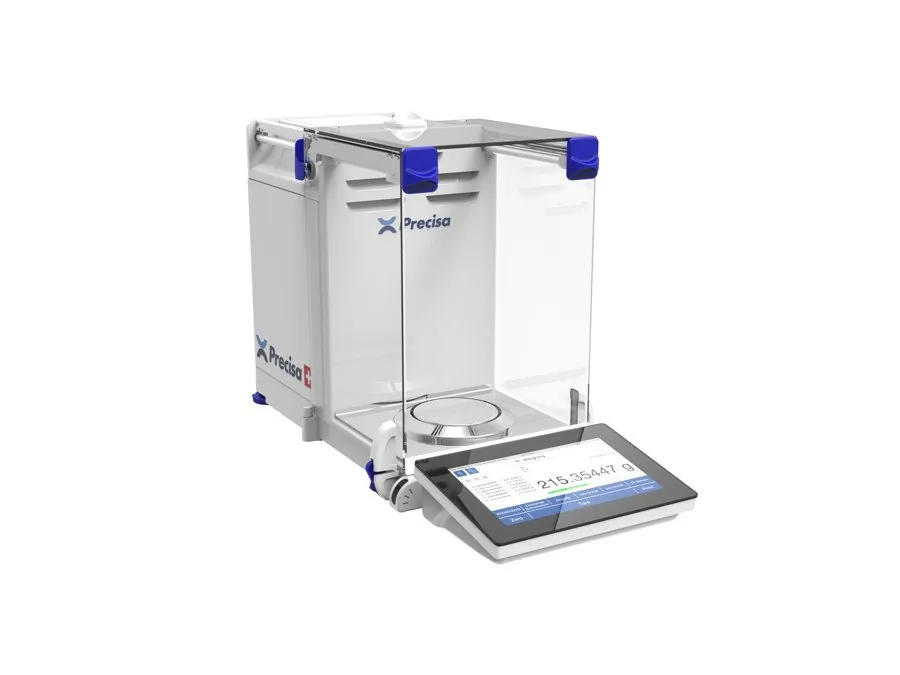
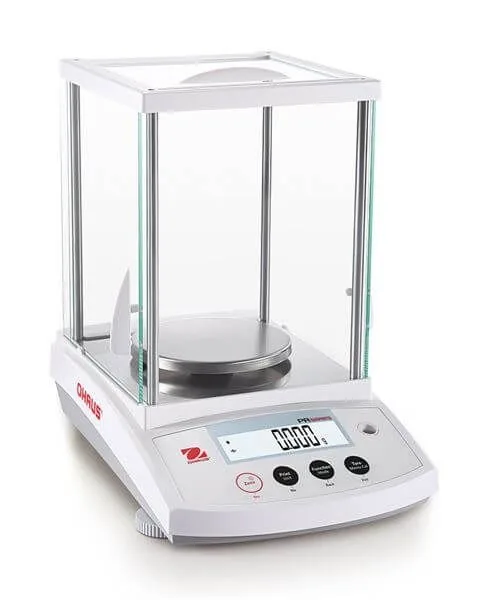
In the drying oven method, the sample is weighed into containers, dried for hours at a defined temperature, cooled in a desiccator and weighed again on an analytical balance. Many product standards accept this method as the reference.
- Strength: Many samples can be processed at the same time, and the method is defined in official methods.
- Weakness: The result is obtained hours later; it is not suitable for instant decisions on the production line.
- Sources of error: Moisture reabsorption during cooling, mix-up of containers and manual handling between weighings.
Halogen moisture analyzer: results within minutes
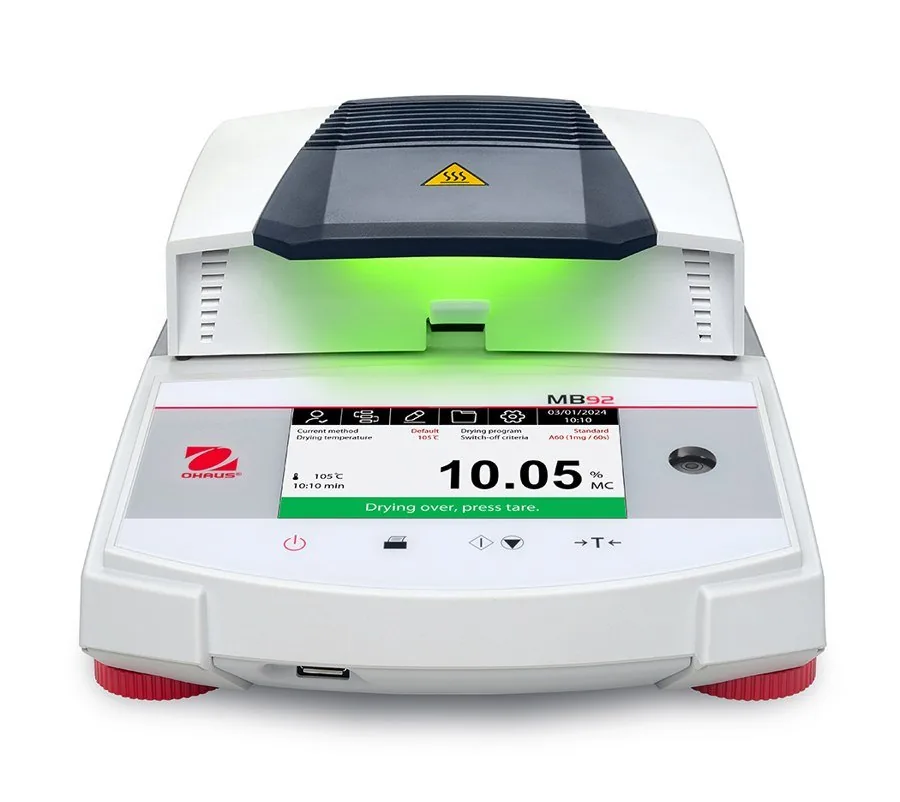
A halogen moisture analyzer combines a precision balance and a halogen heater in a single unit. While heating the sample, the instrument continuously monitors weight loss and ends the measurement automatically when the weight change falls below the set criterion. A process that takes hours in a drying oven is completed within minutes for most samples.
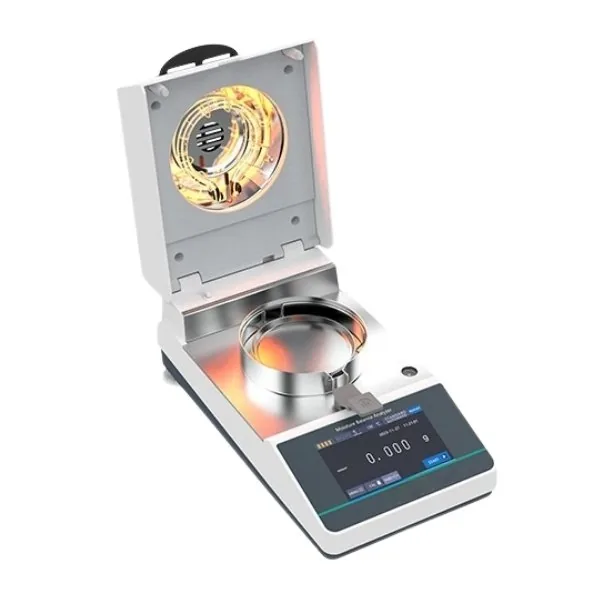
The carbon fiber heated moisture analyzer, which works on the same principle, operates in the 40–200 °C range and offers 90 g capacity and 1 mg readability. Standard, fast, ramp and step drying profiles allow heat-sensitive samples to dry without the surface burning.
The result of a moisture analyzer does not have to be identical to the drying oven result. The correct approach is to adjust the instrument method once against the drying oven result and to perform subsequent measurements with this method.
Moisture determination approach by sample type
Grain, flour and feed
These samples are homogeneous and relatively heat-resistant. The ground sample is spread in a thin layer, and a result is obtained quickly with the standard drying profile. For batch-to-batch comparison, the sample quantity is kept the same in every measurement.
Plastic granules
Moisture in granules is low and causes surface defects in injection molding. At low moisture levels, weighing precision and sample quantity become important; an instrument with high readability and a larger sample quantity improve repeatability.
Sugary and heat-sensitive products
Samples rich in sugar and protein caramelize or decompose at high temperature; in this case, weight loss appears greater than the moisture content. A lower temperature and a step or ramp drying profile reduce this error.
Liquid and paste samples
For samples that form a skin on the surface, a glass fiber pad is used. The pad spreads the sample over a large surface, ensuring that evaporation proceeds evenly.
How is a method set up for halogen moisture determination?
Method adaptation means linking the fast method to the reference method. The following steps can be applied to most sample types:
- A reference moisture value is determined by the drying oven method from the same sample batch.
- Different combinations of temperature and switch-off criterion are tested on the moisture analyzer.
- The combination that gives the result closest to the reference value and is repeatable is saved as the method.
- The method is verified with samples from different batches and periodically compared with the drying oven result.
If the temperature is set higher than necessary, the sample surface darkens and decomposition products are added to the weight loss. If it is set lower than necessary, the measurement takes longer and part of the moisture remains in the sample.
Switch-off criterion and result unit
Moisture analyzers generally end the measurement in one of two ways: after a defined time, or when the weight loss per unit time falls below a defined value. An automatic switch-off criterion adjusts the time to the sample by itself and is preferred for routine measurement; a fixed time simplifies method comparisons.
- Moisture (%): Ratio of the weight lost to the initial weight.
- Solids (%): Ratio of the remaining weight to the initial weight.
- Dry weight: Amount of sample remaining after drying.
In addition to the result unit, the drying temperature, profile, switch-off criterion and sample quantity are also stated in the report. Without this information, comparing two moisture results can be misleading.
Sample preparation and common mistakes
- The sample is spread on the pan in a thin, even layer; a sample placed in a heap does not dry from the inside.
- A glass fiber pad is used for liquid and paste samples; the pad increases the surface area and prevents skin formation.
- The sample quantity is fixed in the method; changing the quantity affects drying time and the result.
- After weighing, the sample is measured immediately; a sample left uncovered exchanges moisture with the environment.
- The instrument is placed on a level bench away from drafts and vibration; the weighing section is sensitive to these effects.
For traceability of moisture determination results, the weighing section of the instrument is checked periodically with calibration weights and the heater with a temperature calibration kit. If precision weighing is also performed in the laboratory, the instrument can be included in the same calibration plan as the precision balances.
Which method should be chosen and when?
- Fast decisions on the production line, many individual samples per day: Halogen or carbon fiber heated moisture analyzer.
- Official analysis, certification or disputes: The drying oven method defined in the standard.
- Using both together: Routine control with the moisture analyzer, periodic verification with the drying oven.
All weighing and moisture determination instruments are listed in the balances and moisture determination section; a summary of measurement principles is on the laboratory technologies page.
Frequently asked questions
Does a halogen moisture analyzer give the same result as a drying oven?
Not always exactly. Because the heating method and time differ, small differences can occur in the result. Once the instrument method has been adjusted against the drying oven result, routine measurements become consistent with the reference.
What is the difference between halogen and carbon fiber heaters?
Both heat the sample rapidly by radiation. Carbon fiber heaters differ in the type of heating element; features such as temperature range, drying profiles and memory vary by model. The method requirement is decisive in the selection.
How long does a measurement take?
The time depends on the moisture content and quantity of the sample and the selected temperature. For most solid samples, a few minutes to ten minutes is sufficient; for samples with high moisture that form a skin, the time is longer.
Can moisture be determined in liquid samples?
Yes. The liquid sample is spread on a glass fiber pad to increase the surface area; this allows evaporation without a skin forming on the surface.