

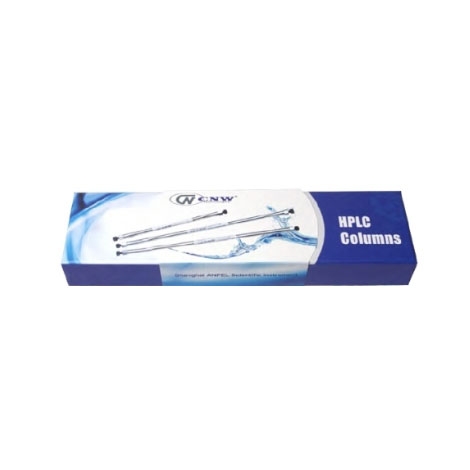
HPLC / LC Columns
HPLC Columns
An HPLC column is a chromatography column that separates the components of a liquid sample based on differences in their distribution between the stationary phase and the mobile phase. Reversed phase, normal phase, HILIC, ion exchange, size exclusion and chiral columns are supplied, along with guard column cartridges and holders.
Request a quote| Phase types | Reversed phase, normal phase, HILIC, ion exchange, SEC, chiral |
|---|---|
| Particle size | 1.5–20 µm |
| Pore size | 60–1000 Å |
| Column diameter | 2.1 · 4.6 · 7.8 mm and preparative dimensions |
| Length | 50–300 mm |
Phase groups
Reversed phase columns
Most analyses are run on reversed phase columns. The C18 phase is the standard for general-purpose use; C8 is suitable for shorter retention and C4 for large biomolecules. Wide-pore (300 Å) versions are used for protein and peptide analysis, and 100% aqueous-compatible versions for fully aqueous mobile phases. Alternative selectivities such as phenyl, pentafluorophenyl and C30 offer a solution for compounds that cannot be separated on C18.
Normal phase and HILIC columns
Bare silica, cyanopropyl and aminopropyl phases are used for normal phase applications, while HILIC columns are used when polar compounds are not retained in reversed phase. Acidic, basic and neutral surface options are available on the HILIC side.
Ion exchange and size exclusion
Strong and weak anion/cation exchange columns are used in nucleotide, organic acid and protein analyses. Size exclusion columns, with silica and polymer matrix options, separate by molecular weight. Ligand exchange columns for sugar and organic acid analysis form a separate group.
Chiral columns
Polysaccharide-based chiral phases are used to separate enantiomers. Coated phases have limited solvent compatibility; an immobilized phase is required when working with tetrahydrofuran and chlorinated solvents. Protein-based chiral phases can also be supplied for specific compound groups.
Guard columns
A guard column cartridge is placed before the analytical column and traps particles and strongly retained impurities. The cartridge costs a small percentage of the analytical column; in laboratories working with dirty matrices, its use significantly extends column life.
HPLC column selection criteria
- Particle size: Smaller particles give sharper peaks and increase system pressure. The pressure limit of the instrument is decisive.
- Pore size: 100–120 Å is used for small molecules, and 300 Å and above for proteins and peptides.
- pH stability: The pH range of the method is the most critical parameter determining column life.
- Silica type: High-purity silica reduces peak tailing for basic compounds.
- Scalability: If a transition from analytical to preparative scale is planned, staying within the same phase family makes method transfer easier.
When the method, current column specifications and sample matrix are provided, an equivalent phase recommendation is presented along with dimensions and technical rationale.
Technical evaluation
The source of problems such as peak tailing, increasing backpressure and retention drift is often the column itself rather than the mobile phase. Applying a washing and conditioning procedure before replacing the column is recommended.
The most effective practice for extending column life is the use of a guard column. Working without a guard column on dirty matrices such as serum, food extracts and wastewater multiplies the cost of analytical columns several times over.
Biomolecule columns require different storage and conditioning conditions; the instructions for use are reviewed together at delivery.
The first step in protecting the column is sample preparation: passing the sample through a syringe filter and cleaning dirty matrices with an SPE cartridge are recommended. 9 mm screw HPLC vials are the standard choice for injection. The general framework of chromatographic separation parameters is defined in EPA SW-846 Method 8000D.
If scaling the same phase from analytical to preparative is planned, scalable analytical HPLC columns can be considered.
Frequently asked questions
Is it right to start with a reversed phase column?
Most analyses are run on reversed phase C18 columns, which are a common starting point for new methods. If polar compounds are not retained, HILIC is considered; for charged compounds, ion exchange columns are considered.
Is a guard column really necessary?
When working with dirty matrices (serum, food extracts, wastewater), a guard column significantly extends the life of the analytical column. It is not mandatory for analyses run with clean standards.
How is an equivalent column determined?
An equivalent phase is recommended by evaluating the phase, particle size, pore size and dimensions of the current column together with the method information; the system suitability test should be repeated after the changeover.
Request a quote for this model
A suitable configuration and pricing are prepared based on sample type and workload.
Request a quote