

Vials, Caps and Septa
ND9 Vials and Caps
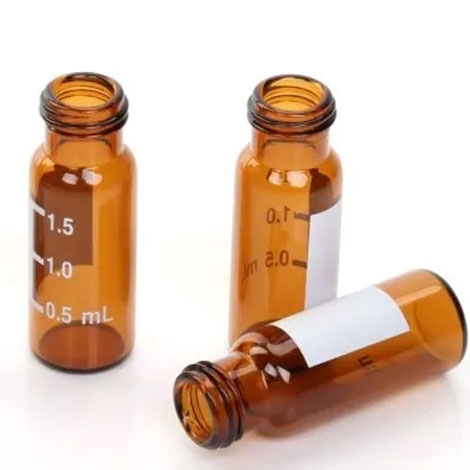
ND9 is the 9 mm screw thread HPLC vial most frequently used in laboratories. It is offered in clear and amber glass, with printed and unprinted bodies, in versions with factory-fitted inserts and with various cap and septum combinations.
Request a quote| Neck type | ND9 screw thread (9 mm) |
|---|---|
| Volume | 1.5 mL |
| Dimensions | 11.6 × 32 mm |
| Insert option | 150 µL and 200 µL factory-fitted |
| Cap | Screw cap; plain, pre-slit or bonded septum |
Product description
ND9 is the most widely used vial type in the laboratory. The 9 mm screw cap closes with one hand and requires no crimping tool. Unlike a crimp cap, it can be opened and reclosed, which is a significant advantage when the sample needs to be stored or reinjected.
Borosilicate glass provides resistance to solvents and to acidic and basic samples. Because ion leaching from the glass into the sample is low, the baseline stays clean in trace-level analyses. The composition and classification of laboratory glass are defined in the ASTM E438 standard.
Versions with factory-fitted inserts are designed for laboratories working with small sample quantities. The separate step of fitting an insert is eliminated, and the risk of the insert bending or shifting is reduced.
9 mm screw thread HPLC vial versions
- Clear, unprinted: The standard choice for routine analysis and for users who need to inspect the sample visually.
- Clear, printed: Has a writing area and graduation on the body. Makes it easier to track sample IDs in series with many samples.
- Amber: For light-sensitive compounds. The sample is not visible, which is a drawback; if not needed, clear glass should be preferred.
- With fitted insert: A 150 µL or 200 µL conical insert comes factory-fitted. The right choice when the sample amount is limited.
Technical assessment
A bonded septum is fixed inside the cap. The septum does not move when the cap is opened; it is preferred in automated capping systems and in high-throughput use.
Vials and caps from different brands should not be combined in the same series. Thread tolerances differ slightly, and leakage and needle alignment problems usually originate here.
Cap and septum
The ND9 vial is used with a 9 mm screw cap. The wide opening makes pipette filling and insert placement easier; however, because the open surface is larger, tightening the cap fully is important.
Cap type
Suitable cap: 9 mm screw caps for vials. In high-throughput automation, caps with bonded septa are preferred.
Septum type
- PTFE/silicone septum: PTFE on the side facing the sample, silicone on the back. Provides both chemical inertness and resealing; it is the standard choice for HPLC and GC applications.
- Single-layer silicone septum: No PTFE facing. Reseals better; used for multiple piercings and storage, not recommended for trace analysis.
In routine HPLC series, a 1.3 mm septum is a balanced choice between sealing and needle resistance; if many injections are to be made from the same vial, a pre-slit septum is considered.
When working with inserts, check that the cap and septum do not press down on the insert. Factory-assembled vials with fitted inserts reduce the need for this check.
Place in the analytical workflow
The ND9 vial sits in the middle of the workflow from sample preparation to separation. The sample is first passed through a syringe filter, then transferred to the vial and injected from the autosampler onto the HPLC column. For other vial sizes, see the vial, cap and septum options section.
Frequently asked questions
Which autosamplers does the ND9 vial fit?
The 11.6×32 mm body is compatible with the vast majority of HPLC autosamplers that use standard 2 mL trays. Once the instrument model is provided, needle depth and tray compatibility are confirmed.
When is an ND9 with insert preferred?
When the sample volume is below 200 µL, the needle cannot reach the liquid in a standard vial. A factory-fitted 150 or 200 µL insert allows almost all of the sample to be drawn.
Can vials and caps from different brands be used together?
This is not recommended. Small differences in thread tolerances can lead to leakage and needle alignment problems; the vial and cap should be selected from the same series.
From the same category
ND8 Vials and Caps
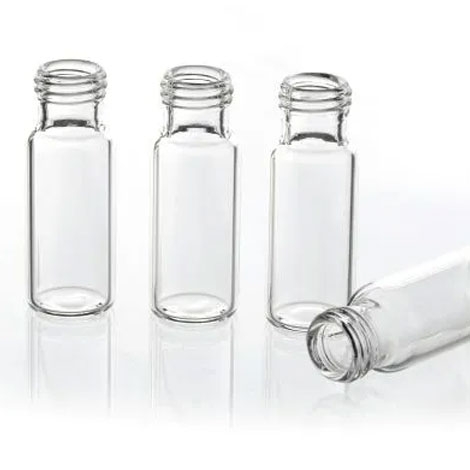
8-425 thread, 1.5 mL screw thread HPLC vials; clear and amber, with printed options.
ND11 Crimp Vials and Caps
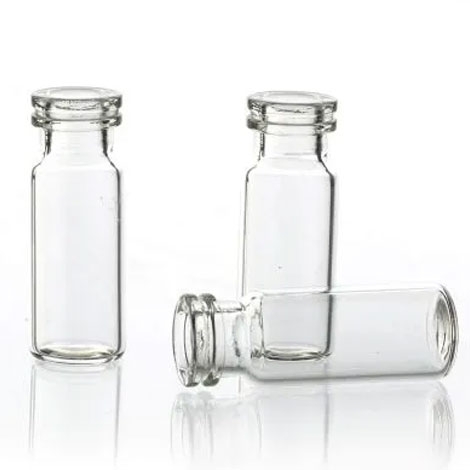
1.5 mL vials with 11 mm crimp neck; aluminum cap and rubber/PTFE septum options.
ND13 Vials and Caps
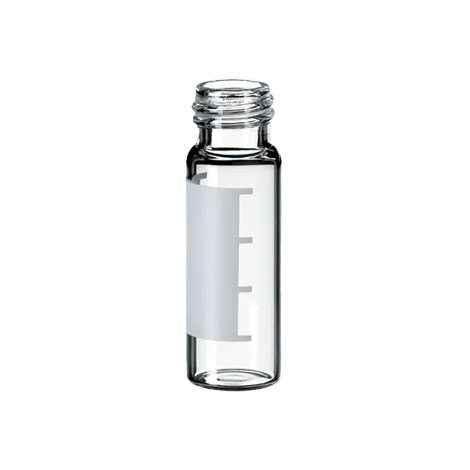
4 mL, 13 mm screw thread vials for large-volume samples and storage.
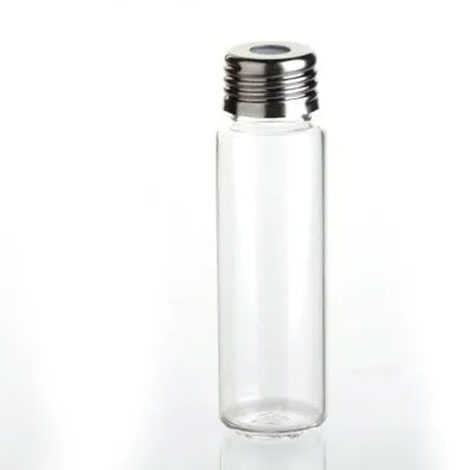
ND18 Headspace Vials and Magnetic Caps
18 mm screw thread headspace vials, 10 and 20 mL, with magnetic cap options.
Request a quote for this model
A suitable configuration and pricing are prepared based on sample type and workload.
Request a quote