

Viscosity and Rheology
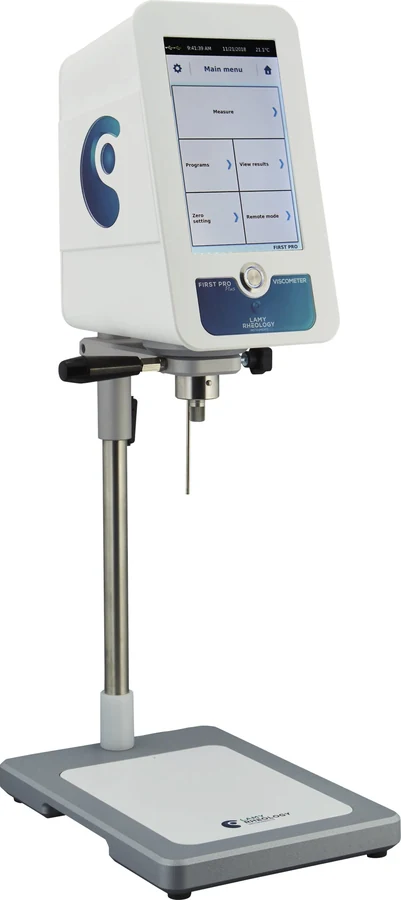
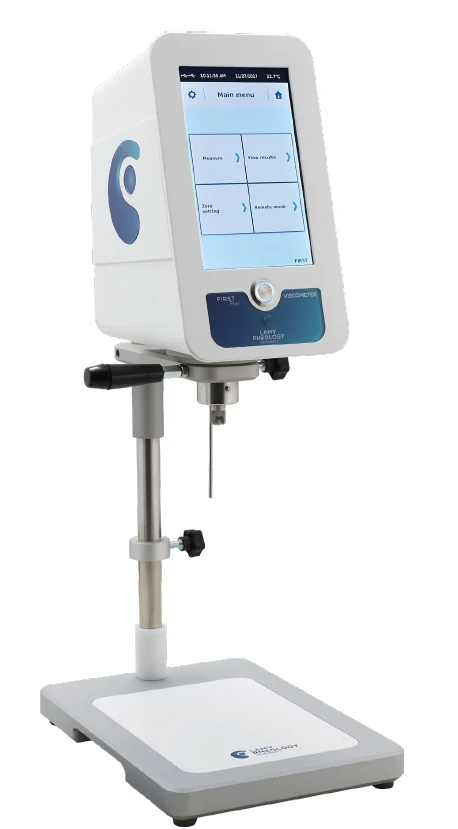
Programmable Rotational Viscometer
The programmable viscometer stores the measurement method step by step, produces pass/fail decisions against quality control limits and directly controls the temperature control unit. LIMS and MODBUS support are included.
Request a quote| Speed | 0.3–250 rpm, unlimited selection |
|---|---|
| Torque | 0.05–13 mNm (LR: 0.005–0.8 mNm) |
| Method | Multi-step, storable |
| Quality limit | Pass / fail indicator |
| Communication | LIMS and MODBUS |
Product description
The programmable viscometer moves the measurement out of the operator's memory and into the instrument's memory. Speed, time, temperature and spindle settings for each sample type are stored as a method; the operator selects the method and presses start.
This approach directly improves repeatability. Even when different people measure on different shifts, the conditions remain the same. In most laboratories, shift-to-shift deviation is a larger source of error than instrument uncertainty; method programming eliminates this source.
A multi-step method applies several conditions in sequence within a single run. For example, a reading is taken at 10 rpm for 60 seconds, followed by 100 rpm for 60 seconds; for thixotropic products, the difference between these two readings is a practical indicator of structural breakdown.
The quality control limit function compares the measured value with defined lower and upper limits and displays pass or fail on the screen. The operator does not need to interpret the number; the decision is made by the instrument.
Common technical platform
All instruments in this class operate on the springless measuring principle. In conventional designs with a spiral spring, spring fatigue leads to calibration drift over time; in a springless system, torque is measured directly and this drift is eliminated.
The spindle coupling is a bayonet type rather than a threaded one. The spindle is attached and removed in a single motion; there is no thread wear or cross-threading over time. In laboratories that change spindles frequently, this detail reduces the daily workload.
- Accuracy: 1% of full scale
- Repeatability: 0.2%
- Temperature sensor: PT100, -50 °C … +300 °C
- Display: 7-inch color touchscreen, Turkish menu
- Values shown on the display: viscosity, speed, shear rate, torque, shear stress, time, temperature
- Power supply: 90–240 VAC, 50/60 Hz
Method programming on the programmable viscometer
Parameters defined in the method
- Measurement geometry and spindle code
- Rotational speed or shear rate directly
- Step time and total measurement time
- Target temperature and hold condition
- Pass and fail limits
- Report title and sample ID fields
Temperature unit control
The instrument directly controls the connected temperature control unit. The target temperature is defined in the method; once the unit reaches the temperature and stabilizes, the measurement starts automatically. The operator does not need to watch a thermometer and time the start.
Method programming is not merely a convenience feature. In regulated laboratories, measurement conditions are expected to be documented and unalterable; a locked method meets this expectation.
Related standards
Rotational viscosity measurement is reported according to different standards depending on the industry. The instruments can be configured to operate in line with the measurement conditions defined in the following standard families.
- ASTM: D2196 (rotational viscosity), D789 (polyamides), D1084 and D2556 (adhesives), D1417 and D1439 (latex and cellulose derivatives), D4878 (polyols), D6279, D3236, D3794, D4016
- ISO: 2555, 3219, 1652, 2884-2
- DIN: 53019, 3219, 2555, 52007-1, 54453
- EN: 12092, 12802, 15425, 15564, 2555, 3219
The applicable standard directly determines the measurement geometry and shear rate. When the standard number is stated in the quotation request, the appropriate geometry set is recommended.
Communication and integration
In addition to RS232, USB and Ethernet connections, the MODBUS protocol is supported. MODBUS allows the instrument to be connected to the control system on the production line; the viscosity value flows live into the process control software.
- LIMS: The result is written to the laboratory information system together with the sample ID.
- MODBUS: Live data transfer to the production control system.
- Printer: Direct reporting with PCL/5-compatible devices.
- Analog output: 4–20 mA signal scaled to the torque range.
Other options in the series and the basic models are listed on the rotational and KU viscometer models page, and all instruments are in the viscosity and rheology category. Determination of apparent viscosity in resins and dispersions is defined in ISO 2555.
Technical specifications
| Speed range | 0.3–250 rpm, stepless |
|---|---|
| Torque (standard) | 0.05–13 mNm |
| Torque (low range) | 0.005–0.8 mNm |
| Viscosity | 200–240,000,000 mPa·s (depending on geometry) |
| Accuracy | 1% of full scale |
| Repeatability | 0.2% |
| Temperature | PT100, -50 °C … +300 °C, standard |
| Method | Multi-step programming and storage |
| Quality control | Lower / upper limit, pass/fail indicator |
| Temperature unit | Controlled directly from the instrument |
| Data output | RS232, USB, Ethernet, 4–20 mA |
| Protocol | LIMS, MODBUS |
| Weight | 6.1 kg |
| Power supply | 90–240 VAC, 50/60 Hz |
Values are taken from the manufacturer's published technical documentation. They may vary by configuration and are confirmed against the current datasheet before quotation.
Frequently asked questions
What is a multi-step method used for?
It applies several measurement conditions in sequence within a single run. Readings taken at different speeds provide information about the sample's shear-thinning or thixotropic behavior. It also guarantees that every measurement is carried out in the same order.
How is a quality control limit defined?
Lower and upper viscosity limits are entered for each method. When the measurement is complete, the instrument compares the result with these limits and displays pass or fail on the screen. In protected mode, the limits can be locked against operator changes.
When is a MODBUS connection needed?
It is used when the viscosity value must be transferred live to the production control system. For routine in-lab testing, a LIMS connection is sufficient.
Can a flow curve be viewed on the display?
This model does not plot curves on the display; it offers method programming and reporting. If the curve needs to be monitored live during measurement, the real-time viscometer should be preferred.
What is the measurement accuracy?
An accuracy of 1% of full scale and a repeatability of 0.2% apply to all instruments. These values should be considered together with the selected measurement geometry; the geometry determines the measurable viscosity range.
How is temperature measured?
A PT100 sensor reads the sample temperature between -50 °C and +300 °C. Since viscosity depends strongly on temperature, the measurement report should also include the temperature. A jacketed vessel or a circulating bath is used to keep the temperature constant.
Is a Turkish menu available?
Yes. The 7-inch color touchscreen offers a multilingual menu that includes Turkish. Users can be defined with an operator name and a four-digit code; in protected mode, the measurement conditions are locked.
From the same category
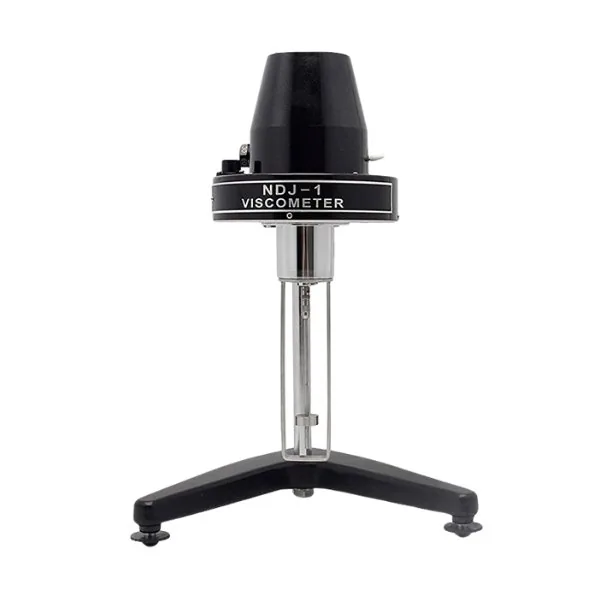
Viscometers
Rotational and KU viscometers; analog, digital and professional series.
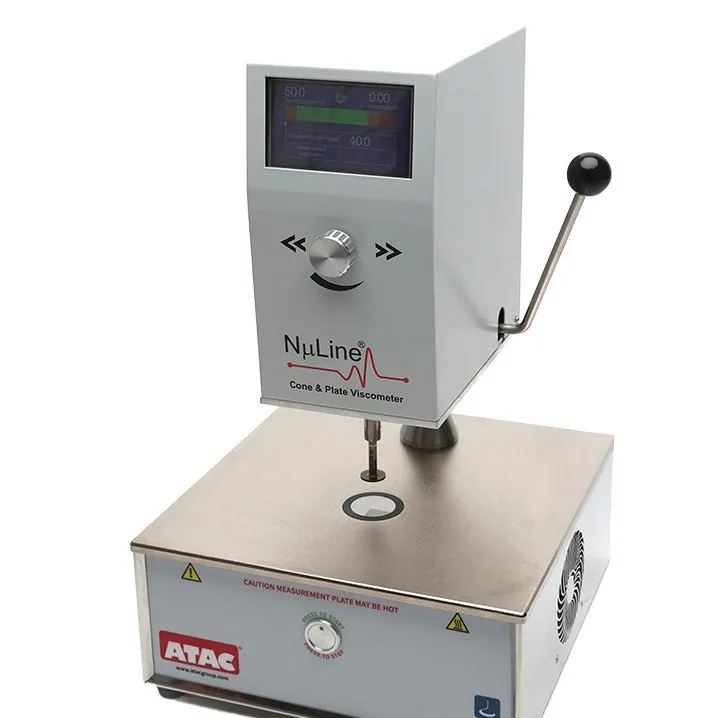
Cone and Plate Viscometer
High shear rate viscosity measurement for polymers, resins, paints and adhesives; up to 250 °C.
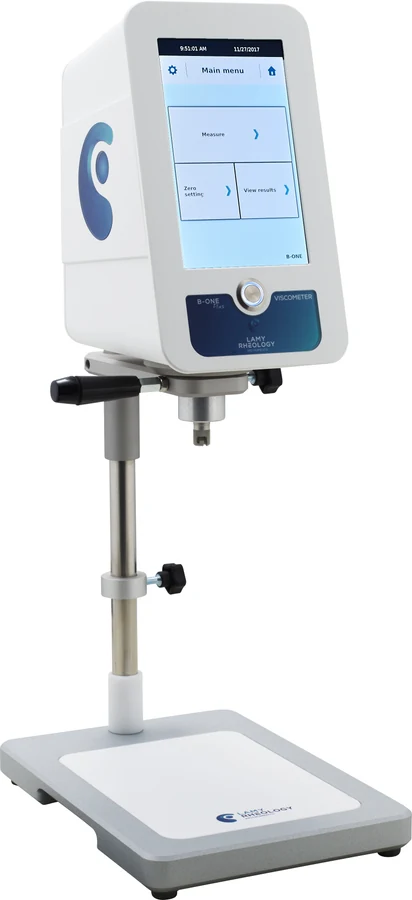
Entry-Level Rotational Viscometer
0.3–250 rpm, 0.05–13 mNm; springless measurement, 7-inch touchscreen, Turkish-language menu.
Laboratory-Class Rotational Viscometer
LIMS-compatible rotational viscometer with standard temperature probe and Ethernet connection.
Request a quote for this model
A suitable configuration and pricing are prepared based on sample type and workload.
Request a quote