

Viscosity and Rheology
Real-Time Rotational Viscometer
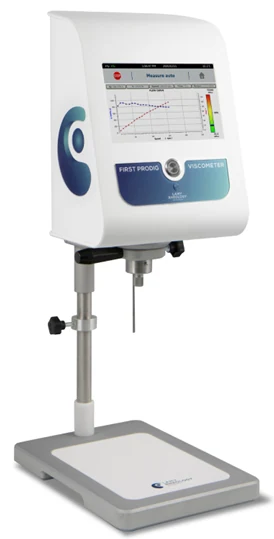
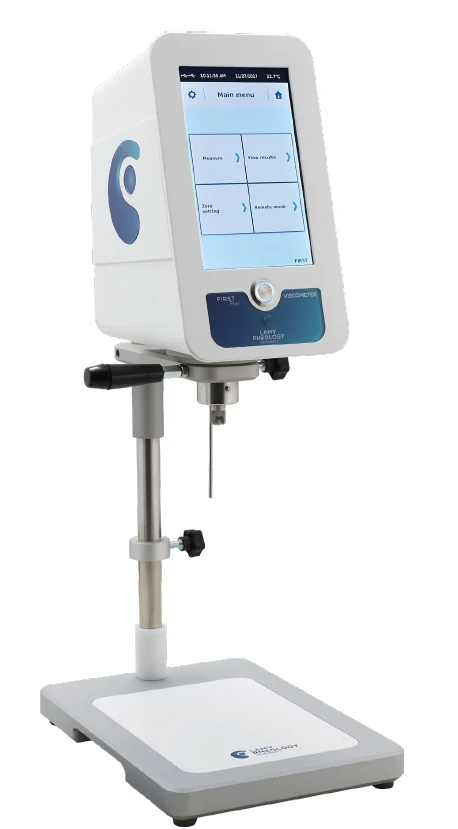
The real-time viscometer plots the curve live on a 7-inch touchscreen during measurement and performs regression analysis and report editing on the instrument without a computer. It is the most fully equipped model in the 250 rpm class.
Request a quote| Speed | 0.3–250 rpm, unlimited selection |
|---|---|
| Torque | 0.05–13 mNm (LR: 0.005–0.8 mNm) |
| Display | Live curve plotting |
| Analysis | On-screen regression |
| Report | Editing on the instrument |
Product description
This model is the most fully equipped member of the 250 rpm viscometer family. Its distinguishing feature is that it plots the curve live on the display during measurement. The operator sees how viscosity changes with time or speed without turning on a computer.
The live curve reveals information that a numerical reading hides. In a thixotropic sample, viscosity decreases throughout the measurement; a single number does not show this decrease, but the curve does. The rate of structural breakdown gives direct insight into how the product behaves in application.
Regression analysis is also performed on the instrument. A mathematical model is fitted to the acquired data points to derive the trend; the result is shown on the display and added to the report.
The report editing function allows the output to be formatted to the laboratory's layout. The title, sample information and measurement conditions are defined on the report; the output is sent directly to a printer or exported to a USB flash drive.
Common technical platform
All instruments in this class operate on the springless measuring principle. In conventional designs with a spiral spring, spring fatigue leads to calibration drift over time; in a springless system, torque is measured directly and this drift is eliminated.
The spindle coupling is a bayonet type rather than a threaded one. The spindle is attached and removed in a single motion; there is no thread wear or cross-threading over time. In laboratories that change spindles frequently, this detail reduces the daily workload.
- Accuracy: 1% of full scale
- Repeatability: 0.2%
- Temperature sensor: PT100, -50 °C … +300 °C
- Display: 7-inch color touchscreen, Turkish menu
- Values shown on the display: viscosity, speed, shear rate, torque, shear stress, time, temperature
- Power supply: 90–240 VAC, 50/60 Hz
On-screen analysis
Live curve
The curve starts plotting as soon as the measurement begins. The axes scale automatically; the operator immediately sees whether the measurement has stabilized. Instead of waiting for an unstable reading, the measurement can be ended at the point where the curve levels off.
Regression and trend
Regression is applied to the collected data points, and the sample's behavioral trend is expressed numerically. Compared with a single-point measurement, this provides a significant gain in information.
Report
The report template is edited on the instrument. Sample ID, operator, date, measurement conditions and the curve graph are combined on a single page. The output is sent to a PCL/5-compatible printer or transferred over the network.
This model operates within limits of 250 rpm and 13 mNm. Although it displays a curve on the screen, it is not a full rheometer; for yield point and model-fitting calculations, the rheometer class should be used.
Related standards
Rotational viscosity measurement is reported according to different standards depending on the industry. The instruments can be configured to operate in line with the measurement conditions defined in the following standard families.
- ASTM: D2196 (rotational viscosity), D789 (polyamides), D1084 and D2556 (adhesives), D1417 and D1439 (latex and cellulose derivatives), D4878 (polyols), D6279, D3236, D3794, D4016
- ISO: 2555, 3219, 1652, 2884-2
- DIN: 53019, 3219, 2555, 52007-1, 54453
- EN: 12092, 12802, 15425, 15564, 2555, 3219
The applicable standard directly determines the measurement geometry and shear rate. When the standard number is stated in the quotation request, the appropriate geometry set is recommended.
Who the real-time viscometer is suited for
- R&D laboratories developing formulations: compare the effect of recipe changes on flow behavior on the curve.
- Paint and coatings manufacturers: monitor thixotropic recovery behavior.
- Cosmetics and personal care: document batch-to-batch consistency of cream and gel texture.
- Adhesive and resin production: record flow behavior before curing.
- Food production: report consistency of sauces, fillings and dairy products.
If higher speed and torque are required, the wide-range viscometer should be considered. Other options in the series and the basic models are listed on the rotational and KU viscometer models page, and all instruments are in the viscosity and rheology category. Determination of apparent viscosity in resins and dispersions is defined in ISO 2555.
Technical specifications
| Speed range | 0.3–250 rpm, stepless |
|---|---|
| Torque (standard) | 0.05–13 mNm |
| Torque (low range) | 0.005–0.8 mNm |
| Viscosity | 200–240,000,000 mPa·s (depending on geometry) |
| Accuracy | 1% of full scale |
| Repeatability | 0.2% |
| Temperature | PT100, -50 °C … +300 °C, integrated |
| Display | 7-inch color touchscreen, live curve |
| Analysis | On-screen regression, report editing |
| Method | Multi-step programming |
| Temperature unit | Controlled directly from the instrument |
| Data output | RS232, USB, Ethernet |
| Protocol | LIMS |
| Weight | 6.1 kg |
| Power supply | 90–240 VAC, 50/60 Hz |
Values are taken from the manufacturer's published technical documentation. They may vary by configuration and are confirmed against the current datasheet before quotation.
Frequently asked questions
Why is it important to see the curve?
A single viscosity value does not show how the sample behaves during the measurement. In thixotropic products, viscosity decreases over time; the curve shows this decrease and its rate. This information is needed to predict behavior in application.
Is a computer required?
No. Curve plotting, regression and report editing are performed on the instrument. PC software can be used optionally, but the core workflow is completed with the instrument.
How does it differ from a rheometer?
A rheometer calculates quantities such as yield point and thixotropy and fits models such as Newton, Bingham, Casson and Ostwald to the data. This model displays the curve and performs regression, but it does not fit rheological models. Its speed and torque ranges are also narrower.
How is data stored?
Measurement results and curves are kept in the instrument memory and exported via USB flash drive or network connection. With LIMS integration, they can be written directly to the laboratory information system.
What is the measurement accuracy?
An accuracy of 1% of full scale and a repeatability of 0.2% apply to all instruments. These values should be considered together with the selected measurement geometry; the geometry determines the measurable viscosity range.
How is temperature measured?
A PT100 sensor reads the sample temperature between -50 °C and +300 °C. Since viscosity depends strongly on temperature, the measurement report should also include the temperature. A jacketed vessel or a circulating bath is used to keep the temperature constant.
Is a Turkish menu available?
Yes. The 7-inch color touchscreen offers a multilingual menu that includes Turkish. Users can be defined with an operator name and a four-digit code; in protected mode, the measurement conditions are locked.
From the same category
Viscometers
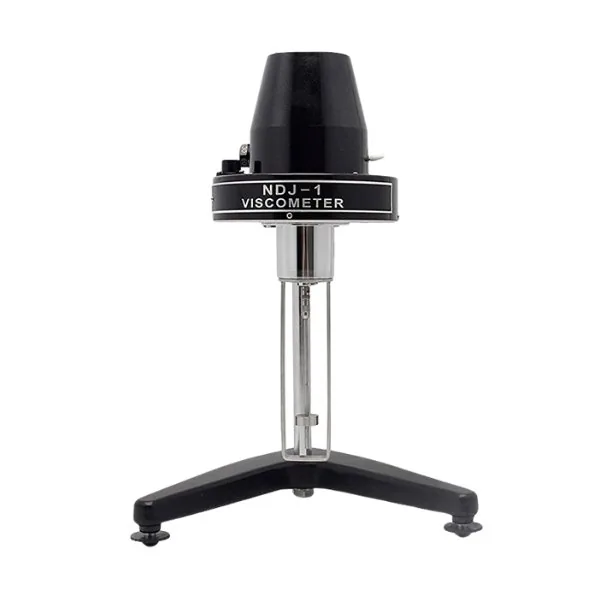
Rotational and KU viscometers; analog, digital and professional series.
Cone and Plate Viscometer
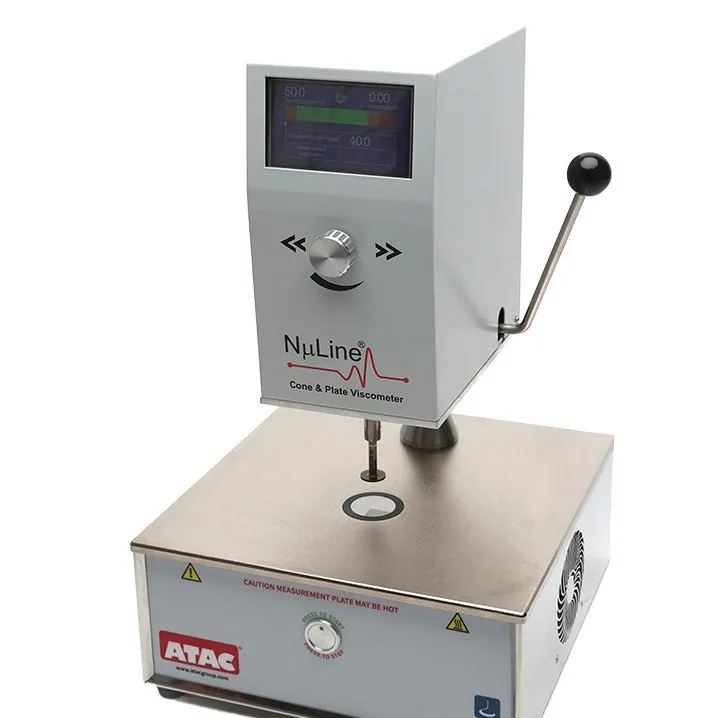
High shear rate viscosity measurement for polymers, resins, paints and adhesives; up to 250 °C.
Entry-Level Rotational Viscometer
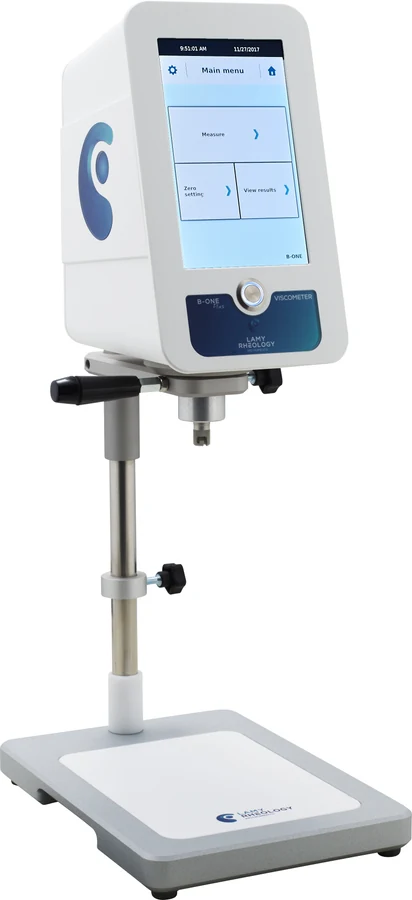
0.3–250 rpm, 0.05–13 mNm; springless measurement, 7-inch touchscreen, Turkish-language menu.
Laboratory-Class Rotational Viscometer
LIMS-compatible rotational viscometer with standard temperature probe and Ethernet connection.
Request a quote for this model
A suitable configuration and pricing are prepared based on sample type and workload.
Request a quote