

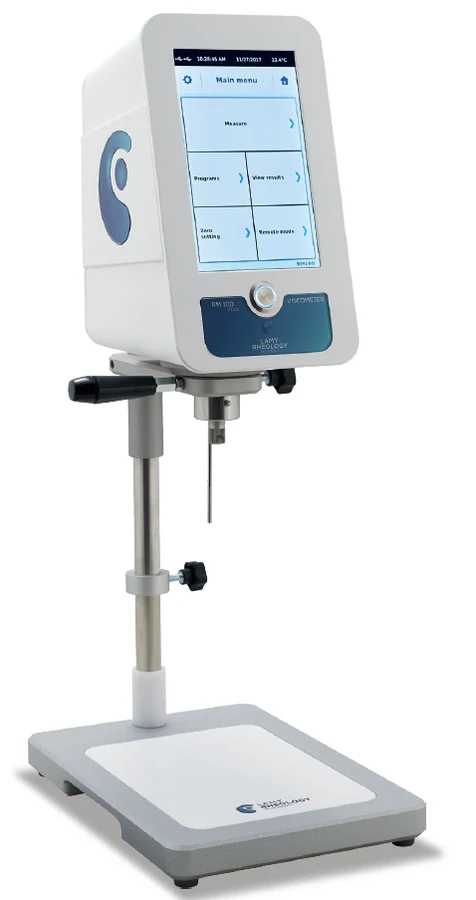
Viscosity and Rheology
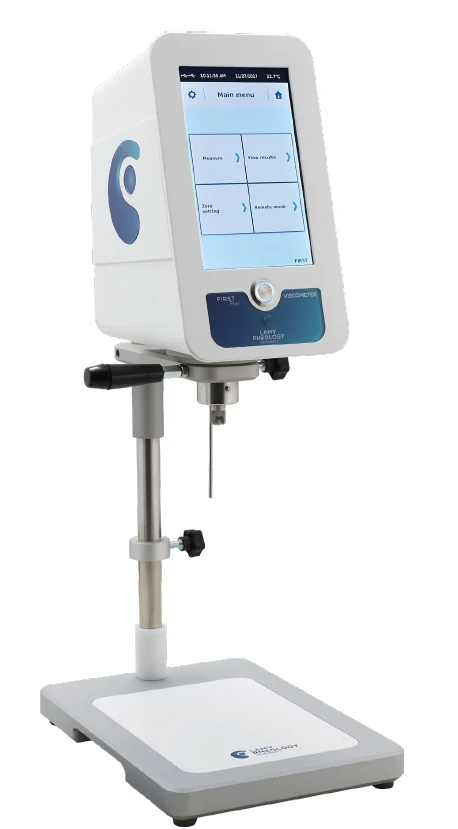
Wide-Range Rotational Viscometer
The wide-range viscometer offers a speed of 0.3–1,500 rpm, a torque of 0.05–30 mNm and, depending on the geometry, a measuring range from 1 mPa·s to 780,000,000 mPa·s. It also supports high-temperature measuring systems.
Request a quote| Speed | 0.3–1,500 rpm, unlimited selection |
|---|---|
| Torque | 0.05–30 mNm (LR: 0.005–0.8 mNm) |
| Viscosity | 1–780,000,000 mPa·s |
| Method | Multi-step programming |
| Communication | LIMS and MODBUS |
Product description
The wide-range viscometer is designed for laboratories that need to measure both very fluid and very viscous products with a single instrument. The maximum speed is 1,500 rpm and the maximum torque is 30 mNm; together, these values represent six times the speed and two and a half times the torque capacity of the 250 rpm class.
With the appropriate geometry, the measuring range extends from 1 mPa·s to 780,000,000 mPa·s. This range covers a broad spectrum of products in a single instrument, from solvent-like liquids to paste-like products.
The high speed capability makes measurement possible for low-viscosity samples. At low viscosity, torque remains very small; increasing the speed raises the torque to a readable level. Likewise, the high torque capacity prevents the spindle from stalling in very viscous samples.
The instrument supports high-temperature measuring systems. For molten polymers and resins, products that cannot be measured at room temperature are measured at their working temperature.
Common technical platform
All instruments in this class operate on the springless measuring principle. In conventional designs with a spiral spring, spring fatigue leads to calibration drift over time; in a springless system, torque is measured directly and this drift is eliminated.
The spindle coupling is a bayonet type rather than a threaded one. The spindle is attached and removed in a single motion; there is no thread wear or cross-threading over time. In laboratories that change spindles frequently, this detail reduces the daily workload.
- Accuracy: 1% of full scale
- Repeatability: 0.2%
- Temperature sensor: PT100, -50 °C … +300 °C
- Display: 7-inch color touchscreen, Turkish menu
- Values shown on the display: viscosity, speed, shear rate, torque, shear stress, time, temperature
- Power supply: 90–240 VAC, 50/60 Hz
Measurement geometries
In a rotational viscometer, the key factor that determines the result is the geometry in contact with the sample. The same instrument covers very different viscosity ranges with different geometries.
- Coaxial cylinder (DIN) geometry: Standard-compliant measurement at a defined shear rate.
- Standard cylindrical spindles: Large vessel, medium and high viscosity.
- High-temperature geometry: Measurement of molten polymers and resins at high temperature.
- Small sample adapter: Limited sample volume, temperature-controlled chamber.
- Vane geometry: Gels, pastes and settling suspensions.
- Krebs geometry: KU measurement in the paint industry.
- Ultra-low viscosity geometry: Liquids in the order of 1 mPa·s.
The wide measuring range can only be used when the geometry set is selected correctly. Once the product group and viscosity band are provided, the required geometries are determined.
Related standards
Rotational viscosity measurement is reported according to different standards depending on the industry. The instruments can be configured to operate in line with the measurement conditions defined in the following standard families.
- ASTM: D2196 (rotational viscosity), D789 (polyamides), D1084 and D2556 (adhesives), D1417 and D1439 (latex and cellulose derivatives), D4878 (polyols), D6279, D3236, D3794, D4016
- ISO: 2555, 3219, 1652, 2884-2
- DIN: 53019, 3219, 2555, 52007-1, 54453
- EN: 12092, 12802, 15425, 15564, 2555, 3219
The applicable standard directly determines the measurement geometry and shear rate. When the standard number is stated in the quotation request, the appropriate geometry set is recommended.
Applications of the wide-range viscometer
- Polymers and resins: Viscosity measurement in the molten state at high temperature; ASTM D4878 for polyols.
- Adhesives: Rotational viscosity according to ASTM D1084 and D2556.
- Paint and coatings: Measurement in KU and thixotropy control.
- Petroleum products: Wide range for oils, greases and bitumen derivatives.
- Food: Consistency control of chocolate, sauces and fillings.
- Construction materials: Structure control of mortars, putties and fillers.
This model is a viscometer. Although its measuring range is wider than that of rheometers, it does not offer yield point calculation, thixotropy calculation or rheological model fitting.
If yield point and thixotropy calculations are required, the rotational rheometer should be considered. Other options in the series and the basic models are listed on the rotational and KU viscometer models page, and all instruments are in the viscosity and rheology category. Determination of apparent viscosity in resins and dispersions is defined in ISO 2555.
Technical specifications
| Speed range | 0.3–1,500 rpm, stepless |
|---|---|
| Torque (standard) | 0.05–30 mNm |
| Torque (low range) | 0.005–0.8 mNm |
| Viscosity | 1–780,000,000 mPa·s (depending on geometry) |
| Accuracy | 1% of full scale |
| Repeatability | 0.2% |
| Temperature | PT100, -50 °C … +300 °C, standard |
| High temperature | High-temperature measurement geometries supported |
| Method | Multi-step programming, quality limit |
| Data output | RS232, USB, Ethernet, 4–20 mA |
| Protocol | LIMS, MODBUS |
| Dimensions | Head Ø115 × H243 × W138 mm · stand 340 × 305 × 70 mm |
| Weight | 6.1 kg |
| Power supply | 90–240 VAC, 50/60 Hz |
Values are taken from the manufacturer's published technical documentation. They may vary by configuration and are confirmed against the current datasheet before quotation.
Frequently asked questions
Why is such a wide range needed?
In laboratories handling many products, working with a single instrument reduces the calibration and training workload. Being able to measure a solvent-like raw material and a paste-like product on the same instrument makes investment in a second viscometer unnecessary.
What does high speed change?
In low-viscosity samples, the measured torque is very small and gets lost in noise. Increasing the speed brings the torque to a readable level. The 1,500 rpm capability allows measurement of fluid samples that cannot be measured at 250 rpm.
Can molten polymers be measured?
Yes, this is possible with the high-temperature measurement geometry. Once the working temperature and sample type are provided, the geometry and temperature unit are selected accordingly.
Can it be used with a cone and plate system?
This model works with cylindrical and vane-type geometries. For cone and plate measurement, models specifically designed for cone and plate geometry are used; these models are offered under a separate heading.
When is it necessary to move to a rheometer?
If a flow curve, yield point, thixotropy area or fitting to Newton, Bingham, Casson or Ostwald models is required, the rheometer class is needed. If wide-range single-point measurement is sufficient, this model is suitable.
What is the measurement accuracy?
An accuracy of 1% of full scale and a repeatability of 0.2% apply to all instruments. These values should be considered together with the selected measurement geometry; the geometry determines the measurable viscosity range.
How is temperature measured?
A PT100 sensor reads the sample temperature between -50 °C and +300 °C. Since viscosity depends strongly on temperature, the measurement report should also include the temperature. A jacketed vessel or a circulating bath is used to keep the temperature constant.
Is a Turkish menu available?
Yes. The 7-inch color touchscreen offers a multilingual menu that includes Turkish. Users can be defined with an operator name and a four-digit code; in protected mode, the measurement conditions are locked.
From the same category
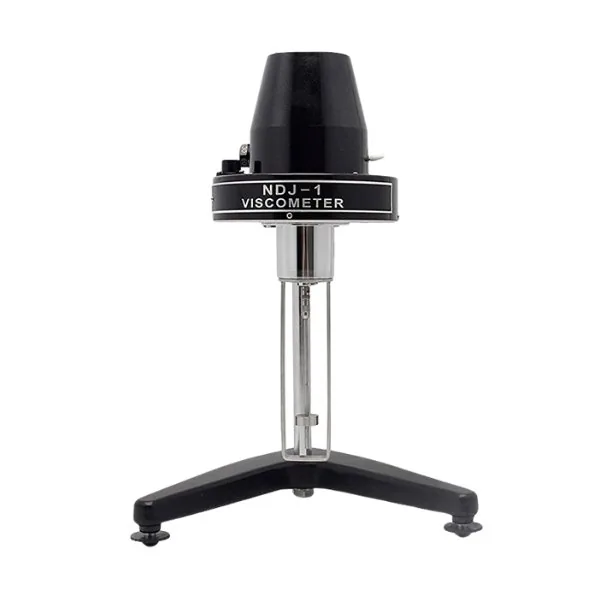
Viscometers
Rotational and KU viscometers; analog, digital and professional series.
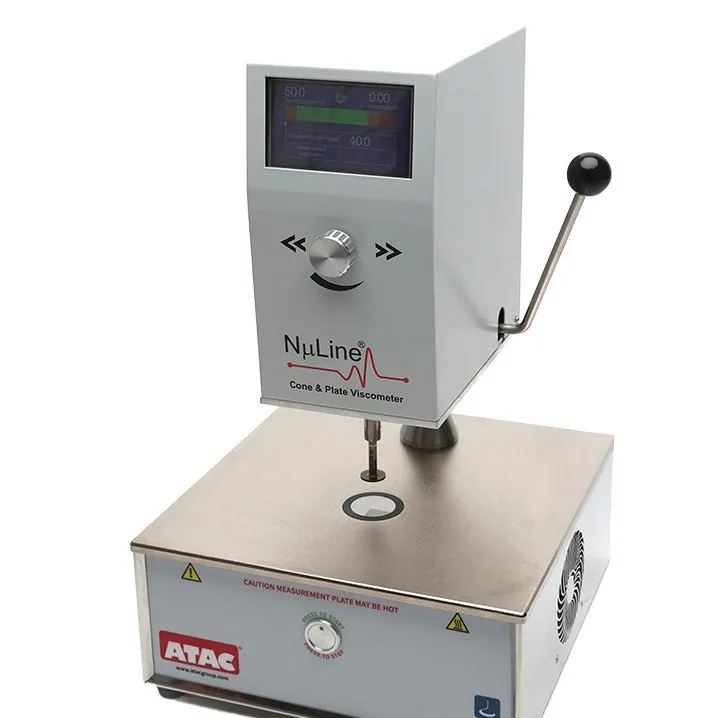
Cone and Plate Viscometer
High shear rate viscosity measurement for polymers, resins, paints and adhesives; up to 250 °C.
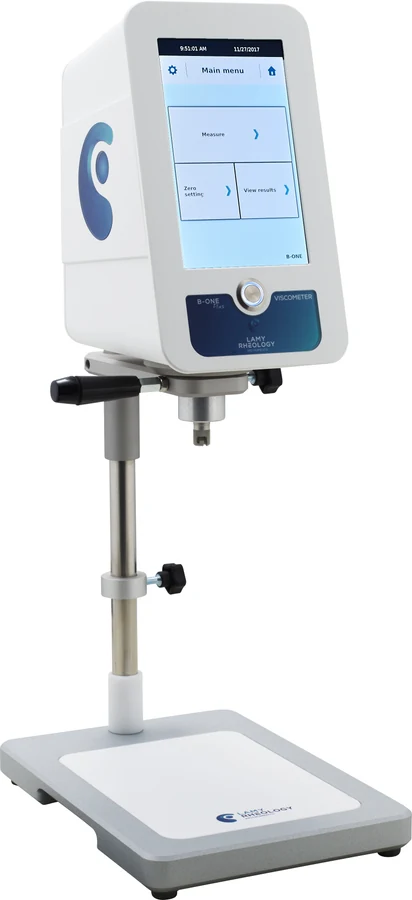
Entry-Level Rotational Viscometer
0.3–250 rpm, 0.05–13 mNm; springless measurement, 7-inch touchscreen, Turkish-language menu.
Laboratory-Class Rotational Viscometer
LIMS-compatible rotational viscometer with standard temperature probe and Ethernet connection.
Request a quote for this model
A suitable configuration and pricing are prepared based on sample type and workload.
Request a quote