

Viscosity and Rheology
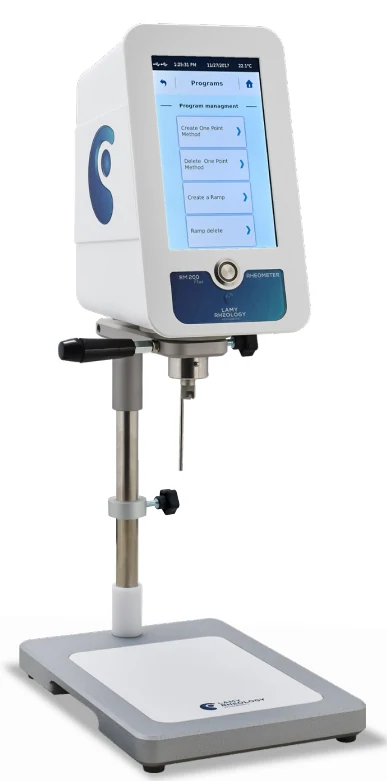
Rotational Rheometer
The rotational rheometer generates a flow curve, calculates yield point and thixotropy, and fits Newton, Bingham, Casson and Ostwald models to the data. All calculations are performed on the instrument without a computer.
Request a quote| Speed | 0.3–1,500 rpm, unlimited selection |
|---|---|
| Torque | 0.05–30 mNm (LR: 0.005–0.8 mNm) |
| Viscosity | 1–780,000,000 mPa·s |
| Analysis | Flow curve, yield point, thixotropy |
| Model | Newton, Bingham, Casson, Ostwald |
Product description
The difference between a rheometer and a viscometer lies in the type of information produced. A viscometer gives a single viscosity value under a given condition. A rheometer varies the shear rate to capture the sample's complete flow behavior.
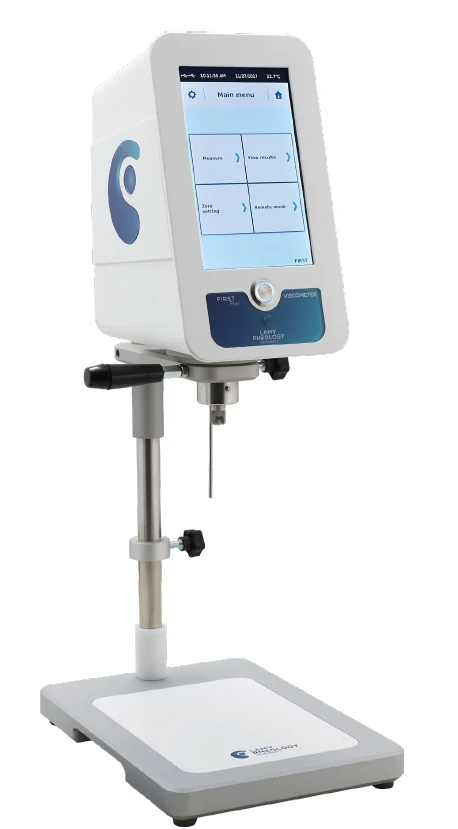
This model generates the flow curve and calculates the yield point and thixotropy area from it. It then fits a rheological model to the data: the appropriate model is selected from Newton, Bingham, Casson and Ostwald, and the model coefficients are calculated. All of this is completed on the 7-inch touchscreen without connecting a computer.
Performing the calculations on the instrument is a practical advantage. The result is obtained at the point of measurement; no data transfer, software license or separate computer is required. In control laboratories next to production, this significantly shortens decision time.
The measuring range is 0.3–1,500 rpm and 0.05–30 mNm; depending on the geometry, it extends from 1 mPa·s to 780,000,000 mPa·s.
Rheological quantities
Flow curve
The shear rate is increased step by step and the shear stress is measured at each step. The resulting curve shows whether the sample is Newtonian or exhibits shear thinning or shear thickening. Most paints, creams, sauces and suspensions exhibit shear thinning.
Yield point
Some products do not flow until a certain stress is exceeded. This threshold value is called the yield point. Toothpaste not flowing out of the tube on its own and paint applied to a wall not running are consequences of the yield point. The rheometer determines this threshold numerically.
Thixotropy
In thixotropic products, viscosity decreases with stirring and recovers when left to rest. The area between the increasing and decreasing shear rate sweeps is the measure of thixotropy. Paint spreading with a brush and then staying in place without running relies on this behavior.
Model fitting
- Newton: Simple liquids whose viscosity is independent of shear rate.
- Bingham: Products that have a yield point and behave linearly thereafter.
- Casson: A model widely used for chocolate and similar suspensions.
- Ostwald (power law): A model that describes shear thinning and thickening with a power law.
In the chocolate industry, the Casson model is an internationally accepted evaluation method. The instrument performs this calculation directly.
Common technical platform
All instruments in this class operate on the springless measuring principle. In conventional designs with a spiral spring, spring fatigue leads to calibration drift over time; in a springless system, torque is measured directly and this drift is eliminated.
The spindle coupling is a bayonet type rather than a threaded one. The spindle is attached and removed in a single motion; there is no thread wear or cross-threading over time. In laboratories that change spindles frequently, this detail reduces the daily workload.
- Accuracy: 1% of full scale
- Repeatability: 0.2%
- Temperature sensor: PT100, -50 °C … +300 °C
- Display: 7-inch color touchscreen, Turkish menu
- Values shown on the display: viscosity, speed, shear rate, torque, shear stress, time, temperature
- Power supply: 90–240 VAC, 50/60 Hz
Measurement geometries
In a rotational viscometer, the key factor that determines the result is the geometry in contact with the sample. The same instrument covers very different viscosity ranges with different geometries.
- Coaxial cylinder (DIN) geometry: Defined shear rate; preferred for standard-compliant curve generation.
- Standard cylindrical spindles: Large vessel, routine measurements.
- High-temperature geometry: Rheology of molten products at working temperature.
- Vane geometry: Measurement without disturbing the structure when determining the yield point.
- Small sample adapter: Limited sample volume, temperature-controlled chamber.
- Krebs geometry: KU measurement in the paint industry.
Coaxial cylinder geometry is preferred for flow curve studies; the shear rate is more uniform across the geometry and the result is comparable with standards.
Related standards
Rotational viscosity measurement is reported according to different standards depending on the industry. The instruments can be configured to operate in line with the measurement conditions defined in the following standard families.
- ASTM: D2196 (rotational viscosity), D789 (polyamides), D1084 and D2556 (adhesives), D1417 and D1439 (latex and cellulose derivatives), D4878 (polyols), D6279, D3236, D3794, D4016
- ISO: 2555, 3219, 1652, 2884-2
- DIN: 53019, 3219, 2555, 52007-1, 54453
- EN: 12092, 12802, 15425, 15564, 2555, 3219
The applicable standard directly determines the measurement geometry and shear rate. When the standard number is stated in the quotation request, the appropriate geometry set is recommended.
Applications of the rotational rheometer
- Paints and inks: Determination of leveling, sagging and thixotropic recovery behavior.
- Cosmetics: Quantifying the yield point and sensory texture of creams and gels.
- Food: Casson viscosity and Casson yield point of chocolate; consistency of sauces and fillings.
- Construction materials: Workability and sag resistance of mortars and putties.
- Polymers and adhesives: Effect of formulation changes on flow behavior.
- Pharmaceutical: Stability indicators in suspension and gel formulations.
For simpler viscosity control, the wide-range viscometer can be considered, and for measurement at high shear rates, the high-RPM cone and plate viscometer. All options are among the viscosity and rheology instruments.
Technical specifications
| Speed range | 0.3–1,500 rpm, stepless |
|---|---|
| Torque (standard) | 0.05–30 mNm |
| Torque (low range) | 0.005–0.8 mNm |
| Viscosity | 1–780,000,000 mPa·s (depending on geometry) |
| Accuracy | 1% of full scale |
| Repeatability | 0.2% |
| Analysis | Flow curve, yield point, thixotropy, plastic viscosity |
| Model fitting | Newton, Bingham, Casson, Ostwald |
| Temperature | PT100, -50 °C … +300 °C, standard |
| Display | 7-inch color touchscreen, real-time curve display |
| Temperature unit | Controlled directly from the instrument |
| Data output | RS232, USB, Ethernet, 4–20 mA |
| Protocol | LIMS |
| Weight | 6.1 kg |
| Power supply | 90–240 VAC, 50/60 Hz |
Values are taken from the manufacturer's published technical documentation. They may vary by configuration and are confirmed against the current datasheet before quotation.
Frequently asked questions
What is the difference between a rheometer and a viscometer?
A viscometer gives a viscosity value under a single condition. A rheometer varies the shear rate to capture the complete flow behavior; yield point, thixotropy and model coefficients are calculated. For formulators, this difference is decisive.
Is PC software required?
No. Flow curve, yield point, thixotropy and model fitting calculations are performed on the instrument. Software can be used for data transfer and advanced reporting, but it is not mandatory.
Which model fit should be selected?
The choice depends on the product type. The Newton model is used for simple liquids, Bingham for products with a yield point, Casson for chocolate and similar suspensions, and Ostwald for shear-thinning products. The instrument calculates all four models; they are compared according to goodness of fit.
How is the yield point measured?
The shear stress is increased gradually and the threshold at which the sample starts to flow is determined. Vane geometry is preferred for yield point studies because it disturbs the sample structure the least during measurement.
Does it work with cone and plate geometry?
This model works with cylindrical and vane-type geometries. Cone and plate measurement is performed with models specifically designed for cone and plate; cone and plate rheometer options with a motorized lift mechanism are offered separately.
What is the measurement accuracy?
An accuracy of 1% of full scale and a repeatability of 0.2% apply to all instruments. These values should be considered together with the selected measurement geometry; the geometry determines the measurable viscosity range.
How is temperature measured?
A PT100 sensor reads the sample temperature between -50 °C and +300 °C. Since viscosity depends strongly on temperature, the measurement report should also include the temperature. A jacketed vessel or a circulating bath is used to keep the temperature constant.
Is a Turkish menu available?
Yes. The 7-inch color touchscreen offers a multilingual menu that includes Turkish. Users can be defined with an operator name and a four-digit code; in protected mode, the measurement conditions are locked.
From the same category
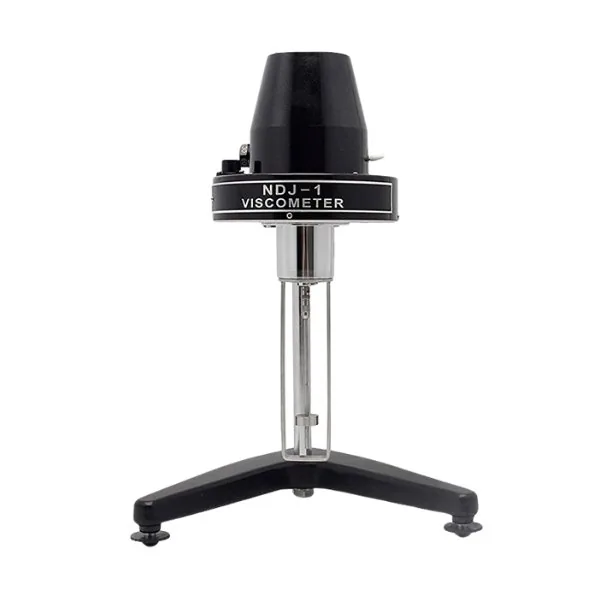
Viscometers
Rotational and KU viscometers; analog, digital and professional series.
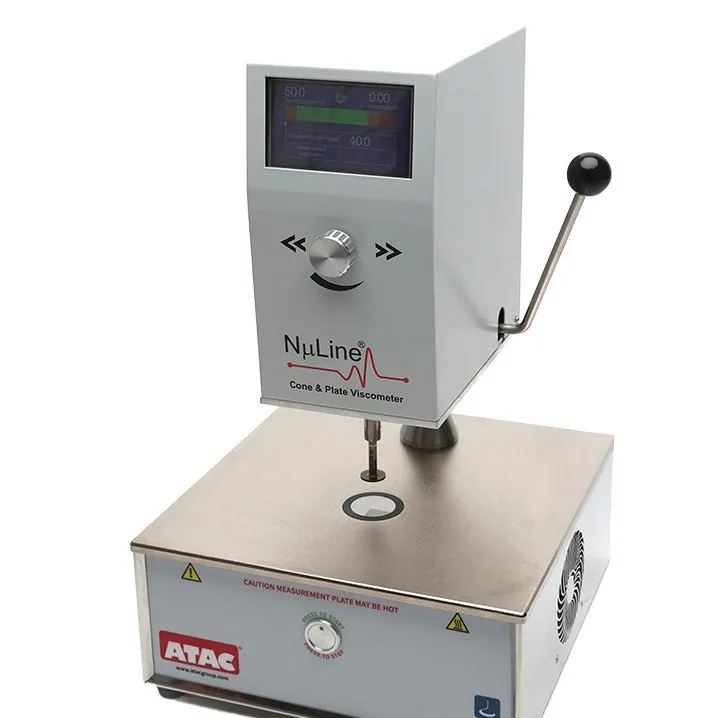
Cone and Plate Viscometer
High shear rate viscosity measurement for polymers, resins, paints and adhesives; up to 250 °C.
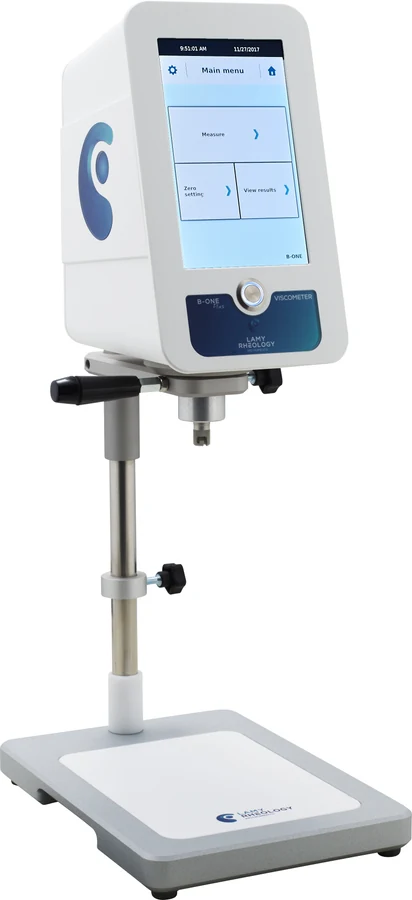
Entry-Level Rotational Viscometer
0.3–250 rpm, 0.05–13 mNm; springless measurement, 7-inch touchscreen, Turkish-language menu.
Laboratory-Class Rotational Viscometer
LIMS-compatible rotational viscometer with standard temperature probe and Ethernet connection.
Request a quote for this model
A suitable configuration and pricing are prepared based on sample type and workload.
Request a quote