

Viscosity and Rheology
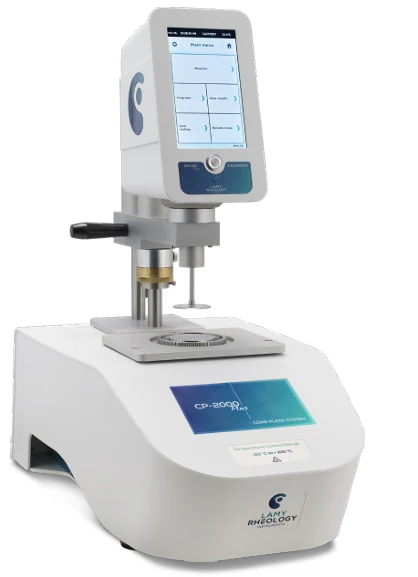
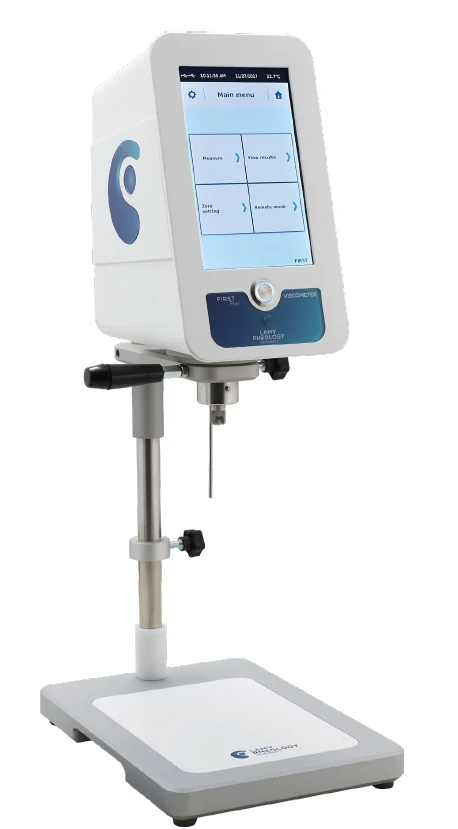
High-RPM Cone and Plate Viscometer
The high-RPM cone and plate viscometer works with parallel plate geometry in addition to cone and plate geometry and reaches a shear rate of 20,000 s⁻¹. It offers measurement with less than 1 mL of sample, Peltier or electric temperature units and more than 30 cone options.
Request a quote| Speed | 0.3–1,500 rpm, unlimited selection |
|---|---|
| Torque | 0.05–30 mNm |
| Maximum shear rate | 20,000 s⁻¹ |
| Sample volume | 0.002–3 mL (depending on cone) |
| Viscosity | 1–190,000,000 mPa·s |
What is a cone and plate system
In cone and plate geometry, the sample is placed between a fixed flat plate and a cone with a very small angle rotating above it. The cone angle is typically between 0.45° and 4°, and its tip comes almost close enough to touch the plate.
The defining feature of this geometry is as follows: because the cone angle is constant, the shear rate is the same at every point of the sample. In cylindrical geometries, the shear rate differs near the center and in the outer region, and an average value is reported. With cone and plate, no averaging takes place; there is a single, true shear rate.
A single shear rate is a fundamental requirement of rheological measurement. In a shear-thinning product, viscosity depends on shear rate; if the shear rate varies within the sample, the measured viscosity is an ill-defined average. Cone and plate eliminates this uncertainty.
The second advantage is sample quantity. The gap between the cone and the plate is very narrow; 0.002 mL to 3 mL of sample is sufficient. This becomes decisive for expensive raw materials, synthesis products obtained in small quantities and small batch trials.
The third advantage is cleaning. The open geometry is cleaned by wiping the cone and the plate with a cloth. In cylindrical geometries, the vessel and spindle are washed and dried separately; with cone and plate, this time is measured in seconds rather than minutes.
For polymer and resin manufacturers
Polymer solutions, resins and adhesives are shear-thinning products. For these products, viscosity measured at a single speed does not represent actual application behavior.
Why high shear rate is needed
Shear rates encountered in application are very high. When a coating is applied by roller, an adhesive is dispensed through a nozzle or a film passes through a calender, the shear rate rises to thousands or even tens of thousands of s⁻¹. A measurement taken in the laboratory at 100 s⁻¹ does not represent this condition.
The 20,000 s⁻¹ capability means that application conditions can actually be reproduced in the laboratory. The formulation is evaluated according to its behavior in the field, and trial-and-error rounds are reduced.
Application benefits
- Coating and film production: Viscosity at high shear rate determines whether the coating will spread evenly. A formulation that thins too much at high shear cannot achieve the target film thickness.
- Extrusion and injection molding: Flow inside the mold depends on viscosity at high shear rate. This value is used to predict mold filling behavior.
- Adhesive application: A balance is struck between thinning during dispensing through the nozzle and sag resistance after application; both are measured at different shear rates.
- Polymer solutions: Molecular weight and degree of branching directly affect the shape of the shear-thinning curve. The curve detects batch differences early.
- Latex and dispersions: Rotational viscosity according to ASTM D1417; effect of filler content on flow behavior.
- Polyols: Measurement according to ASTM D4878; characterization prior to reactivity in polyurethane systems.
The recommended approach for polymer manufacturers is to perform a shear rate sweep: storage and sagging behavior are measured at low shear rate, and application behavior at high shear rate. A single-point measurement hides both behaviors.
Cone options for the high-RPM cone and plate viscometer
More than thirty cone options are available. Diameter ranges from 10 mm to 60 mm and angle from 0.45° to 4°. As the diameter increases, the lowest measurable viscosity decreases; as the angle decreases, the attainable shear rate increases.
- Small-diameter, wide-angle cones (10 mm / 2–3°): High-viscosity products; up to 191,000,000 mPa·s. Sample volume 0.01 mL.
- Medium-diameter cones (19–24 mm): General purpose; wide range from 7 mPa·s to 27,000,000 mPa·s.
- Large-diameter, narrow-angle cones (40–60 mm / 0.5°): Low-viscosity products; measurement from 1 mPa·s. The group best suited for high shear rates.
- Parallel plate geometry: For samples containing particles, it offers an advantage over the cone because the gap is adjustable.
The cone geometries comply with DIN 53019, ISO 3219 and ASTM D4278 / D7395 and are made of 316L stainless steel. Attachment is made in a single motion with a quick-clamp system.
The cone is selected according to the viscosity band to be measured and the targeted shear rate. Once the product and application conditions are provided, the appropriate cone set is determined.
Temperature control
In cone and plate measurement, temperature control is an integral part of the geometry. Because the sample quantity is very small, it quickly equilibrates with the ambient temperature; on the other hand, it can be heated and cooled directly through the plate.
- Air Peltier, +10 °C … +70 °C: Routine measurements around room temperature.
- Air Peltier, 0 °C … +150 °C: Wide range, operation with cooling.
- Liquid Peltier, -20 °C … +100 °C: Low-temperature work; requires a circulating water bath.
- Electric heating, room temperature … +300 °C: Molten polymers and resins.
- Programmer versions: A temperature ramp can be defined; the change of viscosity with temperature is obtained in a single run.
A temperature ramp is particularly valuable in polymer and resin work. The viscosity-temperature curve is used directly to determine the processing window.
Common technical platform
The instrument operates on the springless measuring principle; torque is measured directly and there is no calibration drift due to spring fatigue.
- Accuracy: 1% of full scale
- Repeatability: 0.2%
- Temperature sensor: PT100, -50 °C … +300 °C
- Display: 7-inch color touchscreen, Turkish menu
- Control by speed or directly by shear rate
- Multi-step method programming, quality control limits
- Connectivity: RS232, USB, Ethernet; LIMS and MODBUS
- Power supply: 90–240 VAC, 50/60 Hz
For polymer and resin batch control at temperatures up to 250 °C, the cone and plate viscometer can be considered, and for flow curve and yield point analysis, the rotational rheometer. All options are among the viscosity and rheology instruments. Measurement at high shear rate with cone and plate geometry is defined in ISO 2884-1.
Technical specifications
| Speed range | 0.3–1,500 rpm, stepless |
|---|---|
| Torque | 0.05–30 mNm |
| Maximum shear rate | 20,000 s⁻¹ |
| Viscosity | 1–190,000,000 mPa·s (depending on cone) |
| Sample volume | 0.002–3 mL |
| Cone diameter | 10–60 mm |
| Cone angle | 0.45°–4° |
| Geometry material | 316L stainless steel |
| Geometry standards | DIN 53019, ISO 3219, ASTM D4278 / D7395 |
| Accuracy | 1% of full scale |
| Repeatability | 0.2% |
| Temperature units | Air Peltier +10…+70 °C · 0…+150 °C · liquid Peltier -20…+100 °C · electric room temperature…+300 °C |
| Data output | RS232, USB, Ethernet |
| Protocol | LIMS, MODBUS |
| Dimensions | Ø610 × H700 × W340 mm |
| Weight | 22 kg |
| Power supply | 90–240 VAC, 50/60 Hz |
Values are taken from the manufacturer's published technical documentation. They may vary by configuration and are confirmed against the current datasheet before quotation.
Frequently asked questions
Why is a cone and plate system preferred for polymers?
Polymer solutions and resins are shear-thinning; their viscosity depends on shear rate. In cone and plate geometry, the shear rate is the same at every point of the sample, so the measured viscosity belongs to a single defined shear rate. In cylindrical geometry, this definition does not exist and an average value is read.
Why is a shear rate of 20,000 s⁻¹ needed?
Shear rates encountered in coating, extrusion and adhesive applications rise to tens of thousands of s⁻¹. Viscosity measured in the laboratory at a low shear rate does not represent this condition. High shear rate capability allows the application condition to be reproduced in the laboratory.
How much sample is required?
Between 0.002 mL and 3 mL, depending on the cone geometry. With commonly used medium-size cones, about 0.1 mL of sample is sufficient. This is a significant advantage for expensive raw materials and small-scale synthesis products.
Can samples containing particles be measured?
In cone and plate geometry, the particle size must be significantly smaller than the narrowest gap between the cone and the plate; as a general rule, below 100 µm is recommended. For larger particles, parallel plate geometry with an adjustable gap is used.
How long does cleaning take?
Because the geometry is open, the cone and plate are cleaned by wiping with a cloth. Cylindrical geometries require the vessel and spindle to be washed and dried separately; with cone and plate, this is completed within seconds. In laboratories measuring many samples per day, this difference directly affects productivity.
Can a temperature ramp be performed?
When a programmer temperature unit is selected, a temperature ramp can be defined. The viscosity-temperature curve is obtained in a single run and is used to determine the processing window for polymers and resins.
Which standards does the measurement comply with?
The cone and plate geometries comply with DIN 53019, ISO 3219 and ASTM D4278 / D7395. In the polymer and adhesive industries, measurements can be performed according to ASTM D2196, D1084, D2556, D1417 and D4878.
What is the measurement accuracy?
An accuracy of 1% of full scale and a repeatability of 0.2% apply to all instruments. These values should be considered together with the selected measurement geometry; the geometry determines the measurable viscosity range.
Is a Turkish menu available?
Yes. The 7-inch color touchscreen offers a multilingual menu that includes Turkish. Users can be defined with an operator name and a four-digit code; in protected mode, the measurement conditions are locked.
From the same category
Viscometers
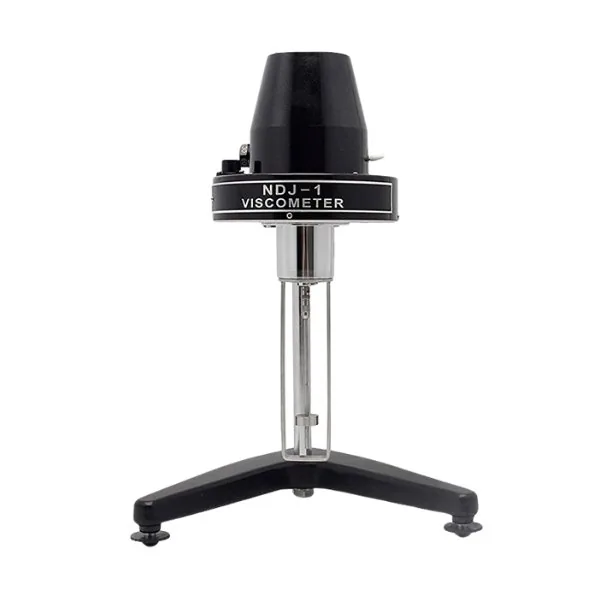
Rotational and KU viscometers; analog, digital and professional series.
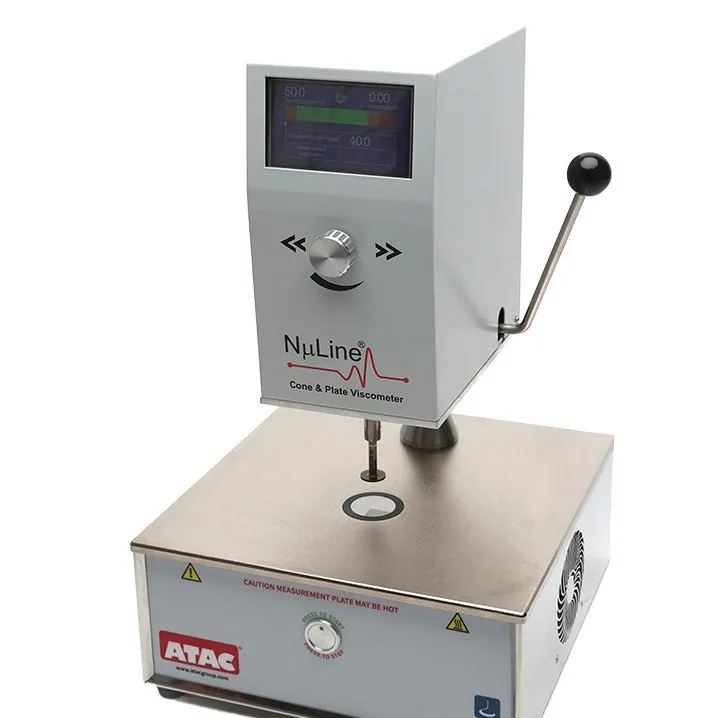
Cone and Plate Viscometer
High shear rate viscosity measurement for polymers, resins, paints and adhesives; up to 250 °C.
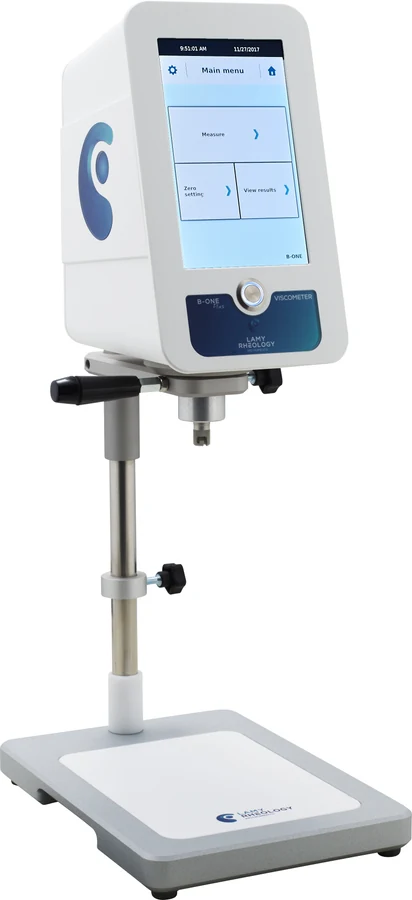
Entry-Level Rotational Viscometer
0.3–250 rpm, 0.05–13 mNm; springless measurement, 7-inch touchscreen, Turkish-language menu.
Laboratory-Class Rotational Viscometer
LIMS-compatible rotational viscometer with standard temperature probe and Ethernet connection.
Request a quote for this model
A suitable configuration and pricing are prepared based on sample type and workload.
Request a quote