

Rhopoint Instruments
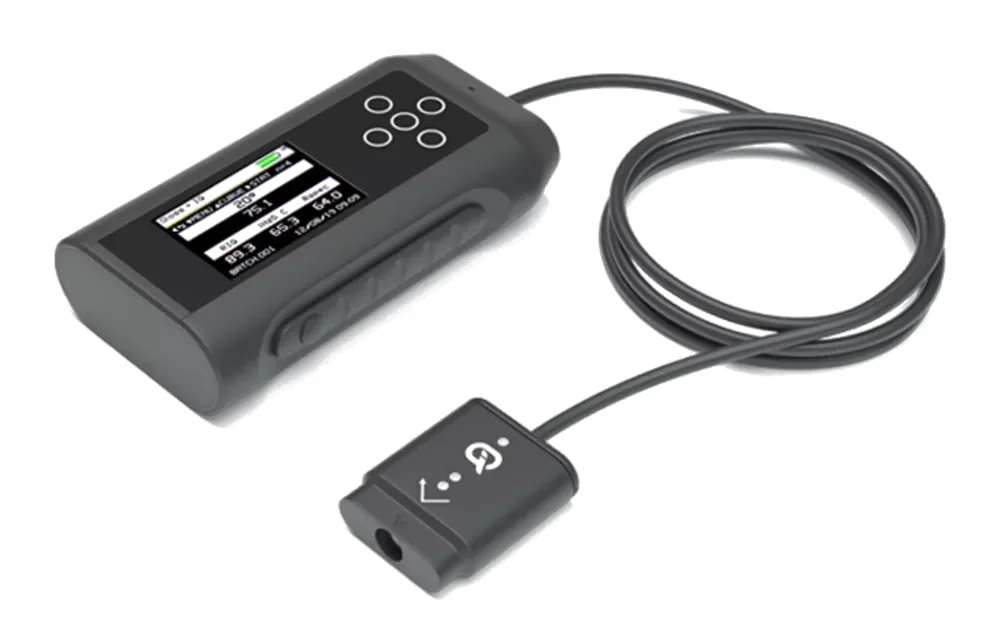
IQ FLEX 20-S Gloss Meter with Flexible Head
The Rhopoint IQ FLEX 20-S is a curved surface gloss meter that operates with a measuring head separate from the main body and measures with 20° geometry. On small or hard-to-reach parts, it provides haze, DOI, RIQ and Rspec values in addition to gloss.
Request a quote| Measurement angle | 20° |
|---|---|
| Additional parameters | Haze, DOI, RIQ, Rspec |
| Measurement range | 0–2000 GU |
| Measurement area | 6×6.4 mm; 4 and 2 mm adapters |
| Weight | 550 g (body without head) |
Product description
The Rhopoint IQ FLEX 20-S is a gloss meter with a flexible design that moves the measurement optics into a cabled head. On curved parts, recessed areas and small details where the body cannot be placed on the surface, the head is positioned directly at the measurement point.
The instrument operates with 20° geometry, the angle with the highest discriminating power on high-gloss surfaces. In addition to the gloss value, reflection haze, distinctness of image (DOI), reflected image quality (RIQ) and Rspec are obtained in the same measurement. Haze can be reported as HU or LogHU and follows the ASTM E430 approach.
The 4 mm and 2 mm adapters narrow the measurement area, enabling measurement on very small surfaces. The instrument is used with a NIST-traceable calibration standard.
Applications
- Curved surfaces such as automotive interior and exterior trim parts, mirror covers and door handles
- Small-area gloss control of molded plastic parts
- Monitoring haze and image clarity on high-gloss coatings
- Assembled parts where flat-bodied instruments cannot be seated
Technical evaluation of the curved surface gloss meter
For 20° gloss in the 0–100 GU range, repeatability is 0.2 GU and reproducibility is 0.5 GU; in the 100–2000 GU range, these values are 0.2% and 0.5% of the reading. RIQ and DOI are measured over 0–100 with ±0.2 repeatability and ±0.5 reproducibility.
Haze repeatability is specified as ±0.5 HU and reproducibility as ±1.5 HU. The Li-ion battery provides approximately 6 hours of operation and more than 4,000 readings; charging time is 4 hours. The instrument stores 999 readings and transfers data via USB or Bluetooth.
If the measuring head is not seated fully on a curved part, some of the light is reflected outside the measurement geometry and the value reads low. The head is therefore held perpendicular and steady on the surface, and the measurement point is marked so it can be repeated. When the small adapter is used, the measurement area is smaller, so several readings from the same region are averaged.
Selection criteria
If three-angle measurement is required on flat, large surfaces, the Rhopoint IQ-S is a more comprehensive solution. For 60° measurement with a remote head on low-gloss and textured surfaces, the Novo-Gloss FLEX 60 should be considered.
Other models in the category are listed under color and gloss measuring instruments. The method for specular gloss measurement is defined in ASTM D523.
Technical specifications
| Measurement angle | 20° |
|---|---|
| Gloss range | 0–2000 GU |
| Repeatability | 0–100 GU: 0.2 GU · 100–2000 GU: 0.2% |
| Reproducibility | 0–100 GU: 0.5 GU · 100–2000 GU: 0.5% |
| Measurement area | 6×6.4 mm; 4 mm and 2 mm adapter options |
| Haze | 17.2–19° / 21–22.8°; HU or LogHU; repeatability ±0.5 HU, reproducibility ±1.5 HU (ASTM E430) |
| RIQ / DOI | 0–100; repeatability ±0.2, reproducibility ±0.5 |
| Rspec | 0–2000 GU |
| Calibration standard | NIST-traceable, uncertainty 1.1 GU |
| Memory | 999 readings |
| Connectivity | USB and Bluetooth |
| Power | Li-ion; approx. 6 hours, more than 4,000 readings, charging time 4 hours |
| Dimensions | 150 × 79 × 34 mm (without head) |
| Weight | 550 g |
Values are taken from the manufacturer's published technical documentation. They may vary by configuration and are confirmed against the current datasheet before quotation.
Frequently asked questions
What advantage does the remote measuring head offer?
On curved, recessed or small parts where the body cannot sit flat on the surface, the optics can be placed directly at the measurement point. Measurements can thus be taken without cutting or disassembling the sample.
Why is only the 20° angle used?
The 20° geometry is the angle most sensitive to small differences on high-gloss surfaces. The surfaces this instrument targets, such as automotive paints and glossy plastics, mostly fall within this range.
When are the 2 mm and 4 mm adapters used?
On narrow details where the measurement area is smaller than the standard 6×6.4 mm window, the adapters are fitted to ensure that only the target surface is read.
From the same category
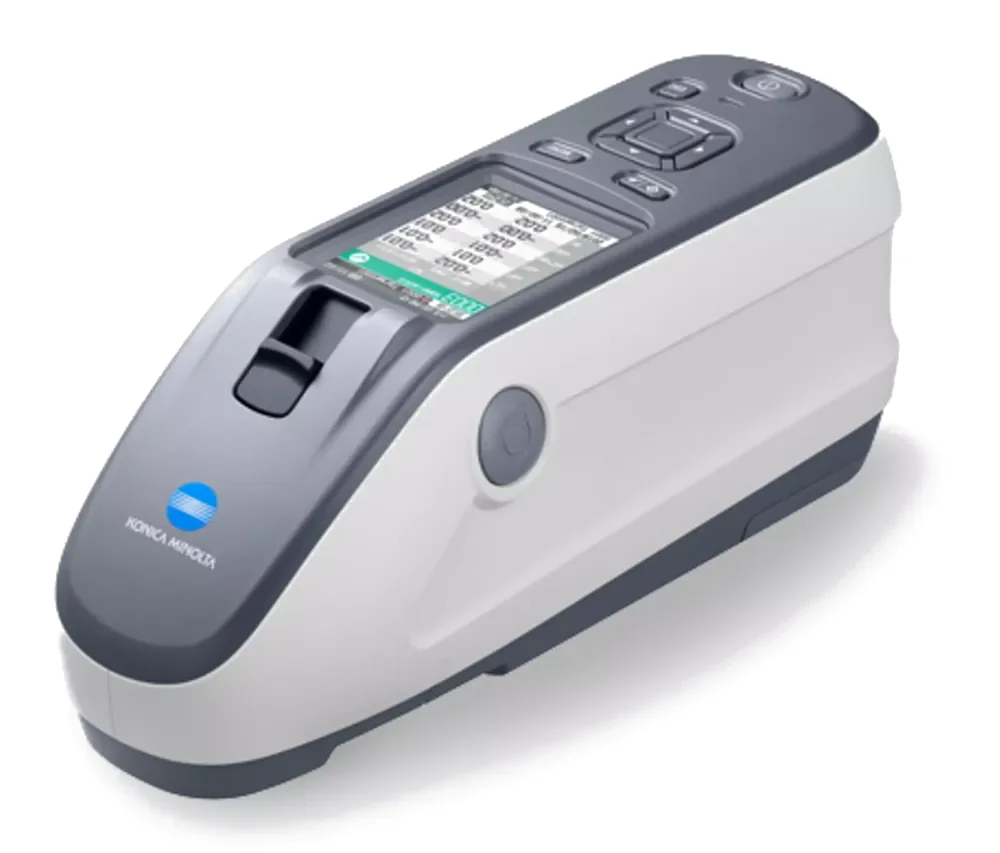
CM-26dG / CM-26d Portable Spectrophotometer
Portable spectrophotometer that captures color and 60° gloss in a single measurement and measures SCI and SCE simultaneously.
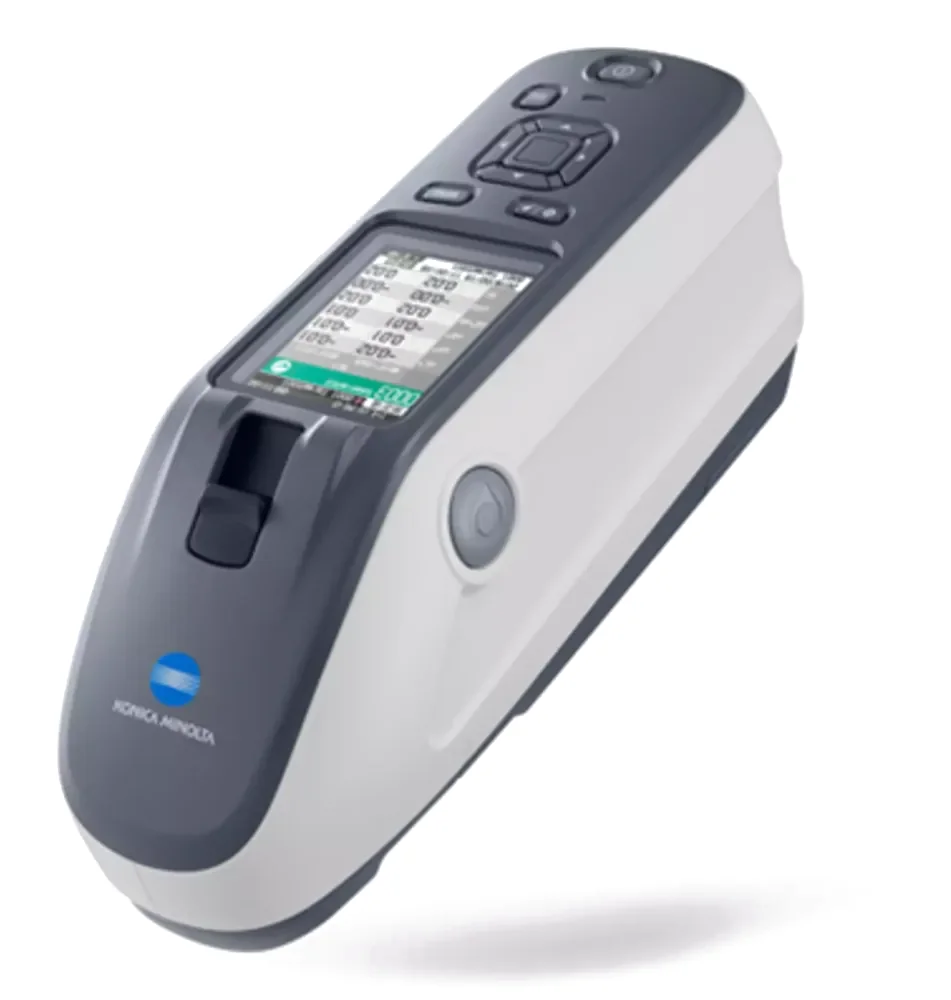
CM-25d Portable Spectrophotometer
Single-aperture portable spectrophotometer that measures SCI and SCE simultaneously and operates in the 400–700 nm range.
CM-23d Portable Spectrophotometer
Entry-level portable spectrophotometer that measures SCI and SCE values together for basic color quality control.
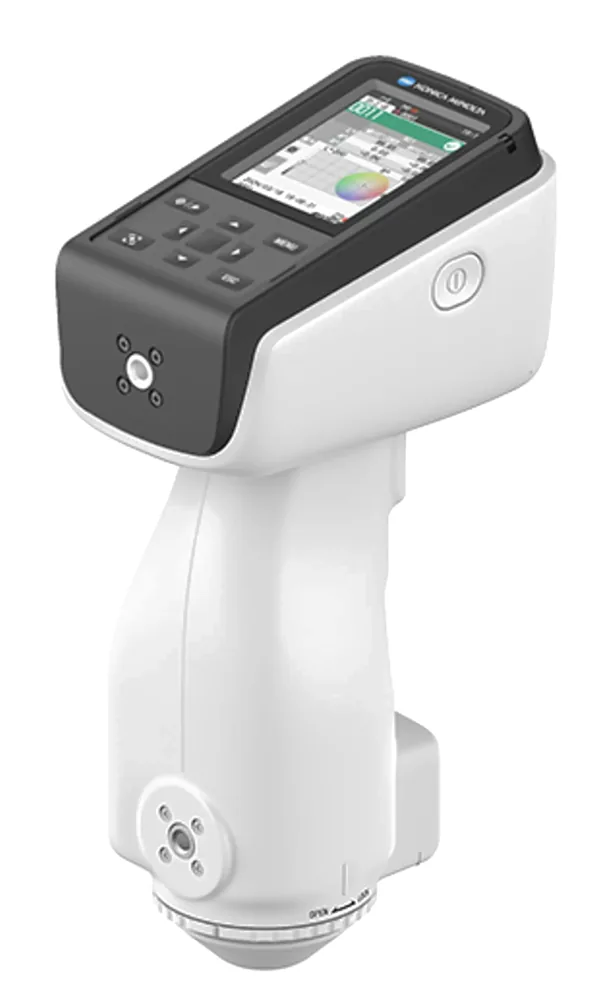
CM-17d / CM-16d Portable Spectrophotometer
Next-generation portable spectrophotometer with vertical body, camera viewfinder and interchangeable apertures.
Request a quote for this model
A suitable configuration and pricing are prepared based on sample type and workload.
Request a quote