

Advion Interchim Scientific
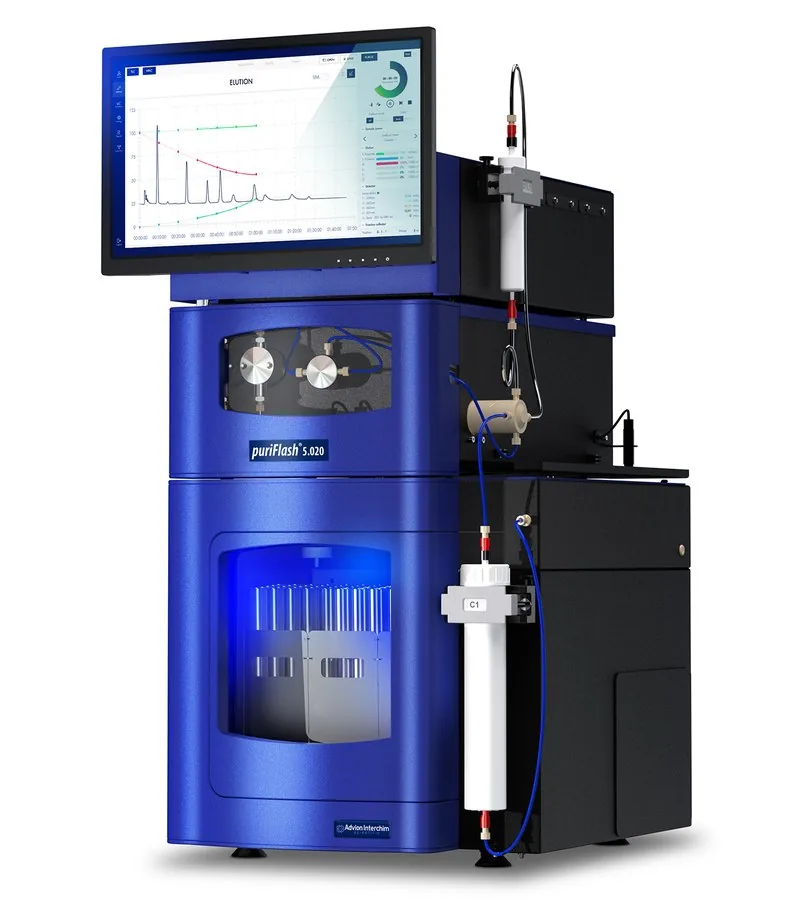
puriFlash 5.020
puriFlash 5.020 is an automated flash chromatography system designed to handle the daily purification workload without interruption. It delivers 300 mL/min flow and 20 bar pressure, identifies columns and racks by RFID, and with optional ELSD and MS detection also captures compounds without chromophores.
Request a quote| Flow / pressure | 300 mL/min · 20 bar |
|---|---|
| Detection | UV 200–400 nm; 200–800 nm and integrated ELSD with packages |
| Column range | F0004–F0800 flash |
| Fractions | 3 racks, 132 tubes (18×150 mm) |
| Display | 15-inch touchscreen |
Product description
The 5.020 is a flash purification system that can run continuously throughout the day. The crude synthesis product is loaded onto the column, and the separated components are collected into tubes as fractions based on the UV signal. Flow rates of up to 300 mL/min allow columns from F0004 to F0800 format to be used at their optimum flow rate.
The defining feature of the model is automation. Columns, tube racks and dry-load cartridges are automatically identified by RFID tags and recorded in the method. Solvent level and possible leaks are monitored by sensors; when a solvent bottle is about to run empty, the system pauses the run to prevent the column from drying out.
With 15 µm puriFlash columns run at higher flow rates, purification time can be cut by up to half, with only a limited loss in separation efficiency.
Applications of automated flash chromatography
It is suited to laboratories that run many columns per week and where the instrument is shared by several chemists. Automatic recognition of columns and tube racks reduces the risk of errors in environments where different users operate the same instrument.
- Pharmaceutical and agrochemical R&D laboratories
- Groups working with natural products and extracts
- Teams working with compounds that have weak chromophores or no chromophores (with the ELSD package)
- High-throughput laboratories planning overnight runs with a sample queue
Key features of the automated flash chromatography system
Triple detection: UV, ELSD and MS
The standard UV detector operates in the 200-400 nm range; the UVextended package extends the range to 200-800 nm. The iELSD package adds an integrated evaporative light scattering detector (ELSD), and a mass spectrometer can also be connected to the system. The ELSD detects compounds without chromophores that are invisible to UV and ensures they are collected without being missed.
Automatic solid loading (dry-load)
The 4-way electric valve package automatically switches the dry-load cartridge into the flow path. Because the cartridge can be prepared while the column is being equilibrated, waiting time is reduced.
Fraction capacity
A total of 132 tubes are used in three tube racks. The racks are numbered, so it is easy to trace which peak each tube belongs to. The collector needle is rinsed automatically after each run.
Software
The system runs InterSoft X software with the Genius artificial intelligence module. When TLC conditions and sample amount are entered, a suitable gradient and column size are suggested. A method can be created directly from a photo of the TLC plate taken with the mobile app.
Columns and complementary systems
The 5.020 works with flash columns up to F0800 format and dry-load cartridges up to F0330. puriFlash silica flash columns are used for normal phase purification, and reversed phase and functionalized columns for reversed phase work and polar compounds. Dry-load cartridges and injection consumables are listed on the puriFlash columns and consumables page.
For applications that require MS detection, the expression CMS compact mass spectrometer is connected to the system. The collected fractions can be dried in batches with a parallel evaporator. The other models in the series are listed in the flash chromatography systems section.
Technical assessment
Due to the 20 bar pressure limit, particle sizes below 15 µm cannot be used. If separation power close to preparative HPLC is required, the 5.050 model, which reaches 50 bar and works with stainless steel columns, should be considered.
The instrument weighs 49 kg. The pump cover and injection valve are not included in the standard package; the configuration is finalized at the quotation stage.
Technical specifications
| Maximum flow | 300 mL/min (from 1 mL/min) |
|---|---|
| Maximum pressure | 20 bar |
| Flow accuracy | ±2% (20–200 mL/min, at 5–16 bar) |
| Gradient | Quaternary gradient valve; gradient step accuracy < 3.5% |
| Injection | Liquid injection or solid loading; automatic dry-load with 4-way valve package, RFID recognition |
| UV detector | 200–400 nm DAD; 200–800 nm with package |
| ELSD | Integrated with iELSD package |
| Flow cell | 0.3 mm / 40 µL |
| Column compatibility | Flash columns up to F0800 format; dry-load up to F0330 |
| Particle size | Normal phase 15–50 µm · reversed phase 15–50 µm |
| Fraction collector | 3 racks · 132 tubes (18×150 mm), RFID rack recognition |
| Display and software | 15-inch touchscreen · InterSoft X + Genius · Windows 10 |
| Connectivity | 8 USB, 2 RJ45, Bluetooth/Wi-Fi |
| Safety | Leak detectors, solvent and waste level sensors, integrated fume enclosure |
| Power supply | 110 V or 220 V |
| Weight | 49 kg |
Values are taken from the manufacturer's published technical documentation. They may vary by configuration and are confirmed against the current datasheet before quotation.
Frequently asked questions
What is the difference between the 5.020 and the XS 530?
The XS 530 goes down to 10 µm particles at 30 bar pressure and stands out with its compact housing. The 5.020 operates at 20 bar but is stronger on automation, with RFID column and rack recognition, the iELSD package and a 132-tube fraction capacity.
Why might an ELSD be needed?
A UV detector only sees compounds that absorb light, that is, compounds containing chromophores. The evaporative light scattering detector added with the iELSD package also detects compounds without chromophores and ensures they are collected without being missed.
How is a method created from a TLC result?
The Genius module suggests a suitable gradient and column size based on the entered TLC conditions and sample amount. In addition, a photo of the TLC plate taken with the mobile app can be converted directly into a method.
Request a quote for this model
A suitable configuration and pricing are prepared based on sample type and workload.
Request a quote