

Syringe Filters
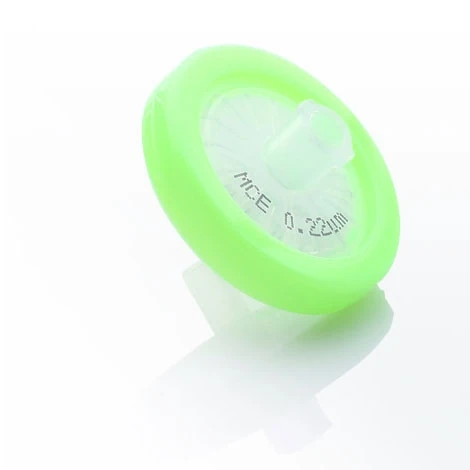
MCE Syringe Filters
With its mixed cellulose ester membrane, the MCE syringe filter offers high porosity and a uniform pore distribution. It is an economical solution for clarifying aqueous samples and for microbiological applications.
Request a quote| Membrane | Mixed cellulose ester (MCE) |
|---|---|
| Diameter | 13 · 25 · 33 mm |
| Pore size | 0.22 µm · 0.45 µm |
| Compatibility | Aqueous solutions |
| Strength | High porosity, economical |
Product description
Mixed cellulose ester membrane is produced by processing cellulose acetate and cellulose nitrate together. The resulting structure has high porosity and a narrow pore size distribution.
High porosity means more flow at the same pressure. The narrow pore distribution ensures consistent retention performance; particles larger than the specified size are reliably retained.
MCE is designed for aqueous solutions. The membrane is damaged by organic solvents and should not be used with acetonitrile, acetone or chlorinated solvents.
It is widely used in microbiological applications. The 0.22 µm version provides sterile filtration, and gridded versions are also available for colony counting by the membrane filtration method.
Applications
- Aqueous sample clarification: Water, buffers and dilute solutions.
- Microbiological analysis: Sterile filtration and colony counting with 0.22 µm.
- Environmental analysis: Preparation of drinking water and wastewater samples.
- Ion chromatography: Filtration of aqueous samples prior to injection.
- Routine quality control: High-volume work where cost is a priority.
MCE does not resist organic solvents. If the acetonitrile or methanol content of the sample is high, a nylon, RC or PTFE membrane should be selected.
For samples containing organic solvents, a regenerated cellulose (RC) membrane filter or a PTFE membrane filter should be used. Other membrane types are listed in the syringe filters category.
MCE syringe filter diameter and pore size selection
For MCE filters, the pore size is defined by the application: 0.22 µm is used for microbiological and sterile work, and 0.45 µm for general clarification of aqueous samples. For turbid water and wastewater samples, a large-diameter filter filters more volume before clogging.
- Aqueous samples: Drinking water, wastewater and buffers are typical samples for MCE.
- Economical routine work: Provides a unit cost advantage with high sample numbers.
- Organic solvents: Not used for these samples, as the membrane is damaged by solvents.
Correct use of MCE filters and common mistakes
The most common mistake with MCE is overlooking that solvent has been added to an aqueous sample later on. If acetonitrile or methanol was added during extraction or dilution, the membrane may swell and release substances into the filtrate; another membrane is used for these samples.
- If suspended solids are high in environmental samples, a coarse prefiltration is performed first.
- In microbiological work, the filter and filtrate container are opened under aseptic conditions.
- For ion chromatography samples, the ionic contribution of the membrane is checked with a blank.
- A clogged MCE filter is not forced; filtration is continued with a new filter.
In aqueous sample preparation, collecting the solution clarified with MCE in a 2 mL HPLC vial prevents fine particles in water and wastewater samples from reaching HPLC columns.
Technical specifications
| Membrane material | Mixed cellulose ester (MCE) |
|---|---|
| Diameter options | 13 mm · 25 mm · 33 mm |
| Pore size | 0.22 µm · 0.45 µm |
| Wettability | Hydrophilic |
| Porosity | High; fast flow |
| Compatibility | Aqueous solutions; not suitable for organic solvents |
| Protein binding | Medium |
| Maximum temperature | 75 °C |
| Use | Single use |
| Package | Box of 100 |
Values are taken from the manufacturer's published technical documentation. They may vary by configuration and are confirmed against the current datasheet before quotation.
Frequently asked questions
Which samples is MCE used for?
It is used for aqueous solutions: water, buffers, dilute samples and microbiological samples. The membrane is damaged by samples containing organic solvents.
Why is it preferred in microbiology?
Thanks to its narrow pore size distribution, the 0.22 µm version reliably retains bacteria. Gridded versions are also available for colony counting by the membrane filtration method.
How does it differ from cellulose acetate?
MCE is a mixture of cellulose acetate and cellulose nitrate; it has higher porosity and flows faster. Cellulose acetate has lower protein binding.
How is an MCE filter used with environmental samples?
Water and wastewater samples are first allowed to settle or passed through a coarse prefilter, then filtered with the MCE filter. This keeps the membrane from clogging quickly and gives a filtrate clear enough for analysis.
From the same category
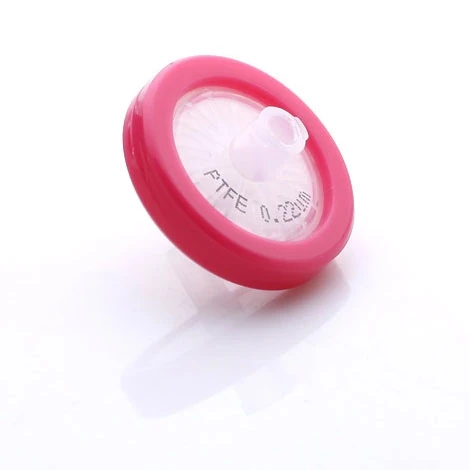
PTFE Syringe Filters
The most solvent-resistant membrane: PTFE syringe filter for HPLC mobile phases and aggressive solvents.
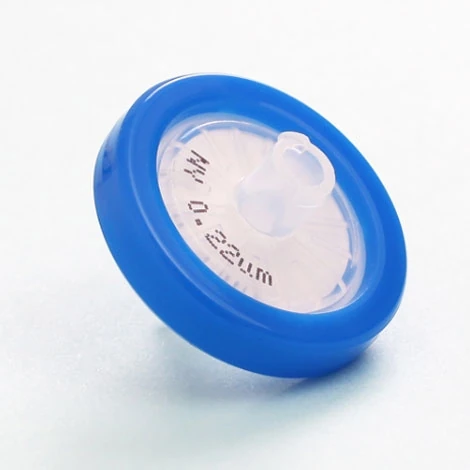
Nylon Syringe Filters
General-purpose nylon syringe filter for both aqueous and organic samples; the most common HPLC choice.
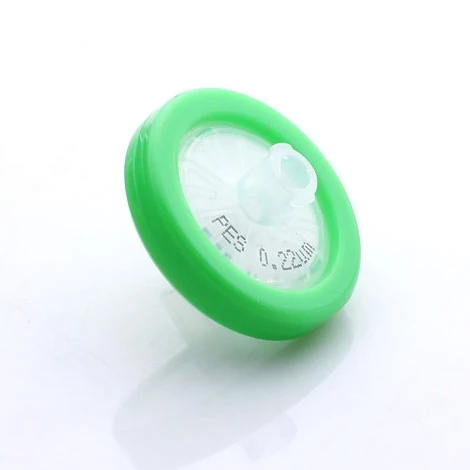
PES Syringe Filters
PES syringe filter offering low protein binding and high flow rate; for biological and aqueous samples.
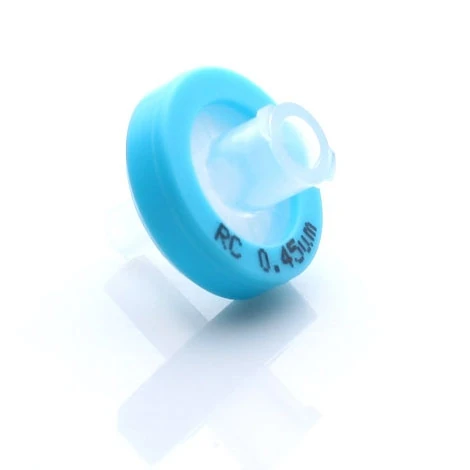
RC (Regenerated Cellulose) Syringe Filters
RC syringe filter with the lowest level of extractables; for trace analysis of aqueous and organic samples.
Request a quote for this model
A suitable configuration and pricing are prepared based on sample type and workload.
Request a quote