

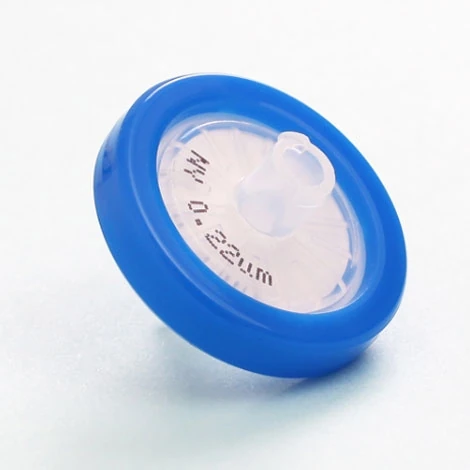
Syringe Filters
Nylon Syringe Filters
Thanks to its polyamide membrane, the nylon syringe filter is naturally hydrophilic and requires no prewetting with aqueous solutions. Since it also resists most organic solvents, a single membrane filters both water-based and solvent-based samples, making it the most common general-purpose choice.
Request a quote| Membrane | Nylon (polyamide) |
|---|---|
| Diameter | 13 · 25 · 33 mm |
| Pore size | 0.22 µm · 0.45 µm |
| Wettability | Naturally hydrophilic |
| Limitation | Binds protein; not suitable for biological samples |
Product description
Nylon membrane is naturally hydrophilic. An aqueous solution spreads as soon as it touches the membrane; no prewetting step is required. The same membrane also works with common organic solvents such as methanol, acetonitrile and ethanol.
This dual compatibility makes nylon the general-purpose filter of the laboratory. Laboratories working with different sample types can cover most needs by stocking a single membrane.
Nylon has one distinct limitation: a high tendency to bind protein. In protein-containing samples, part of the protein in solution adheres to the membrane and is lost. PES or PVDF should be preferred for biological samples.
Its mechanical strength is high. It resists rupture under pressure, which is an advantage with samples carrying a high particle load.
Applications
- General HPLC sample preparation: Clarification of aqueous and organic mixtures.
- Food and beverage analysis: Prior to determination of sugars, organic acids and additives.
- Environmental samples: Prefiltration in water and wastewater analysis.
- Chemical quality control: Filtration of raw material and product solutions.
- Mobile phase preparation: Water-acetonitrile and water-methanol mixtures.
Nylon should not be used for samples containing proteins, peptides or antibodies. Recovery losses directly lower the measurement result.
For protein-containing samples a PES membrane filter is preferred, and for strong solvents a PTFE membrane filter. All membrane options are listed in the syringe filters category.
Nylon syringe filter diameter and pore size selection
Since the nylon filter is used for general purposes, most laboratories stock it in a single pore size and diameter: 0.45 µm for routine HPLC samples and 0.22 µm for columns with small particle size. If the sample volume does not exceed a few milliliters, a small diameter reduces the sample retained in the housing.
- Aqueous and organic mixtures: Water-methanol and water-acetonitrile mixtures are filtered without prewetting.
- Protein-containing samples: Since nylon tends to retain protein, PES or PVDF is selected for these samples.
- Strong acids and chlorinated solvents: As they can degrade nylon, PTFE is used for these samples.
Correct use of nylon filters and common mistakes
The most common mistake with nylon is assuming that a single membrane suits every task. Being general-purpose does not mean it is also suitable for proteins and certain strong solvents; the membrane selection is reviewed before these sample groups are filtered.
- Although its mechanical strength is high, the plunger is pushed in a controlled manner; sudden pressure can cause leakage at the housing connection.
- When working with trace-level analytes, the first few drops are discarded to remove any contribution from the membrane.
- Samples containing acidic or chlorinated solvents are not applied to a nylon filter.
- The nylon filter is replaced for each sample; residue from the previous sample accumulates on the membrane and causes carryover.
In routine sample preparation, the solution passing through the nylon filter is filtered directly into a 2 mL HPLC vial and made ready for the autosampler. This step prevents fine sediment in food and environmental samples from reaching HPLC columns.
Technical specifications
| Membrane material | Nylon (polyamide) |
|---|---|
| Diameter options | 13 mm · 25 mm · 33 mm |
| Pore size | 0.22 µm · 0.45 µm |
| Wettability | Naturally hydrophilic; no prewetting required |
| Housing material | Polypropylene |
| Compatibility | Water, alcohols, acetonitrile, moderately strong solvents |
| Protein binding | High; not recommended for biological samples |
| Maximum temperature | 80 °C |
| Use | Single use |
| Package | Box of 100 |
Values are taken from the manufacturer's published technical documentation. They may vary by configuration and are confirmed against the current datasheet before quotation.
Frequently asked questions
Why is nylon the most common choice?
A single membrane filters both aqueous and organic samples and requires no prewetting. In laboratories working with different sample types, most needs are covered with a single stock item.
Why is it not used for protein-containing samples?
Nylon has a high tendency to bind protein; part of the protein in solution adheres to the membrane. This lowers recovery and makes the result appear smaller than it is. PES or PVDF should be used for these samples.
Which solvents should it not be used with?
Strong acids, chlorinated solvents such as dichloromethane, and tetrahydrofuran can degrade nylon. A PTFE membrane should be preferred for these solvents.
What should be done if a nylon filter clogs?
Because the nylon membrane withstands pressure, excessive force may be applied without noticing. When resistance increases, filtration is stopped and a new filter is attached; for turbid food or environmental samples, using a glass fiber prefilter first delays clogging.
From the same category
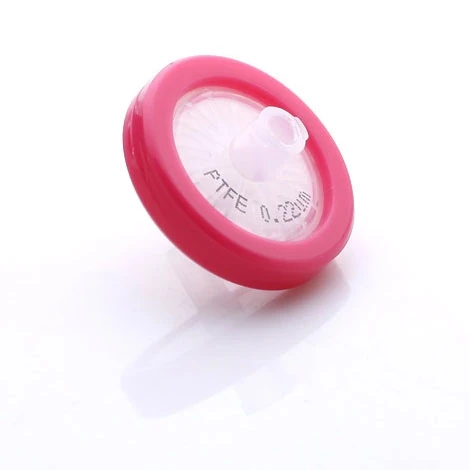
PTFE Syringe Filters
The most solvent-resistant membrane: PTFE syringe filter for HPLC mobile phases and aggressive solvents.
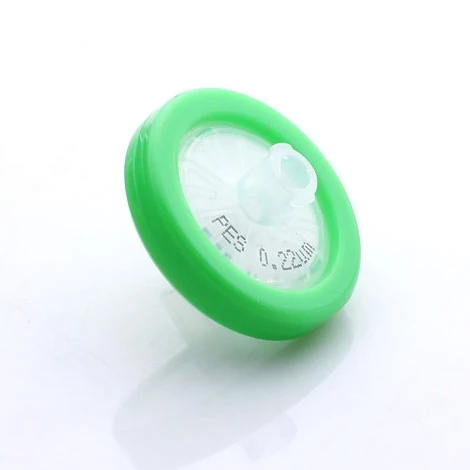
PES Syringe Filters
PES syringe filter offering low protein binding and high flow rate; for biological and aqueous samples.
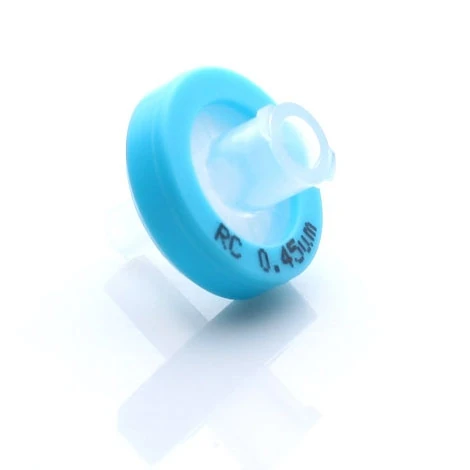
RC (Regenerated Cellulose) Syringe Filters
RC syringe filter with the lowest level of extractables; for trace analysis of aqueous and organic samples.
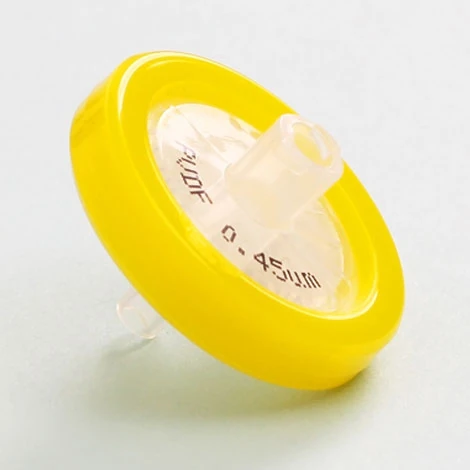
PVDF Syringe Filters
PVDF syringe filter combining low protein binding with chemical resistance; for protein solutions.
Request a quote for this model
A suitable configuration and pricing are prepared based on sample type and workload.
Request a quote