

Syringe Filters
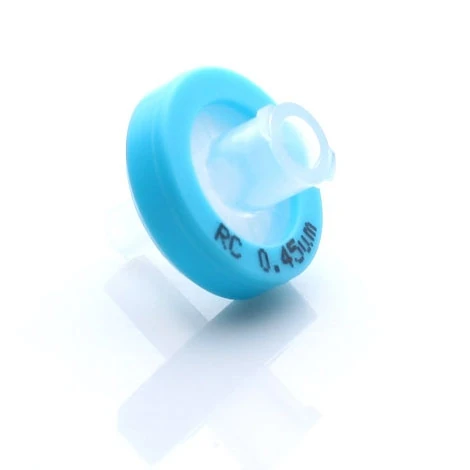
RC (Regenerated Cellulose) Syringe Filters
With its regenerated cellulose membrane, the RC syringe filter is one of the membranes with the lowest level of extractables. It works with both aqueous and organic samples and is preferred for trace analysis and low-concentration measurements.
Request a quote| Membrane | Regenerated cellulose (RC) |
|---|---|
| Diameter | 13 · 25 · 33 mm |
| Pore size | 0.22 µm · 0.45 µm |
| Extractables | Very low |
| Compatibility | Aqueous and organic |
Product description
Regenerated cellulose membrane is produced from cellulose restructured by chemical treatment. The resulting membrane is hydrophilic and resists a wide range of solvents.
The distinguishing feature of RC is its low level of extractables. The amount of components passing from the membrane into the solution is very small, which minimizes the risk of ghost peaks in the chromatogram.
This property is decisive in trace analysis. When the measured concentration drops to the ppb range, even a trace component from the membrane can distort the result. RC is among the options that keep this risk lowest.
Its protein binding rate is also low. In work requiring both trace analysis and biological samples, a single membrane meets both requirements.
Applications
- Trace analysis: Minimizing the risk of ghost peaks in ppb-level measurements.
- Pharmaceutical quality control: Determination of impurities and degradation products.
- Mass spectrometry: LC-MS applications requiring a low background.
- Mixed sample types: Laboratories working with both aqueous and organic solutions.
- Protein-containing samples: Low recovery loss thanks to low binding.
In LC-MS work, membrane selection directly affects background noise. RC and PTFE are the two options giving the lowest background in this application.
For protein-free general-purpose work, a nylon membrane filter can be considered as a more economical option. The different membrane types are presented together in the syringe filters category.
RC syringe filter diameter and pore size selection
Since RC filters are mostly used for trace analysis and LC-MS samples, the pore size is determined by the column to be injected onto; 0.22 µm is safer for columns with small particle size. When the sample amount is limited, a small-diameter filter minimizes the volume retained in the housing.
- Trace analysis: Low extractables reduce the risk of extraneous peaks in the chromatogram.
- Mixed solvents: The hydrophilic structure tolerates aqueous samples and the cellulose backbone tolerates common organic solvents.
- Strong acids and bases: The cellulose structure may be damaged in these media; PTFE is considered.
Correct use of RC filters and common mistakes
The most common mistake in trace analysis is never checking the contribution from the filter. Although the extractables level of RC membrane is low, the background is documented during method validation by analyzing a blank sample in which only the solvent is passed through the filter.
- Part of the initial filtrate is discarded to remove trace components that may come from the housing and membrane surface.
- For LC-MS samples, the filtrate is collected in a clean, low-adsorption vial or insert.
- For samples containing strong acids or bases, PTFE is selected instead of RC.
- When resistance increases, the membrane is not forced; filtration is continued after replacing the filter.
For low-concentration samples, collecting the filtrate from the RC filter in a 2 mL HPLC vial achieves both protection of HPLC columns and a clean background in the same step.
Technical specifications
| Membrane material | Regenerated cellulose (RC) |
|---|---|
| Diameter options | 13 mm · 25 mm · 33 mm |
| Pore size | 0.22 µm · 0.45 µm |
| Wettability | Hydrophilic |
| Extractables | Very low |
| Protein binding | Low |
| Compatibility | Water, alcohols, acetonitrile, DMSO, DMF |
| Maximum temperature | 80 °C |
| Use | Single use |
| Package | Box of 100 |
Values are taken from the manufacturer's published technical documentation. They may vary by configuration and are confirmed against the current datasheet before quotation.
Frequently asked questions
When should RC membrane be preferred?
RC is preferred when the measured concentration is low and extraneous peaks in the chromatogram must be avoided. Trace analysis, pharmaceutical impurity determination and LC-MS applications are the main areas of use.
How does it differ from nylon?
Both work with aqueous and organic samples. RC has lower extractables and lower protein binding, while nylon is mechanically more robust and more economical.
Which solvents can it be used with?
It is compatible with water, alcohols, acetonitrile, DMSO and DMF. A PTFE membrane is recommended for strong acids and some chlorinated solvents.
How is the background from the filter checked?
Only solvent is passed through the filter instead of sample, and this blank is analyzed by the same method. If no peak appears in the chromatogram, the filter contribution is negligible; if one does, the volume of initial filtrate discarded is increased.
From the same category
PTFE Syringe Filters
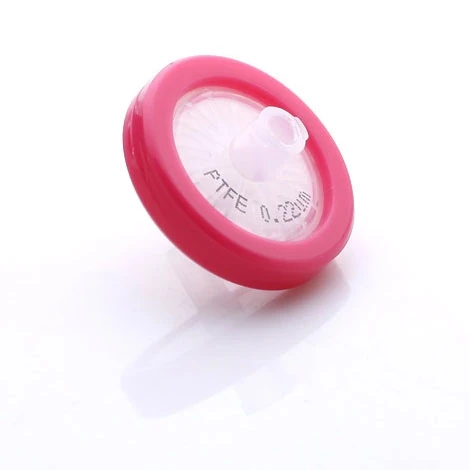
The most solvent-resistant membrane: PTFE syringe filter for HPLC mobile phases and aggressive solvents.
Nylon Syringe Filters
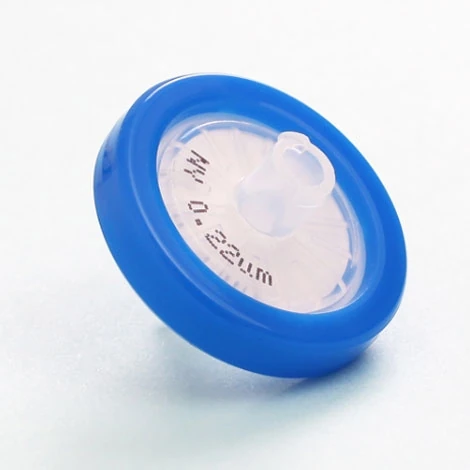
General-purpose nylon syringe filter for both aqueous and organic samples; the most common HPLC choice.
PES Syringe Filters
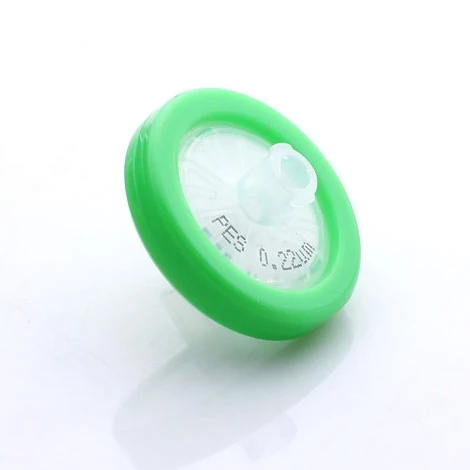
PES syringe filter offering low protein binding and high flow rate; for biological and aqueous samples.
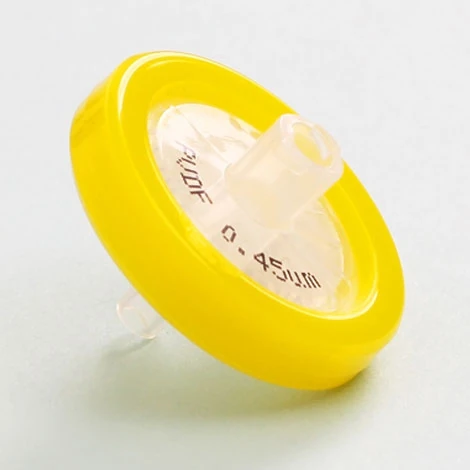
PVDF Syringe Filters
PVDF syringe filter combining low protein binding with chemical resistance; for protein solutions.
Request a quote for this model
A suitable configuration and pricing are prepared based on sample type and workload.
Request a quote