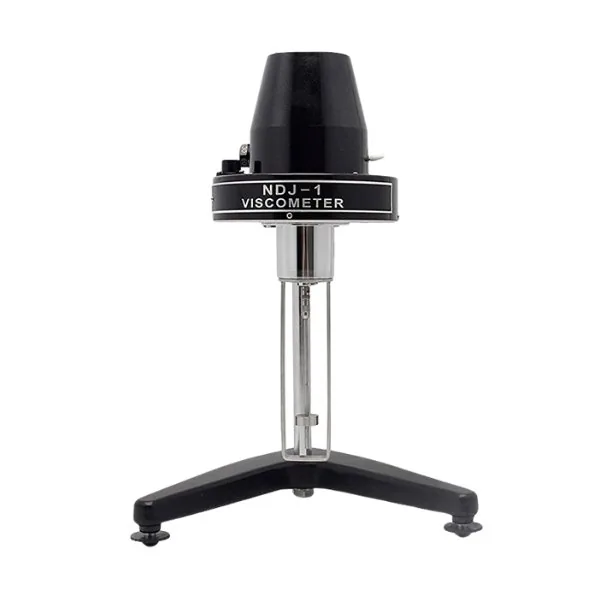
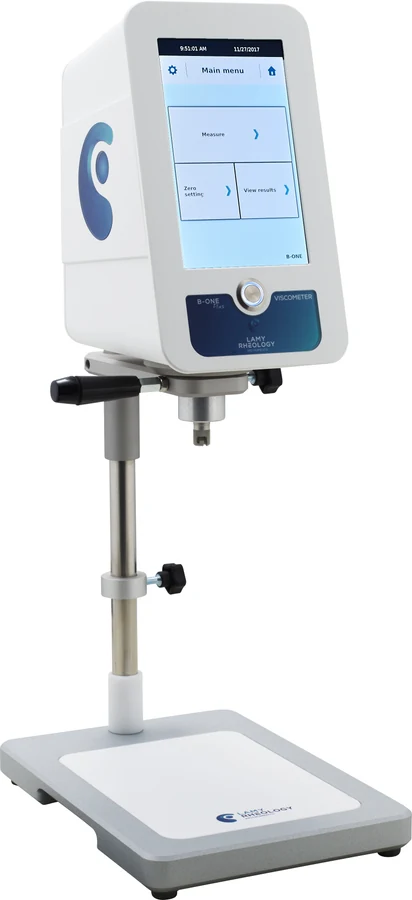
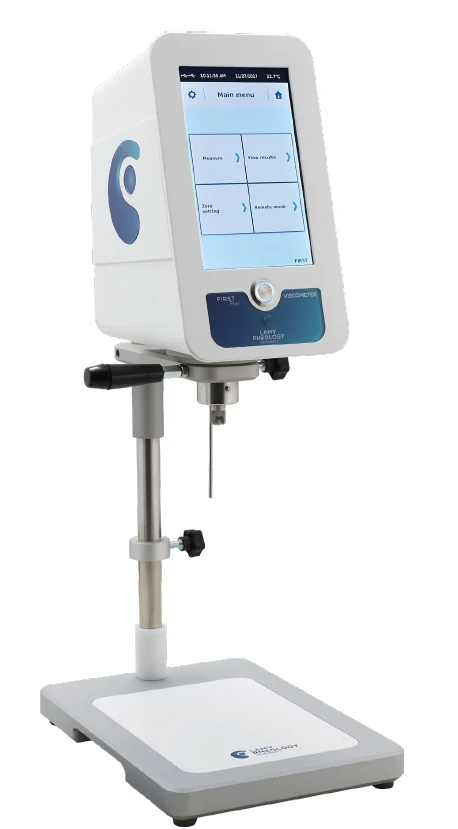
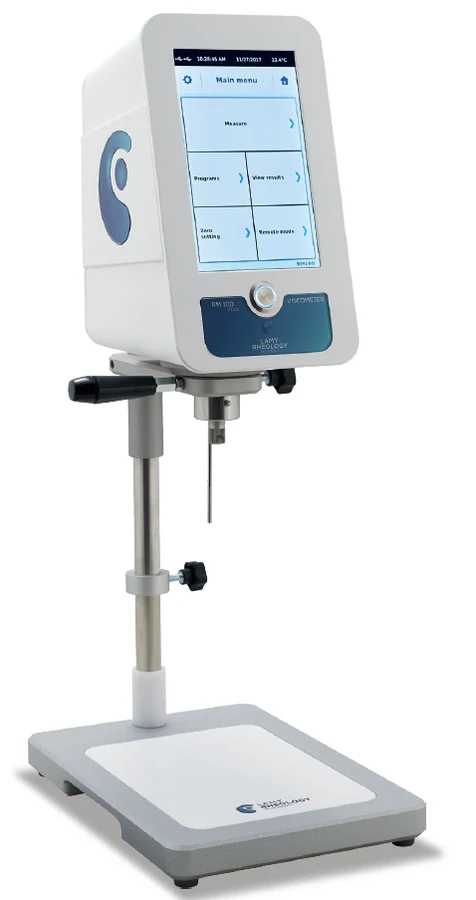
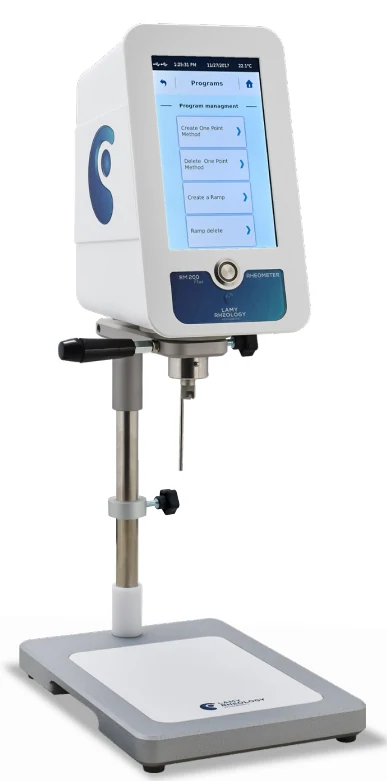
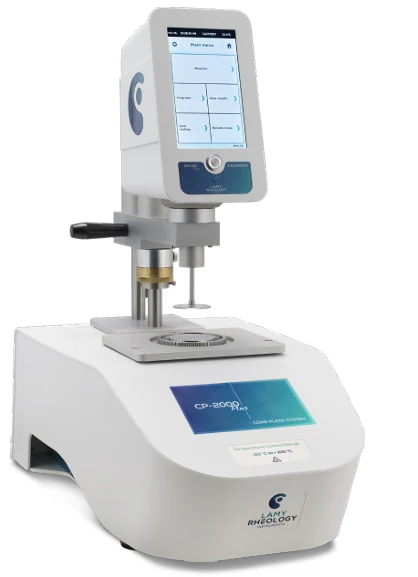
How does a rotational viscometer measure?
A rotational viscometer rotates a spindle immersed in the sample at constant speed and measures the resistance to rotation as torque. The instrument converts this torque into viscosity using factors specific to the spindle geometry and speed. The result is given in mPa·s (cP in the older unit).
Two variables determine the measuring range: spindle size and rotational speed. A spindle with a large surface area and a high speed increase torque; a small spindle and a low speed decrease torque. The right combination brings the measured torque into the range in which the instrument operates reliably.
The torque range rule in viscometer spindle selection
With rotational viscometers, common practice is to measure between approximately 10% and 100% of full-scale torque. When torque is below this range, the reading approaches the accuracy limit of the instrument; when it exceeds full scale, no measurement can be taken.
- If torque is low: A larger spindle is selected or the speed is increased.
- If torque is close to or above full scale: A smaller spindle is selected or the speed is reduced.
- If the reading is unstable: Air bubbles in the sample, incorrect spindle immersion depth or temperature changes are checked.
Accuracy values are generally given as a percentage of full scale. An accuracy of 1% of full scale means an uncertainty of about 10% of the reading at 10% torque. For this reason, the combination that brings torque as high as possible is selected.
Example workflow for spindle and speed selection
When setting up a method for a new product, the following sequence can be followed:
- The estimated viscosity of the product is determined from previous data or similar products.
- A first measurement is taken with a medium-sized spindle and a medium speed.
- The spindle or speed is changed based on the torque percentage; the aim is for torque to be within the reliable range and as high as possible.
- Repeatability is checked by measuring the same sample several times with the selected combination.
- Spindle, speed, temperature and measurement time are recorded as a written method.
This workflow ensures that the same result is obtained across different shifts and between different users. A real-time rotational viscometer, which makes decisions easier by displaying the measurement curve on screen, saves time during method development.
Spindle types and where they are used
The geometries used with rotational viscometers differ according to the flow behavior of the sample and the purpose of the measurement. Each geometry has a factor defined in the instrument; if the wrong spindle is fitted and a different spindle is entered in the instrument, the result will be completely wrong.
- Disc and cylindrical spindles: Standard geometries for routine measurements in a beaker with a large volume.
- Small sample adapters: Allow measurement with a small amount of sample in a defined gap; temperature control is also easier.
- Low viscosity adapters: Used to generate measurable torque with samples whose flow behavior is close to that of water.
- T-bar spindles: Used together with a helical stand to prevent channeling in pastes, gels and semi-solid samples that do not flow back.
- Cone and plate: For applications requiring a defined shear rate and a very small sample volume.
Correctly entering the spindle in the instrument is a prerequisite for measurement. The spindle number and geometry are reported together with the result.
Spindle selection at low and high viscosity
Low-viscosity samples
With samples as fluid as water, standard spindles do not generate sufficient torque. In this case, special geometries working with a low-torque (LR) measuring head or a small-volume adapter are used. In the digital rotational viscometer models, the low-range option operates in the 0.005–0.8 mNm torque band.
High-viscosity samples
For pastes, resins and thick creams, a small spindle and a low speed are selected. Where the measuring range is insufficient, the wide-range rotational viscometer with higher torque capacity extends coverage, reaching up to 30 mNm torque and 1,500 rpm speed.
Small samples and defined shear rate
If the amount of sample is small or the result must be reported at a specific shear rate, cone and plate geometry is preferred. The high-RPM cone and plate viscometer works with samples from a few microliters to a few milliliters.
Speed selection for non-Newtonian samples
In Newtonian liquids such as water and mineral oil, viscosity is independent of speed. In products such as paint, shampoo, ketchup and cream, however, viscosity changes with speed; this behavior, in which viscosity decreases as speed increases, is called shear thinning. For these products, a result obtained at a single speed is valid only for that speed.
- In quality control, a fixed spindle and speed combination is defined and not changed.
- To understand product behavior, measurements are made at several speeds and a flow curve is plotted.
- For samples showing time-dependent viscosity change (thixotropy), the measurement time is fixed.
A programmable rotational viscometer is suitable for multi-step measurements, and a rotational rheometer for flow curve and yield point analysis. The rotational measurement method for non-Newtonian materials is defined in the ASTM D2196 standard.
Effect of temperature and sample preparation
Viscosity is extremely sensitive to temperature; for many liquids, a difference of a few degrees changes the result significantly. For this reason, the measurement temperature is fixed and reported together with the result. A PT100 temperature probe and control of an external temperature unit are used for this purpose.
- The sample is brought to the measurement temperature and held at this temperature long enough.
- The spindle is immersed up to the mark on it; insufficient or excessive immersion changes the result.
- The spindle is inserted into the sample at an angle to prevent air bubbles from being trapped underneath.
- Container diameter and sample volume are kept the same for every measurement.
A summary of rotational measurement techniques and other measurement methods is on the laboratory technologies page.
How should a viscosity result be reported?
A rotational viscosity result has no meaning as a number on its own. So that the result can be reproduced in another laboratory or on another date, the measurement conditions are recorded with it:
- Instrument model, spindle number or geometry
- Rotational speed (rpm) and, if required, shear rate
- Measurement temperature
- Measurement time or moment of reading
- Torque percentage
The LIMS-compatible viscometer, which makes this recording discipline easier on the instrument itself, transfers results together with their conditions to the laboratory information management system. All models can be compared on the viscosity and rheology page.
Frequently asked questions
How is the right spindle determined?
First, a spindle suitable for the estimated viscosity and a medium speed are selected. If the torque reading is below 10%, a larger spindle or higher speed is used; if it is close to full scale, a smaller spindle or lower speed. The combination found is fixed as the method.
Why do results measured with different spindles differ?
In non-Newtonian samples, each spindle and speed combination applies a different shear rate to the sample. Because viscosity depends on shear rate, the results change; comparisons are made only under the same conditions.
Is there a difference between cP and mPa·s?
No. 1 centipoise (cP) equals 1 mPa·s; mPa·s is used in the SI system of units.
How is viscometer calibration checked?
Traceable calibration oils of known viscosity are measured at a specified temperature. The reading should agree with the certified value of the oil within the accuracy limit of the instrument.