

Vials, Caps and Septa
Vial Inserts
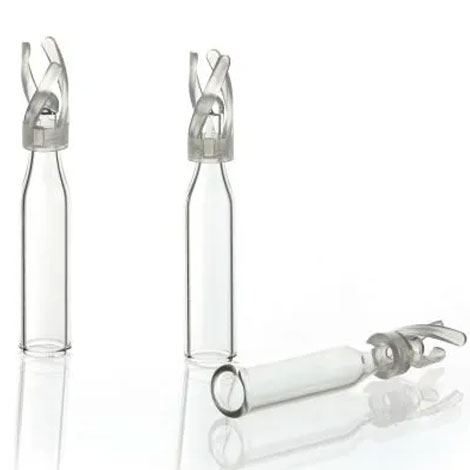
An HPLC vial insert is a glass reservoir placed inside a standard vial that allows work with small sample volumes. It is offered in 150, 200, 250 and 350 µL volumes with conical, flat and plastic spring bottom options, and reduces dead volume.
Request a quote| Volumes | 150 · 200 · 250 · 350 µL |
|---|---|
| Bottom | Conical, flat or plastic spring |
| Compatibility | ND8, ND9 and ND11 vials |
| Dimensions | 31×5 / 29×5 mm (ND8) · 31×5.8 / 29×5.8 mm (ND9-ND11) |
| Glass | Borosilicate, clear |
Product description
When only 100 µL of sample is placed in a 1.5 mL vial, the needle cannot reach the liquid. The insert sits inside the vial and concentrates the liquid in a narrow cross-section, so the needle can go down to the bottom and almost all of the sample can be drawn.
This reduces both sample waste and the cost of repeat preparation. The difference is clearly seen with biological samples, isolated metabolites and expensive standards.
The bottom type is selected according to the sensitivity of the application. A conical bottom allows withdrawal down to the last drop. A flat bottom stands more stably and is preferred in calibration series. The plastic spring model prevents the insert from slipping or jamming inside the vial.
HPLC vial insert technical assessment
If fitting inserts is time-consuming, factory-assembled vials with fitted inserts can be considered. This option eliminates both the labor and the risk of the insert seating incorrectly.
The needle depth setting must be readjusted for the insert. An incorrect setting causes the needle to hit the bottom of the insert and break the glass.
Cap and septum
The insert is not closed on its own; it is closed by the cap of the carrier vial in which it is placed. For this reason, the cap is selected according to the ND8, ND9 or ND11 vial.
Cap type
Suitable cap: screw caps for vials or aluminum crimp caps, depending on the carrier vial.
Septum type
- PTFE/silicone septum: PTFE on the side facing the sample, silicone on the back. Provides both chemical inertness and resealing; it is the standard choice for HPLC and GC applications.
- Single-layer silicone septum: No PTFE facing. Reseals better; used for multiple piercings and storage, not recommended for trace analysis.
When working with inserts, a thin (1.0 mm) septum helps the needle pass through without pressing down on the insert.
Inserts with plastic springs sit on the bottom of the vial and prevent slipping under needle pressure; they reduce the risk of breakage in long series.
Compatible vials
The ND8 8-425 screw thread HPLC vial, ND9 9 mm screw thread HPLC vial and ND11 11 mm crimp HPLC vial are used as carrier vials. A 5 mm diameter insert is selected for ND8, and a 5.8 mm diameter insert for ND9 and ND11.
Correct use
After the insert is placed in the vial, the sample is dispensed directly to the bottom of the insert with a fine-tip pipette, avoiding droplets on the wall and air bubbles. A bubble causes the needle to draw air and the injection volume to deviate. Tapping the vial lightly after filling brings the liquid down into the conical bottom.
Frequently asked questions
Should a conical or flat-bottom insert be chosen?
A conical bottom is preferred if the sample has to be drawn down to the last drop; a flat bottom is preferred if a more stable stand is needed in calibration series.
Why do inserts break?
The most common reason is that the needle depth has not been adjusted for the insert. When the needle hits the bottom of the insert, the glass can break; an insert with a plastic spring reduces this risk.
Which volume should be chosen?
A typical approach is for the sample to fill roughly half of the insert volume. For samples of around 100 µL, 150-200 µL inserts are common.
From the same category
ND8 Vials and Caps
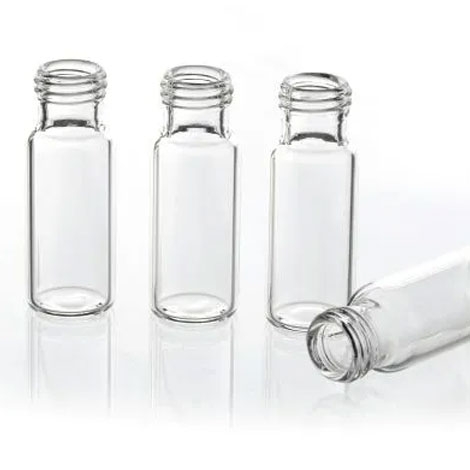
8-425 thread, 1.5 mL screw thread HPLC vials; clear and amber, with printed options.
ND9 Vials and Caps
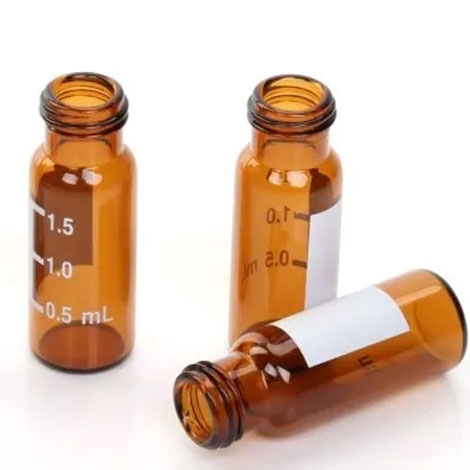
The most common HPLC vial: 9 mm screw thread, 1.5 mL, with options featuring fitted inserts.
ND11 Crimp Vials and Caps
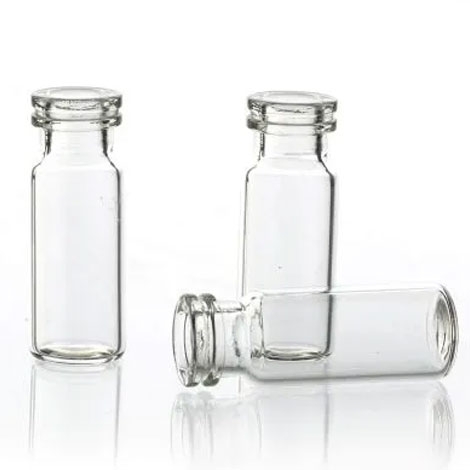
1.5 mL vials with 11 mm crimp neck; aluminum cap and rubber/PTFE septum options.
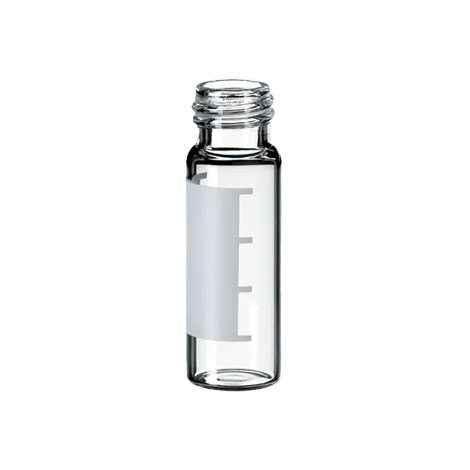
ND13 Vials and Caps
4 mL, 13 mm screw thread vials for large-volume samples and storage.
Request a quote for this model
A suitable configuration and pricing are prepared based on sample type and workload.
Request a quote