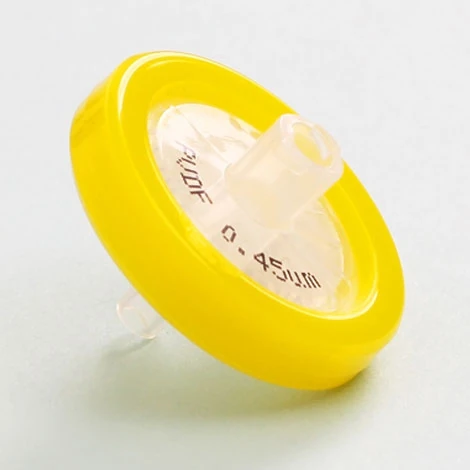
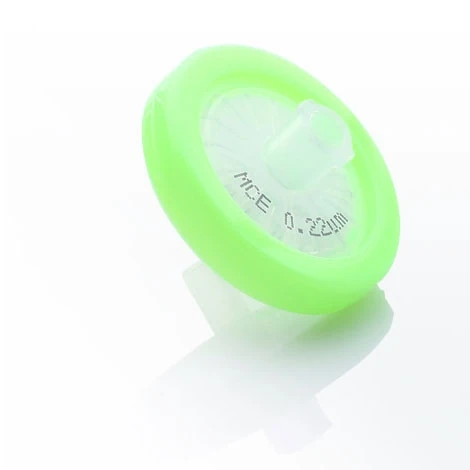
Why is a syringe filter used?
In HPLC and GC analysis, particles in the sample clog the column inlet, the injector and capillaries. A syringe filter retains these particles just before the sample is transferred to the vial, protecting the instrument and preventing repeatability problems caused by pressure increase.
The filter's only task is to retain particles; it should not change the composition of the sample. For this reason, membrane selection is based on the sample solvent and the structure of the analyte. The filter housing is mostly polypropylene; the real difference is determined by the membrane material.
Syringe filter membrane selection: comparison of six membranes
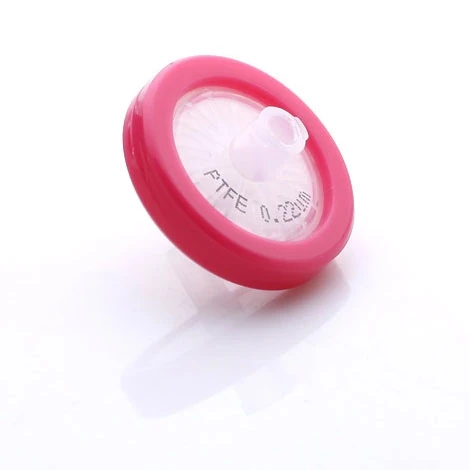
PTFE
The membrane with the highest chemical resistance; it is used safely with aggressive organic solvents. It is inherently hydrophobic; for aqueous samples, it is either prewetted with alcohol or the hydrophilic PTFE version is selected. Details are on the PTFE syringe filter page.
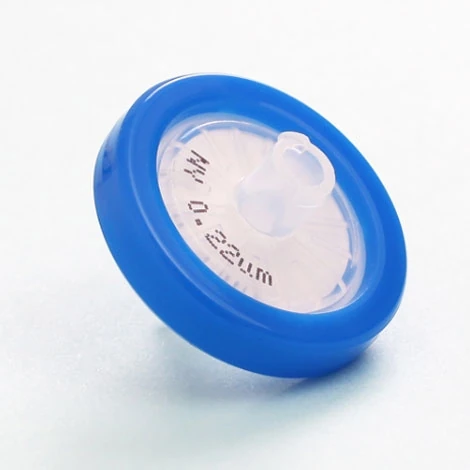
Nylon
Because it is naturally hydrophilic, it does not require prewetting for aqueous and many organic samples; it is common in general-purpose HPLC preparation. On the other hand, it has a high tendency to bind protein and is not recommended for strong acids. See nylon syringe filter.
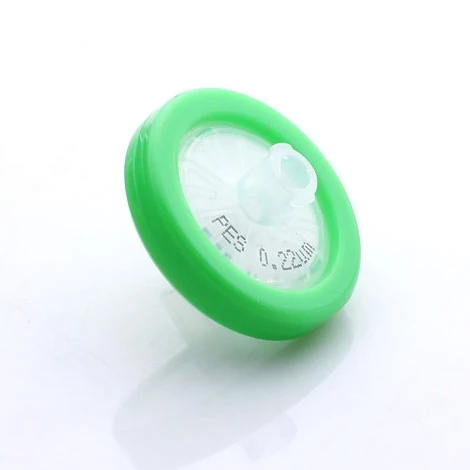
PES
Offers low protein binding and high flow rate. Suitable for buffers, cell culture media and biological samples; its resistance to organic solvents is limited. See PES syringe filter.
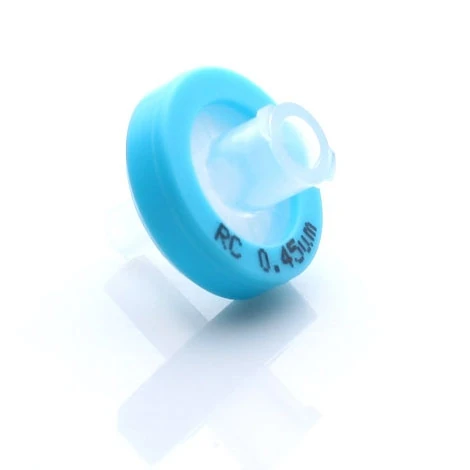
RC (regenerated cellulose)
Works with both aqueous and organic samples and has a very low level of extractables. This property is decisive in applications where background signal is critical, such as trace analysis and ion chromatography. See RC syringe filter.
PVDF
Combines low protein binding with good chemical resistance. It is a balanced choice in mixed systems where protein solutions contain alcohol or acetonitrile. See PVDF syringe filter.
MCE (mixed cellulose ester)
An economical membrane offering high porosity and fast flow. Suitable for aqueous solutions only; the membrane is damaged by organic solvents. See MCE syringe filter.
Syringe filter selection: quick decision by solvent
- Pure organic solvent (acetonitrile, methanol, THF, dichloromethane): PTFE; RC is also suitable if the organic proportion is high.
- Water and organic mixture mobile phase: Nylon, RC or PVDF.
- Aqueous buffer and biological sample: PES or PVDF.
- Sample containing protein or peptide: PES, PVDF or RC; nylon is avoided.
- Trace analysis, method requiring low background: RC.
- Economical aqueous clarification: MCE.
When in doubt, the sample is analyzed both filtered and unfiltered (clarified by centrifugation). The difference between the two results shows whether the membrane retains the analyte.
UptiDisc syringe filters, which offer different membranes and prefilter options in a single product family, simplify stock management in laboratories working with multiple sample types. All options are listed on the syringe filters page.
Example scenarios by sample type
Active pharmaceutical ingredient in organic solvent
For active ingredient samples dissolved in acetonitrile or methanol, chemical resistance is the priority. PTFE or RC membranes carry no risk of swelling or dissolving in the solvent. In impurity analyses with strict extractables limits, RC provides a cleaner background.
Food extract, aqueous and organic mixture
Extracts obtained from food samples are mostly mixtures of water and organic solvent and have a high particle load. Nylon or PVDF membranes are compatible with these mixtures; for heavy turbidity, a model with a glass fiber prefilter delays clogging.
Protein and biological samples
In protein solutions and cell culture supernatants, the main risk is adsorption of the analyte onto the membrane. Low-protein-binding PES or PVDF is preferred; nylon can reduce recovery with these samples.
Environmental and water samples
For aqueous environmental samples, MCE is sufficient if economical clarification is needed. If ion analysis is to be performed, membranes with low background ion contribution, such as RC, are selected and a check is made with a blank sample.
How are diameter and pore size determined?
Diameter is selected according to the volume to be filtered. 13 mm filters are sufficient for HPLC samples of a few milliliters, and the hold-up volume in the membrane is low. For larger volumes, a 25 mm or 33 mm filter delays clogging. For micro-volume samples, 4 mm diameter filters minimize sample loss.
Pore size is determined by the column packing. For standard HPLC columns, 0.45 µm is often sufficient; for UHPLC columns with small particles and applications requiring reduction of microbial load, 0.22 µm is preferred. For samples with a high particle load, models with a glass fiber prefilter prevent clogging of the main membrane.
Filter selection is only one part of column protection. Suitable HPLC columns and SPE cartridges, which reduce matrix interference in sample preparation, are evaluated together.
Correct use and common mistakes
- The sample is drawn into the syringe first and the filter is attached afterwards; the reverse order can damage the membrane.
- The first 0.5–1 mL of filtrate is discarded; this volume removes trace components that may come from the membrane.
- Excessive pressure is not applied. If flow becomes difficult, the filter is replaced; forcing it causes the membrane to rupture.
- Filters are single-use; cleaning and reusing them carries a risk of cross-contamination.
- Aqueous samples are not filtered through hydrophobic PTFE without prewetting.
The choice of vial and cap into which the filtered sample is transferred also affects result quality; this topic is covered in the HPLC vial selection guide and on the vials, caps and septa page.
Syringe filter stock and quality management
When there are several membrane types in a laboratory, the risk of mix-ups increases. Membrane, diameter and pore size information should be clearly visible on filter boxes, and the method document should state which filter is to be used.
- For each analytical method, the membrane, diameter and pore size are defined in the method document.
- When switching to a new filter lot, a background check is performed with a blank sample.
- Filters are stored in their original packaging, away from dust and solvent vapors.
- In validated methods, the filter compatibility study is repeated when the filter brand or type is changed.
This discipline makes it possible to quickly identify the source of problems such as unexpected peaks, low recovery or a sudden increase in column pressure.
Frequently asked questions
Which syringe filter membrane is most commonly used?
Nylon and PTFE are the most common choices for general-purpose HPLC preparation. However, PES or PVDF is preferred over nylon for protein-containing samples, and RC for trace analysis; no single membrane suits every sample type.
What is the difference between hydrophobic and hydrophilic membranes?
A hydrophilic membrane wets spontaneously with water and passes aqueous samples directly. A hydrophobic membrane (standard PTFE) does not pass water; for aqueous samples it must first be wetted with alcohol, or the hydrophilic version must be selected.
How can it be determined whether the filter retains the analyte?
The same sample is analyzed filtered and unfiltered (clarified by centrifugation). If the peak area is significantly lower in the filtered sample, the membrane is retaining the analyte; a membrane with lower binding is then used.
Which pore size is used for sterile filtration?
A 0.22 µm pore size is used to retain microorganisms. For this purpose, hydrophilic membranes with low protein binding, such as PES, and sterile-packed filters are generally preferred.