First criterion: autosampler compatibility
The first criterion in vial selection is the instrument. The autosampler rack limits the vial body size, and the needle depth limits the vial height and septum thickness. Standard HPLC vials have an 11.6 × 32 mm body and offer 1.5 mL volume; this size fits the racks of most analytical instruments.
The instrument manual specifies the recommended vial type and cap size. If this information is confirmed at the outset, incompatibility after ordering is avoided; especially in laboratories where instruments from different manufacturers are used together, choosing a single vial type also simplifies stock management.
Fill level and needle depth
How full the vial should be depends on the autosampler's needle depth and injection volume. The needle usually stops slightly above the vial bottom; if the sample level drops below this point, the instrument draws air and injection repeatability deteriorates.
On the other hand, filling the vial completely also causes problems. When the septum is pierced, the internal pressure cannot equalize, sample may be pushed back or the cap may leak. In practice, filling the vial to about two-thirds provides both sufficient sample and headspace.
If many injections are to be made from the same vial, the total volume to be drawn is calculated in advance and the sample volume in the vial is adjusted accordingly.
Neck size and cap type
There are three common neck types for HPLC vials. Each has a different closure method and sealing level.
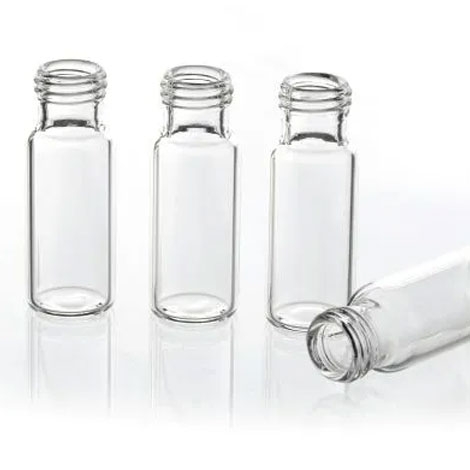
- ND8 (8-425 thread): Classic screw design; the 8-425 screw-thread HPLC vial is compatible with many older and newer instruments.
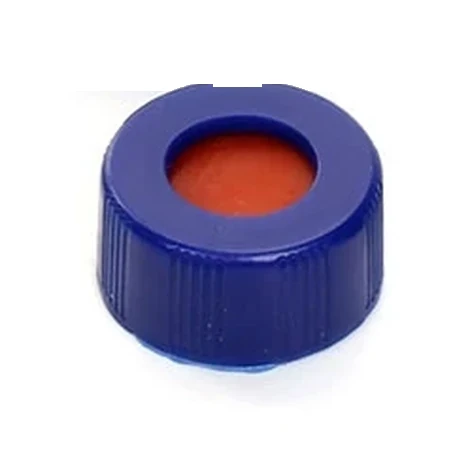
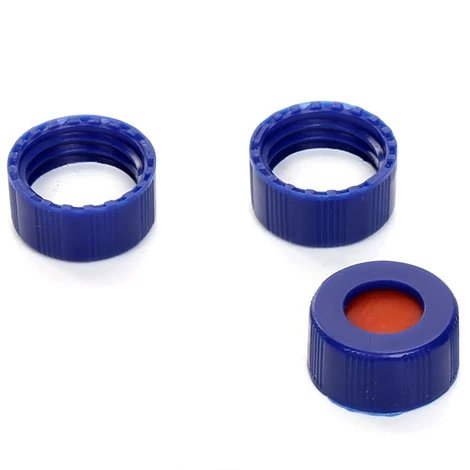
- ND9 (9 mm short thread): Wide-opening design that closes with a half turn; it makes needle alignment easier. The 9 mm screw-thread HPLC vial is the most commonly used type in laboratories.
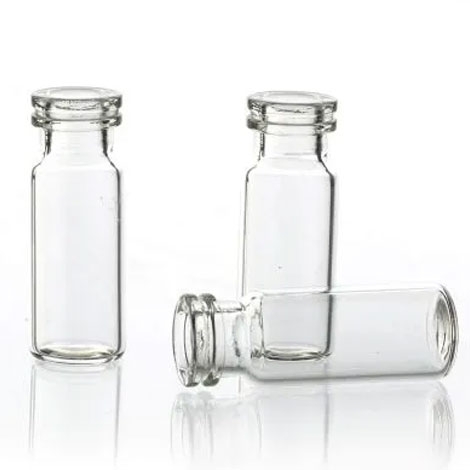
- ND11 (11 mm crimp): The aluminum cap is crimped on; the 11 mm crimp HPLC vial provides a higher seal for volatile samples and long-term storage.
Screw caps are fitted and removed by hand and are practical for daily routine analyses. Crimp caps require a crimping tool, but because the cap-septum pressure is constant, evaporation loss is minimal. Cap options are listed on the screw caps for vials and aluminum crimp caps pages.
Glass type, color and volume
Analytical vials generally use borosilicate glass. Borosilicate glass is chemically resistant and releases few ions into the sample. When working with basic compounds or very low concentrations, surface-treated (deactivated) glass options are also evaluated. The classification of laboratory glass is defined in the ASTM E438 standard.
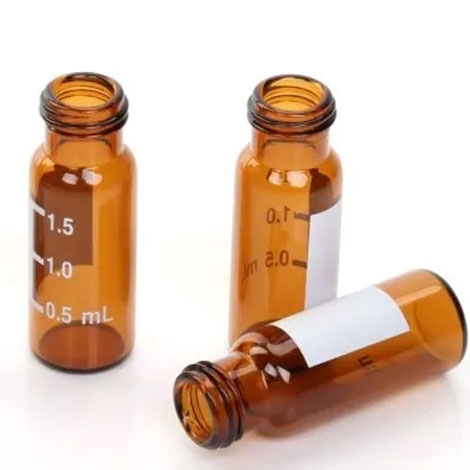
Amber glass is preferred for light-sensitive compounds (some vitamins, pigments, active pharmaceutical ingredients). Amber glass filters out UV and short-wavelength visible light, reducing sample degradation while waiting in the autosampler.
Working with small sample volumes
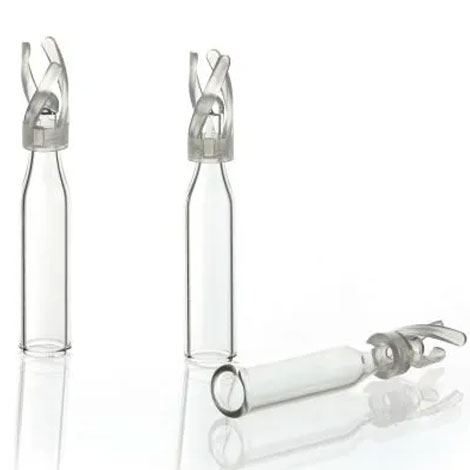
If the sample volume is below 1 mL, the dead volume remaining at the bottom of a standard vial becomes a problem. In this case, an HPLC vial insert placed inside the vial is used; conical and flat-bottom options are available for volumes of 150–350 µL. To eliminate the task of fitting inserts, a vial with fused insert can also be chosen.
Septum material in HPLC vial selection
The septum is the seal through which the needle passes and which separates the sample from the outside environment. The sample-facing side of the septum determines chemical compatibility, while the backing layer ensures the hole reseals after the needle is withdrawn.
- PTFE/silicone: Only PTFE contacts the sample; suitable for organic solvents and trace analysis. Details are on the PTFE/silicone septum page.
- Single-layer silicone: Flexible and reseals well after multiple piercings; however, silicone can interact with some solvents. The single-layer silicone septum is used for routine and aqueous samples.
- Pre-slit septum: Allows the needle to pass through the septum easily, reducing needle bending and septum coring; however, evaporation protection is lower than with a solid septum.
If multiple injections are made from the same vial, the resealing property of the septum is the priority criterion; for a single injection, chemical compatibility comes first.
Sample preparation and the difference from headspace vials
Particles in the sample placed in the vial clog the needle and the column. For this reason, the sample is passed through a syringe filter with a suitable membrane before being transferred to the vial. Membrane compatibility with the solvent is explained in the syringe filter membrane selection guide; options are listed on the syringe filters page.
The headspace method, in which volatile compounds are analyzed from the vapor phase in GC, requires a different vial. These applications use a 10 or 20 mL crimp headspace vial or screw-thread headspace vial. All vial, cap and septum options are collected in the vials, caps and septa category.
Considerations for volatile and sensitive samples
Volatile solvents and low-boiling compounds can evaporate rapidly after the septum is pierced. In long sequences, this creates a concentration difference between the first and last injections. For such samples, a crimp cap, a non-slit septum and a cooled autosampler are evaluated together.
With very low-concentration samples, adsorption of the analyte onto the glass surface can be a problem. Basic compounds and some peptides are particularly sensitive in this respect. In such cases, deactivated glass or polypropylene vial options are tested comparatively during method development.
Common mistakes
- Filling the vial to the brim; air cannot be displaced and a vacuum forms
- Overtightening the screw cap; the septum bulges inward and deflects the needle
- Mixing vials and caps from different manufacturers
- Leaving light-sensitive samples in clear vials for long periods
- Skipping filtration intended to protect the column; particle problems shorten HPLC column life
Stock and supply planning
Vials, caps and septa are among the fastest-consumed laboratory consumables. Changing the vial and cap combination used in a validated method may require revalidation of the method. For this reason, recording the codes of the products used and planning stock according to annual consumption is recommended.
Dimensional and quality consistency between different lots of the same vial type is also important. Supply with quality certificates and lot traceability makes it easier to prepare the records required during audits.
Frequently asked questions
Do ND9 and ND8 vials fit the same rack?
Both vials have an 11.6 × 32 mm body and fit most racks. They differ in the neck and cap thread; therefore the caps are not interchangeable.
When is a crimp vial preferred?
When working with volatile solvents, when samples wait in the autosampler for a long time or when samples are to be stored, a crimp cap provides lower evaporation loss.
Can amber vials be used for every sample?
They can, but they make visual inspection of the sample more difficult. For samples that are not light-sensitive, clear vials are often more practical.
Can vials be reused?
This is not recommended in analytical work. Washing residues and compounds remaining on the glass surface can cause carry-over and ghost peaks in the next analysis.